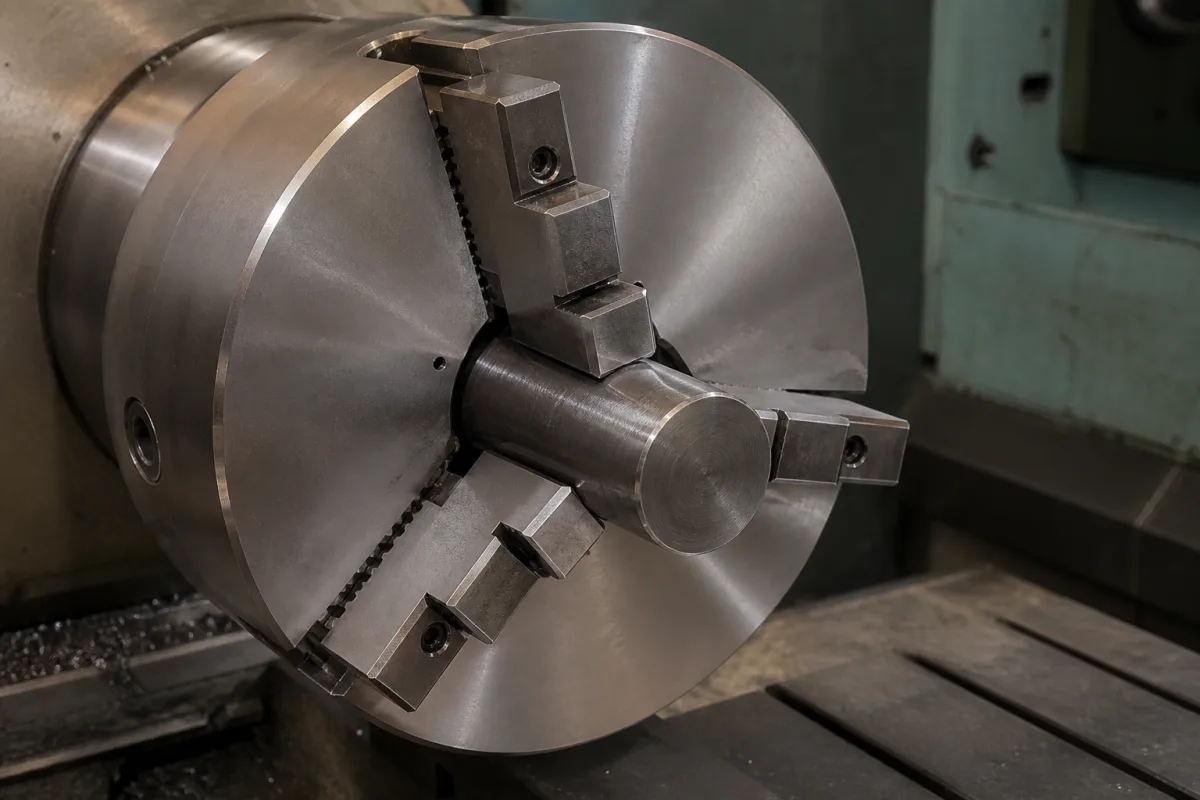
Lathe chuck jaw assembly (base jaw and top jaw of a three-jaw chuck)
Base jaw, top jaw, T-nut and screws of a lathe chuck · serration standard and key width, jaw mass and centrifugal force at speed, soft-jaw boring and repeatability, jaw stroke per chuck size
A lathe chuck jaw assembly is one of the three (or more) jaws of a lathe chuck: a hardened base jaw, also called a master jaw, that the chuck's wedge or lever mechanism moves radially, and a top jaw bolted to it through a serration or tongue-and-groove interface with T-nuts and screws. Top jaws are hard (stepped, for gripping as supplied) or soft (bored in place to the workpiece). Check three things first: that the top jaw's serration or key matches the base jaw, how much the jaw set weighs and where its centre of gravity sits, since that sets the speed the chuck can run, and how the soft jaws will be bored and relocated.
Base (master) jaws, soft and hard top jaws, T-nuts and jaw screws for three-jaw power and manual lathe chucks: interface, mass and centrifugal force, boring and repeatability, jaw stroke. Machine vises and their clamping jaws for milling are covered on the Clamping jaws / vise page. Complete lathe chucks as machines, collet chucks, magnetic chucks and the jaws of crushers or pipe tongs are outside this page.
CNFX editorial research · Sources checked October 12, 2026 · 4 sources
1.5 mm × 60° or 1/16" × 90°: the serration and key that join top jaw to base jaw
Kitagawa's BR, QJR and N series power chucks, as listed by its UK distributor Cutwel, take standard soft and hard jaws with 60° 1.5 mm serration; on the BR chucks from 170 to 315 mm the jaw key way is 12, 14, 16 and 21 mm and the hole centre 20, 25, 30 and 30 mm. [4] SCHUNK's STB base jaws carry an angled 1/16" × 90° serration with a 17.0 or 21.0 mm slot width, and its STB 400-2 a 3/32" × 90° serration; other SCHUNK base jaws use tongue and groove instead. [2]
Editorial calculation: 1/16 in = 1.5875 mm, so a 1/16" × 90° serration differs from a 1.5 mm × 60° serration in both pitch and flank angle; a top jaw has to be ordered for the base jaw's serration and key width, not only for the chuck diameter. [4][2]
SCHUNK requires jaw mounting screws of quality grade 12.9 at the specified tightening torques, and on fine-serration chucks the screws must go into the holes closest to the clamping point, with T-nuts not protruding radially beyond the base jaws. [1] Röhm likewise always uses strength class 12.9 for top-jaw mounting screws and gives, for example, 144 Nm for an M12 and 354 Nm for an M16 12.9 cap screw; it calls for a weekly visual check of jaw screws and replacement every year. [3]
Give the supplier the chuck maker, model and size, the base jaw serration (pitch and angle) or tongue-and-groove width, key way width and hole centre distance, whether jaws are soft or hard, and the workpiece diameter and gripping length.
02
Top-jaw mass and centre-of-gravity radius against spindle speed
SCHUNK's ROTA NC manual explains that when gripping from the outside in, the centrifugal force of the jaws reduces the effective clamping force as speed rises, and that the workpiece is released once it falls below the minimum required force. It cites DIN EN 1550: the centrifugal force may be at most 67% of the initial clamping force, and VDI 3106 safety factors of at least 1.5 for both machining force and clamping force. [1]
The centrifugal moment of a split jaw is the base-jaw value plus the top-jaw value, mass × centre-of-gravity radius. SCHUNK lists 0.319 kgm per base jaw for the ROTA NC 400 and uses a top jaw of 5.33 kg at 0.107 m in its worked example. [1] Editorial calculation: 5.33 kg × 0.107 m = 0.570 kgm, so in that example the top jaw contributes more centrifugal moment than the base jaw it sits on.
Röhm lists the centrifugal moment per base jaw of its DURO-A RC from 0.016 mkg (180 mm chuck) to 0.168 mkg (400 mm). [3] Editorial calculation: three base jaws of the 180 mm size give 0.048 kgm; at the chuck's 6,300 rpm maximum, ω = π × 6,300 ÷ 30 ≈ 660 rad/s, so F = 0.048 × 660² ≈ 20.9 kN, about a third of the 64 kN maximum total clamping force, before any top jaw is added.
Both makers state that the maximum speed applies only with full clamping force and the chuck's standard jaws. Röhm requires jaws as light as possible with the clamping point close to the chuck, reduced force and speed for heavier, larger or less rigid jaws, and treats welded jaws as improper use; SCHUNK requires soft or special jaws to be recalculated to VDI 3106, checked by dynamic measurement, and limits the top jaws' outer diameter to 10% beyond the chuck's. [3][1]
03
Boring soft jaws at one third of clamping force, and reattaching them to 0.01 mm
Röhm describes boring (turning) the clamping jaws in place for exact concentricity: the jaws are clamped onto a turning ring or disk, gripped in the base jaw or the top jaw depending on whether the work will be clamped externally or internally, at a clamping force of Fmax/3, with the permissible speed checked for that reduced force. [3]
Kitagawa's BR series is listed with a gripping accuracy below 0.01 mm T.I.R. immediately after jaw forming, and with its optional Tnut-Plus T-nuts a repeatability of 0.01 mm T.I.R. or less after detaching and reattaching jaws, without re-forming. Its QJR quick-change chucks fix standard 60° serrated jaws to removable base jaws with two locating bolts, so top jaws are changed off the machine. [4] SCHUNK states that exchanging a unit of base and top jaw in the stationary chuck reduces set-up time. [2]
Editorial note: when bored soft jaws are kept for a repeat job, record which base jaw each top jaw sat on and the serration tooth used; the repeatability figures above are maker claims for their own T-nut systems.
04
Jaw stroke per chuck size: 5.5 mm to 16 mm
Jaw stroke limits how far a jaw set can open and close around one bored diameter, so the top jaw position must be chosen so the work sits within it.
Editorial calculation: a radial stroke of 5.5 mm per jaw moves the gripping diameter by up to 2 × 5.5 = 11 mm on the 170 mm BR chuck; SCHUNK's manual calls for regular checks of clamping force and jaw stroke, and Röhm's for comparison of the measured stroke of base and top jaws with its table. [4][1][3]
Explore company information and manufacturing capabilities, then discuss the scope of your project with a relevant supplier.
Share this page
Compiled and source-reviewed by the CNFX editorial team.
Each manufacturer above links to the page on that company's own website where the product is listed, with the date we checked it. How we source and review
· Page last updated 13 October 2026
Buyer questions
Can a 1/16" × 90° top jaw fit a 1.5 mm × 60° base jaw?
No; the pitch (1.5875 mm against 1.5 mm) and the flank angle differ, so the top jaw must match the base jaw's serration. [4][2]
Why do heavy top jaws lower the safe chuck speed?
Jaw centrifugal force grows with mass, centre-of-gravity radius and the square of speed and, when gripping from outside, subtracts from clamping force; SCHUNK cites a 67% limit of initial clamping force under DIN EN 1550. [1]
At what force are soft jaws bored?
Röhm specifies a clamping force of Fmax/3 on a turning ring or disk, with the permissible speed checked for that force. [3]
Sources and what still needs a direct check
Sources checked 2026-10-12. SCHUNK and Röhm data come from their own power chuck operating manuals and SCHUNK's base-jaw catalogue; the Kitagawa data come from its UK distributor's catalogue pages. Speed and force limits apply to the stated chuck with its standard jaws.