Fork (slot) label sensors for labelling machines · slot width and depth, minimum label gap, infrared versus ultrasonic sensing, response time and frequency against web speed, NPN/PNP and light-on/dark-on outputs, housing and IP rating
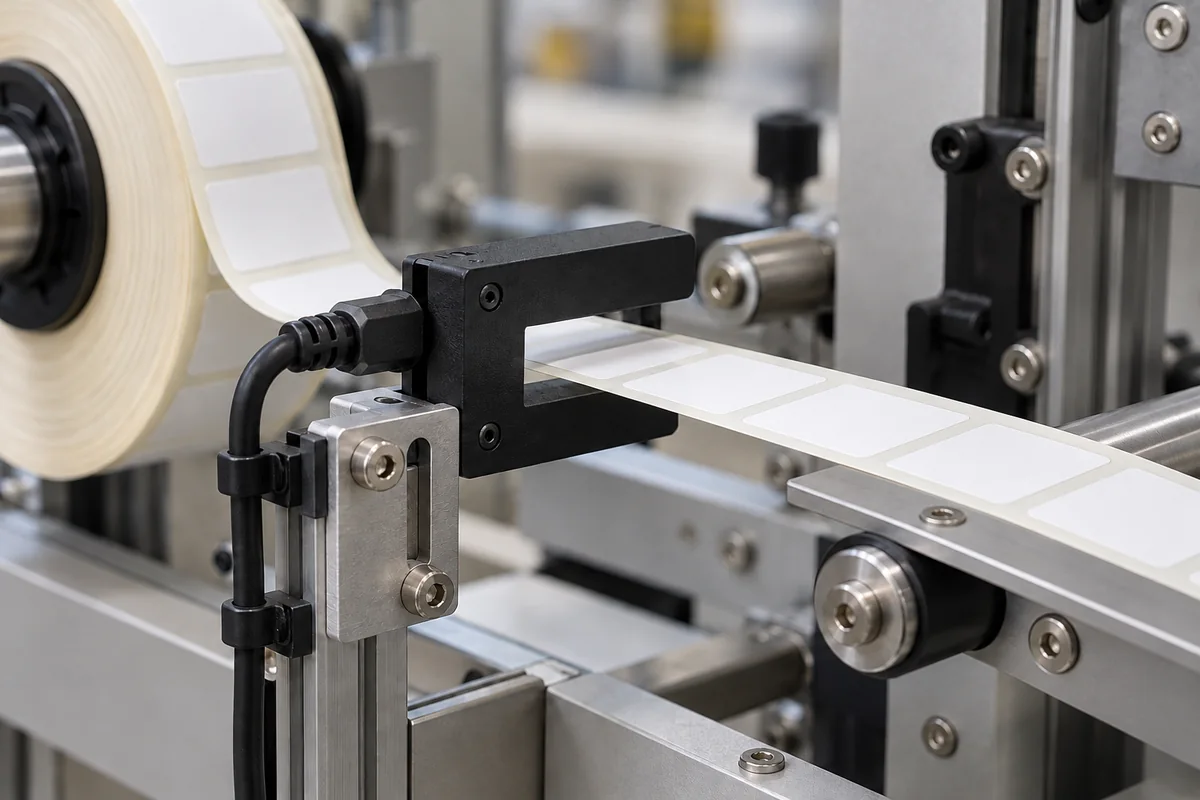
A label sensor, as used on labelling and packaging machines, is a fork-shaped (slot) sensor through which the label web runs, so that it can detect each label against the gaps in the backing and give a switching signal to stop, count or position labels. Ask three things first: what slot width and depth the web and machine need, what minimum label gap and web speed the sensor must handle, and whether infrared or ultrasonic sensing suits the label and liner material.
Fork (slot) label sensors, photoelectric (infrared) and ultrasonic, for label dispensers, labelling machines and printers. Labelling machines (a separate product page), general photoelectric sensors (a separate product page), colour mark and contrast sensors, and code readers are outside this page except where compared.
CNFX editorial research · Sources checked October 11, 2026 · 4 sources
Lanbao, a sensor maker linked to this page, lists its LAP series photoelectric label sensor with a 3 mm slot width and 60 mm slot depth, a minimum detection width or depth of 2 mm or more, a 940 nm infrared light source, NPN or PNP output with switchable light-on or dark-on function, indicators for calibration or operation errors, IP65 protection and a zinc die-cast housing, with cable or M8 connection. It also lists an LAU series ultrasonic fork label sensor with a 5 mm width and 68 mm depth. [1]
F&C Sensing lists its FC-2100 fork optical label sensor with a 2 mm detection distance, 940 nm modulated infrared light, NPN NO+NC output, DC 12–24 V ±10 %, reverse polarity and short-circuit protection, an aluminium metal housing, M8 connector and IP66 protection, for operation from −10 to 50 °C. [2]
Editorial note: slot depth limits how far from the web edge the gap can be sensed; check it against the label position on the liner, and ask whether the sensor needs calibration or teach-in for each new label stock.
Give the supplier the label and liner material and thickness (paper, film, transparent), label length and minimum gap, web width and the distance from the web edge to the sensing point, web speed, required slot width and depth, sensing principle (infrared or ultrasonic), output type (NPN or PNP, NO or NC), supply voltage, connector, mounting and protection rating.
02
Match response time and frequency to web speed
Lanbao's LAP data gives a response time of 50 µs or less, a maximum response frequency of 10 kHz, a conveyor speed of up to 20 m/min (0.3 m/s), a start-up delay of 300 ms or less, and a supply of 12–24 V DC. [1] F&C gives its FC-2100 a response time under 500 µs. [2]
Editorial calculation: at 20 m/min (about 0.33 m/s) the web moves 0.33 m/s × 50 µs ≈ 0.017 mm during a 50 µs response, and about 0.17 mm during a 500 µs response, both well under a 2 mm gap. With 30 mm labels on a 3 mm gap, the sensor sees 0.33 / 0.033 ≈ 10 labels per second, far below a 10 kHz switching limit. Label length and gap are assumed examples; for stop accuracy, the machine's own response also counts.
03
Compare what suppliers offer
Suppliers linked to this page list label sensors; each card links to the page reviewed.
Listings include infrared and ultrasonic fork label sensors from sensor makers, and fork optical label sensors with 2 mm slots for packing and labelling machines. Ask each for slot size, minimum gap, response time, rated web speed and output options.
04
Check teach-in, timing jitter and ambient limits on the data sheet
SICK's data sheet for its WFS3-40N115 optical fork sensor, with a 3 mm fork width and 42 mm fork depth, gives a minimum detectable gap between labels or label size of 2 mm, with a footnote that this depends on the label thickness. Alongside a response time of 50 µs or less and a 10 kHz switching frequency, it states a response-time stability of ± 20 µs and a jitter of 40 µs, an initialization time of 20 ms, ambient light immunity of 10,000 lx or less, an operating range of –20 °C to +60 °C, IP65 and a supply of 10 V DC to 30 V DC. [3]
The sensor offers 2-point teach-in and dynamic teach-in with labels moving through the fork, set by plus/minus buttons or a cable input. The data sheet notes that only the first teach-in after switching on is permanently stored, that teach-in can be repeated cyclically and that the switching threshold can be adjusted afterwards. [3]
Editorial calculation: at the 20 m/min (about 0.33 m/s) web speed used above, a 40 µs jitter corresponds to 0.33 m/s × 40 µs ≈ 0.013 mm of label travel. Editorial note: ask suppliers to state the minimum gap for your label thickness, the jitter as well as the response time, and whether a new label stock needs a fresh teach-in.
05
Align ultrasonic label sensors for transparent and metallic labels
Pepperl+Fuchs explains that the ultrasonic principle used in its double sheet sensors also serves label detection, and states that the colour and material of the label and backing, and the width of the gap between labels, make no difference to it: transparent, reflective, metallic or non-metallic labels of any colour can be detected. Its label detection systems adjust the switching threshold automatically and can be taught label and backing combinations so that slight variations in attenuation are still detected. [4]
Alignment matters more than with an optical fork. Pepperl+Fuchs says the best detection is at the centre of each transducer, so the transmitter and receiver must face each other; for its cylindrical M18 devices it gives a maximum shaft offset of ±1 mm and a maximum angular deviation of ±1°. Sensors with short response times are to be mounted at an angle of 20° to 40° to the vertical of the label, because a short-response sensor placed vertical to the label can false-trip from the ultrasonic waves. It also warns that folds and creases in the web can cause detection errors. [4] Editorial note: an ultrasonic fork such as Lanbao's LAU series (5 mm × 68 mm) sets the transducer alignment in its housing; with separate M18 transducers, the bracket has to hold these tolerances. [1]
Point
Value from the source
Check in the order
Labels detected
Transparent, reflective, metallic or non-metallic, any colour. [4]
Fill the specification fields with values for your machine
A label sensor quotation needs values for your machine. The table explains each field, gives published values where a reviewed source states them, and says what to obtain from the supplier.
Field
What it means and published values
Ask the supplier for
Slot width / depth
Examples: 3 × 60 mm; 5 × 68 mm (ultrasonic); 2 mm. [1][2]
Explore company information and manufacturing capabilities, then discuss the scope of your project with a relevant supplier.
Share this page
Compiled and source-reviewed by the CNFX editorial team.
Published product pages show what a company offers, not tested performance. Confirm the legal seller, factory and scope for your order. How we source and review
· Page last updated 13 October 2026
Buyer questions
What slot size does a label sensor have?
Examples: Lanbao's LAP has a 3 mm × 60 mm slot and its LAU ultrasonic series 5 mm × 68 mm; F&C's FC-2100 has a 2 mm slot. [1][2]
How fast can a label sensor respond?
Lanbao lists ≤ 50 µs and up to 10 kHz for the LAP; F&C lists under 500 µs for the FC-2100. [1][2]
What is the smallest label gap a sensor can detect?
Lanbao gives a minimum detection width of 2 mm or more for its LAP series. [1]
Does the minimum label gap on a data sheet apply to every label?
No; SICK's WFS3-40N115 data sheet gives a 2 mm minimum gap between labels but notes that it depends on the label thickness, so the figure should be confirmed for your own label stock. [3]
When is an ultrasonic label sensor the better choice?
Pepperl+Fuchs states that ultrasonic sensing is unaffected by the colour and material of label and backing, so it can detect transparent, reflective and metallic labels; its M18 transducers need alignment within ±1 mm and ±1°. [4]
Sources and what still needs a direct check
Sources checked 2026-10-11. The sources are sensor makers' product pages, data sheets and a technical article describing their own label sensors; their figures are examples, not general limits.