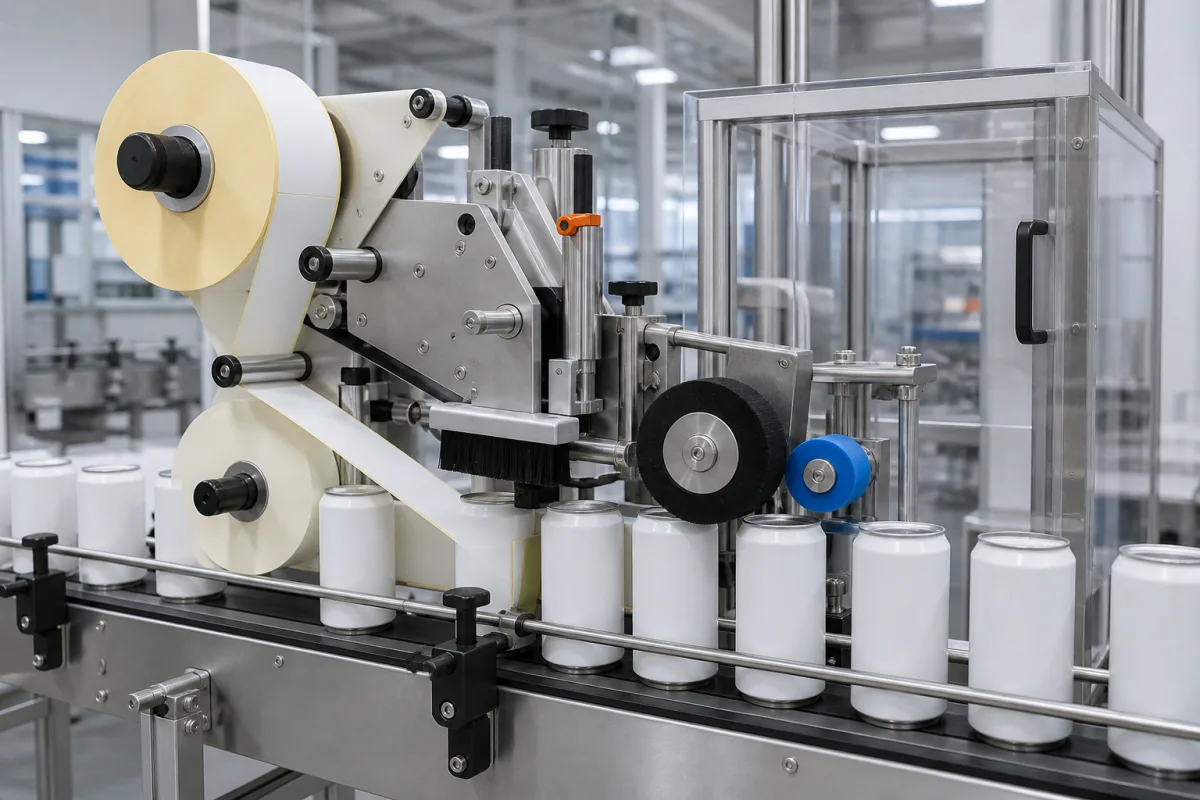
Self-adhesive labeling systems · Web speed against label pitch, web width and roll size, roll-change redundancy, 100% label verification
A labeling system applies labels to products or packs on a moving line; in a self-adhesive system like the wrap-around labeler pictured, a label web is unwound from a roll, labels are peeled from the backing at a dispensing edge and pressed or rolled onto each container, and the backing is rewound. Ask three things first: what web speed the system needs for your label length and product rate, how it handles roll ends and faults without unlabeled or double-labeled products, and how correct labels are verified where regulations or customers require it.
Self-adhesive (pressure-sensitive) labeling systems and label applicators for bottles, cans, cartons and packs on production lines. Shrink-sleeve, wet-glue and hot-melt labelers, label printers on their own, and labels as consumables are outside this page.
CNFX editorial research · Sources checked October 12, 2026 · 4 sources
Match web speed and width to your labels and output
HERMA's page for its 500 label applicator states dispensing speeds of 30 to 200 m/min, devices in 80, 160, 240 and 320 mm widths to suit label size, motorized winders and a loop unit for up to 200 metres or 2,000 labels a minute synchronized with product speed, a master encoder function, and automatic label length detection to shorten set-up. [1]
Editorial calculation: a wrap-around label for a 66 mm diameter can is about π × 66 ≈ 207 mm long; with the gap on the backing, take a label pitch of about 210 mm. At 30 m/min that pitch allows about 30,000 ÷ 210 ≈ 143 labels a minute, and at 200 m/min about 950. The can size and gap are assumed examples; use your own label length and gap.
The same page describes modular dispensing systems for different label types, an Ethernet interface and configurable fieldbus, and use across pharmaceuticals, cosmetics, food and beverages. [1] Editorial note: ask for the applicator's speed range at your label length together with the product handling (conveyor, spacing and container rotation for wrap-around labels), because the line output depends on both.
Give the supplier the containers and their sizes, label material, size, gap and roll core and outer diameter, line speed and products per minute, label position and tolerance, any printing or coding on the label, verification required, changeover frequency, and the regulations or customer standards that apply.
02
Prevent missing, duplicate and wrong labels
HERMA describes a redundancy function in which two 500 applicators in series communicate directly, so at the end of a roll or another fault the second takes over, preventing products with no label or duplicate labels without an extra PLC. [1]
For drug products in the US, 21 CFR 211.122(g) requires that where cut labeling is used for immediate container labels or certain cartons, packaging and labeling operations include one of these controls: dedicated lines for each strength of each product; electronic or electromechanical equipment for a 100% examination for correct labeling; 100% visual inspection independently verified by a second person for hand-applied labels; or an automated technique that physically prevents incorrect labeling. Section 211.122(h) requires printing devices on the line to be monitored so imprinting conforms to the batch record. [2]
21 CFR 211.130 adds written procedures to prevent mix-ups by physical or spatial separation from other products, lot or control numbers on the product, examination of labeling materials before packaging, and inspection of the line before use to remove previous products and unsuitable labels, with results recorded in the batch record. [3]
03
Sticker, wrap-around, clamshell and shrink-sleeve labelers inside filling lines
Listings include adhesive sticker labelers, wrap-around labeling machines, clamshell labelers and shrink-sleeve and hot-melt labelers supplied as part of bottling and liquid filling lines. Ask each supplier for the applicator make, web speed and width, label placement tolerance, and the verification and reject options offered.
04
Get placement accuracy, cycle rate and utilities in writing
Weber Marking Systems' data sheet for its Legi-Air 4050E, a print-apply labeling system that prints each label and applies it with a tamp or wipe applicator, lists a label application rate of up to 240 a minute, depending on label size, text change and dispense stroke, and a positioning accuracy of ±0.8 mm, or 0.5 mm with a precision applicator. Label sizes run from 12.5 × 7 mm to 160 × 210 mm on rolls up to 350 mm in diameter. [4]
For utilities and environment it lists a 92–263 V supply at 50–60 Hz and 5 A, a 6 bar compressed air connection to DIN ISO 8573-1, IP 20 ingress protection, 2–35 °C ambient temperature, 15–95% non-condensing relative humidity and an A-weighted sound pressure level of 72 dB. Weber says its modulated vacuum reduces compressed air consumption by up to 80%. [4]
Editorial calculation: 240 labels a minute leaves 60 ÷ 240 = 0.25 s per cycle for printing, applying and return, and 6 bar is 0.6 MPa for the air supply field. Editorial note: IP 20 gives no protection against water, so ask for a washdown-rated version where needed, and for the accuracy at your product speed and label size.
05
Web path from unwinder to rewinder, plus handling and reject
Four rows follow the label web through the applicator; product handling and the reject station sit outside it, and the reject is where the 100% examination of 21 CFR 211.122(g) comes in on drug lines. [1][2]
Speed from web and pitch, then size, accuracy and utilities
Labels per minute come from web speed divided by label pitch, as the calculation at the top of the page shows, so give the supplier your label length and gap before anything else. [1]
Field
What it means and published values
Ask the supplier for
Labeling Speed (pcs/min)
Web speed ÷ label pitch; example 30–200 m/min web. [1]
iBottling lists sticker, shrink-sleeve and hot-melt labelers as part of its bottling lines; VKPAK offers wrap-around and clamshell machines for liquid filling lines.
iBottling
Manufacturing site to be confirmed for the order
Lists adhesive sticker, shrink-sleeve and hot-melt labelers within bottling lines.
Explore company information and manufacturing capabilities, then discuss the scope of your project with a relevant supplier.
Share this page
Compiled and source-reviewed by the CNFX editorial team.
Each manufacturer above links to the page on that company's own website where the product is listed, with the date we checked it. How we source and review
· Page last updated 13 October 2026
Buyer questions
How fast can a self-adhesive labeler run?
HERMA states 30 to 200 m/min for its 500 applicator; the products per minute depend on label pitch, about 143 to 950 for a 210 mm pitch (editorial calculation). [1]
Must labels be checked 100%?
For US drug products using cut labeling, 21 CFR 211.122(g) requires “one of the following special control procedures”, including 100% electronic examination for correct labeling. [2]
How do labelers avoid unlabeled products at roll change?
HERMA's redundancy function lets a second applicator take over at the end of a roll or a fault. [1]
How accurately does a print-apply labeler place labels?
Weber Marking Systems lists ±0.8 mm for its Legi-Air 4050E, or 0.5 mm with a precision applicator, at up to 240 labels a minute depending on label size and stroke. [4]
Sources and what still needs a direct check
Sources checked 2026-10-12. HERMA is a labeling machine maker describing its own applicator. 21 CFR 211.122 and 211.130 are US drug manufacturing regulations and apply to drug product labeling.