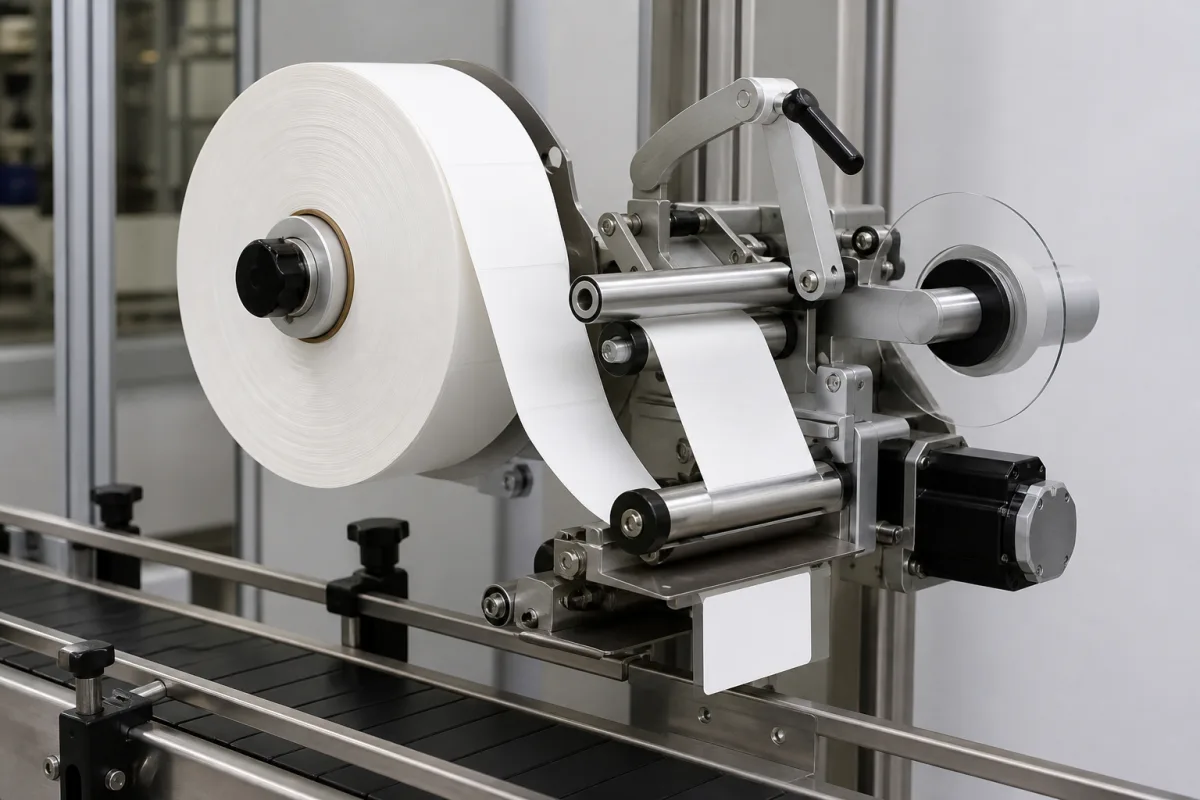
Automatic label dispenser: electric peel-and-present unit for hand or pick-and-place application
Electric peel-and-present label dispensers that strip each label from its liner and hold it ready to be taken · label width and length, feed speed, roll size and the gap sensor that stops the feed
A label dispenser does only one part of labeling: it separates the label from the liner and holds it out, half-peeled, for an operator or a robot gripper to take and place. It replaces picking labels off a sheet by hand on packing benches, kitting stations and assembly lines. The buying decisions are the label size range and roll the unit accepts, how fast it presents the next label, and whether its sensor can find the gap between labels made of paper, film or clear material.
Electric (automatic) label dispensers that peel labels and die-cut parts from a liner and present them one at a time, used on benches or mounted at workstations, with their strip plates, liner rewind, label-gap sensors and counters. Self-adhesive labeling systems and applicators that place labels on bottles, cans and cartons on a moving line, with their web speed matching and placement accuracy, are covered on the Labeling systems for packaging lines page. Label printers, manual handheld applicators and tape dispensers are outside this page.
CNFX editorial research · Sources checked October 12, 2026 · 5 sources
Label width, length and roll diameter each dispenser accepts
The label range is set by the width of the strip plate and liner path, the label length the sensor and feed can handle, and the roll the spindle can carry. Published ranges for four electric dispensers:
Editorial calculation: feed speed sets how long the operator waits for the next label. A 150 mm label is presented in about 150 ÷ 130 ≈ 1.2 s on the YH-118C-320, 150 ÷ 84 ≈ 1.8 s on the LD6050 (3.3 in/s ≈ 84 mm/s) and 150 ÷ 41.7 ≈ 3.6 s on the FTR-118C (250 cm/min ≈ 41.7 mm/s); short labels are ready almost at once. [2][1][3]
Yuanhan's AL-1150D product page names the model AL-1150D in its heading but AC-1150D in its specification table; confirm the model designation on the quotation. [4] START lists 100/120 V, 50/60 Hz at under 1 A for the LD6050 with a 230 V version available, and a weight of 10.5 lb (4.76 kg); Yuanhan lists 220 V, 50 Hz and 6 W for the FTR-118C. [1][3]
Measure the label and the liner separately: the dispenser's width limit applies to the liner, and START gives its range as liner capacity width.
02
Finding the gap: photoelectric, fibre-optic and ultrasonic label sensing
The dispenser stops when its sensor sees the gap between labels, so the sensor decides which label stock it can run. START's LD6050 uses a photosensor and lists a separate model, the LD3500, for clear labels; Yuanhan offers its FTR-118C with either an optical fibre sensor (for adhesive and transparent labels) or a photoelectric sensor (for paper and self-adhesive labels). [1][3]
SICK's UFS3-37N117 ultrasonic fork sensor, an example of a sensor that detects labels by ultrasound rather than light, has a 2.6 mm fork width and 42.5 mm fork depth, a minimum detectable label of 2 mm and a minimum label gap of 1 mm, which SICK notes depends on label thickness. It lists a response time of ≤ 440 µs and a switching frequency of 1.1 kHz on 10 to 30 V DC. [5]
Editorial calculation: at 130 mm/s the web moves 130 × 0.00044 ≈ 0.06 mm during a 440 µs response, and a 1 mm gap passes the sensor in 1 ÷ 130 ≈ 7.7 ms, so at bench-dispenser speeds the sensor response is small against the gap. [5][2] START mentions an adjustable strip plate for hard-to-release labels on the LD6050, and Yuanhan a counter on the FTR-118C and AL-1150D. [1][3][4]
03
Label stock and workstation details for a dispenser quote
Paste it into your enquiry below or into an email to a maker, then replace every bracket.
Label: [width; length; gap between labels; shape or die-cut part]
Material: [paper, polyester, vinyl, foil, clear film; adhesive]
Liner: [width; material; thickness]
Roll: [core diameter; outside diameter; winding direction]
Rate: [labels per minute or per shift; operator or robot pick]
Sensing: [opaque, transparent or metallised labels]
Power: [voltage and frequency]
Options: [counter; workstation mounting or stand; liner rewind]
Kunshan Yuanhan, a wire-processing machine maker, sells three electric label dispensers alongside its tape cutters: the YH-118C-320 for labels up to 320 mm wide, the FTR-118C with fibre or photoelectric sensing, and the compact AL-1150D.
Kunshan Yuanhan Electronic Equipment Co., Ltd.
Manufacturing site to be confirmed for the order
Lists automatic label dispensers YH-118C-320 (labels 5–320 mm wide, 130 mm/s), FTR-118C (optical fibre or photoelectric sensor, counter) and AL-1150D (labels 4–140 mm wide), alongside electric tape dispensers.
Explore company information and manufacturing capabilities, then discuss the scope of your project with a relevant supplier.
Share this page
Compiled and source-reviewed by the CNFX editorial team.
Each manufacturer above links to the page on that company's own website where the product is listed, with the date we checked it. How we source and review
· Page last updated 13 October 2026
Buyer questions
What size labels can an electric label dispenser take?
START's LD6050 takes labels 6 to 120 mm wide and 13 to 152 mm long; Yuanhan's YH-118C-320 lists 5 to 320 mm wide and 5 to 300 mm long. [1][2]
Can a label dispenser handle clear labels?
Only with a suitable sensor: START lists a separate model (LD3500) for clear labels, Yuanhan offers an optical fibre sensor version of the FTR-118C for transparent labels, and SICK's ultrasonic fork sensor detects labels by ultrasound. [1][3][5]
How small a gap between labels can be detected?
SICK's UFS3-37N117 lists a minimum label gap of 1 mm and a minimum label of 2 mm, depending on label thickness. [5]
Sources and what still needs a direct check
Sources checked 2026-10-12. Dispenser ranges are the makers' own published figures; the sensor data are SICK's for one ultrasonic fork sensor and illustrate gap detection, not the sensor fitted in any dispenser listed.