Editorial Technical Reference

Laser Measurement Scanner

This page explains how Laser Measurement Scanner is classified within Machinery and Equipment Manufacturing. Technical values and manufacturer relationships are research references; confirm the current specification and supplier evidence for each order.

Technical Definition & Core Assembly

A precision optical-electronic device that uses laser triangulation or time-of-flight principles to capture dimensional data of objects for quality inspection purposes.
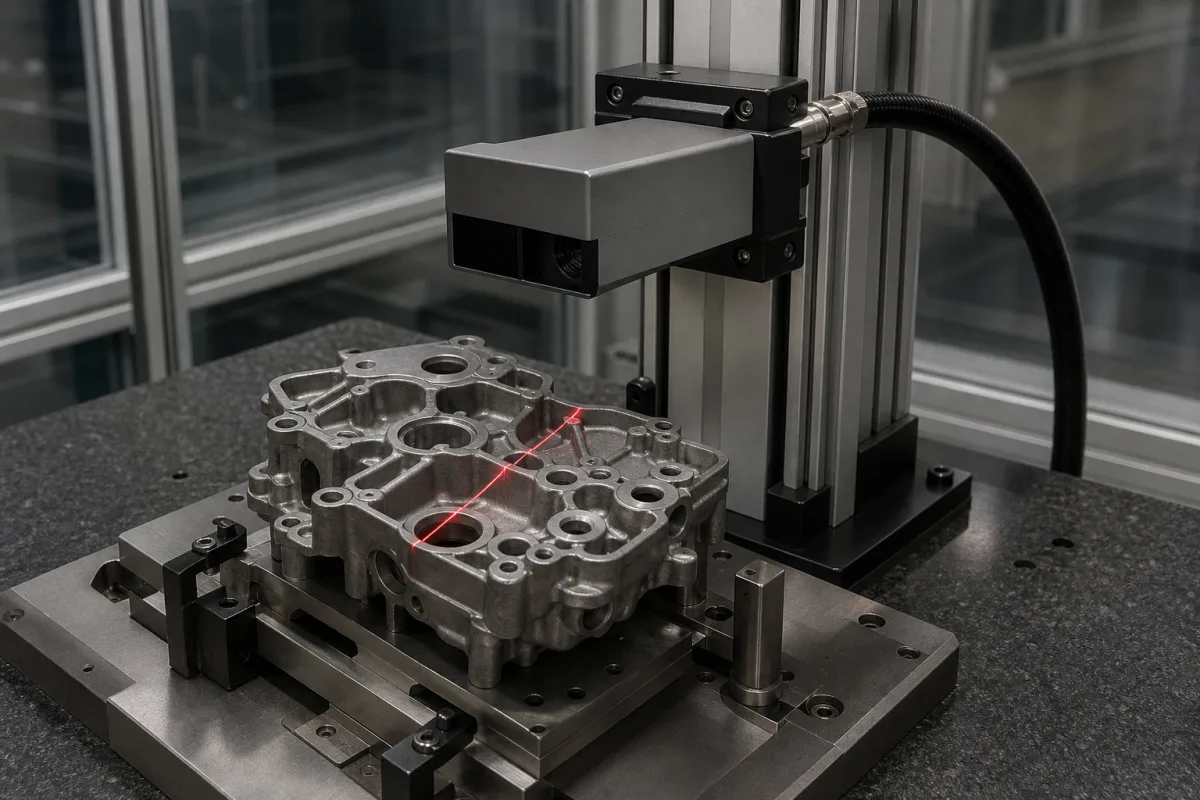
Representative product image. Confirm appearance and specifications with the manufacturer.

Product Specifications

Technical details and manufacturing context for Laser Measurement Scanner

Definition
The Laser Measurement Scanner is a component used in quality inspection modules within machinery and equipment manufacturing. It performs non-contact dimensional measurement and surface profiling of manufactured parts. By projecting laser lines onto target surfaces and analyzing reflected light patterns, it captures high-resolution 3D point cloud data. This enables real-time detection of dimensional deviations, surface defects, and geometric tolerances during production processes.

The scanner operates on laser triangulation or time-of-flight principles. In triangulation, a laser beam is projected onto the target surface, and the reflected light is captured by a high-resolution CMOS or CCD sensor. The displacement of the laser line on the sensor is used to calculate precise distance measurements. For 3D scanning, either the scanner or the target moves to capture multiple profiles, which are then reconstructed into complete 3D models using specialized software algorithms.

Key specifications include a measurement range of 0.1 to 10 meters (depending on model and target reflectivity), accuracy of ±0.05 mm at 1 m range with 90% reflectivity, and repeatability of ±0.02 mm under constant temperature. The scan rate is adjustable from 10 to 100 Hz. The laser is Class 2 (IEC 60825-1) with a red wavelength of 650 nm. Power supply is 24 V DC ±10% with reverse polarity protection, and power consumption ranges from 15 to 30 W depending on model. Operating temperature is -10 to 50 °C (non-condensing), storage temperature is -20 to 70 °C (in original packaging), and protection class is IP54 to IP65 (IEC 60529). Weight ranges from 0.5 to 2.5 kg without mounting bracket. Interfaces include Ethernet and RS-422, with Profibus optional.

Materials include an aluminum alloy housing, optical-grade glass lenses, a gallium arsenide laser diode, and a CMOS/CCD image sensor. These specifications are reference ranges; verify model-specific values and standards with the legal manufacturer or supplier before procurement or use.
Working Principle
The scanner emits a laser beam that strikes the target surface. Using triangulation principles, the reflected light is captured by a high-resolution CMOS/CCD sensor. The displacement of the laser line on the sensor is calculated to determine precise distance measurements. For 3D scanning, either the scanner or target moves to capture multiple profiles, which are then reconstructed into complete 3D models through specialized software algorithms.
Common Materials
Aluminum alloy housing, Optical-grade glass lenses, Gallium arsenide laser diode, CMOS/CCD image sensor
Technical Parameters
ParameterTypical rangeNotes & selection driver
Measurement Range0.1–10 mDepending on model and target reflectivity
Accuracy±0.05 mmAt 1 m range, 90% reflectivity
Repeatability±0.02 mmUnder constant temperature
Scan Rate10–100 HzAdjustable
Laser Class2Visible, safe for eyesIEC 60825-1
Wavelength650 nmRed laser
Power Supply24 ±10% V DCReverse polarity protected
Power Consumption15–30 WDepending on model
Operating Temperature-10–50 °CNon-condensing
Storage Temperature-20–70 °CIn original packaging
Protection ClassIP54–IP65Dust and splash water protectedIEC 60529
Weight0.5–2.5 kgWithout mounting bracket
InterfaceEthernet, RS-422Optional Profibus

Ranges are indicative industry figures for RFQ preparation, not a supplier commitment. Confirm every value and standard with the legal manufacturer before ordering.

Components / BOM
  • Laser Emitter Module
    Generates and projects structured laser patterns onto target surfaces
    Material: Gallium arsenide semiconductor
  • Optical Lens System
    Focuses and directs laser beams while collecting reflected light
    Material: Optical-grade glass with anti-reflective coating
  • Image Sensor Array
    Captures reflected laser patterns for triangulation calculations
    Material: CMOS/CCD silicon sensor
  • Signal Processing Unit
    Converts optical data into digital measurement values
    Material: Printed circuit board with DSP/FPGA chips
  • Protective Housing
    Provides environmental protection and thermal stability
    Material: Anodized aluminum alloy

Applied To / Applications

This component is essential for the following industrial systems and equipment:

Industrial Ecosystem & Supply Chain Structure

Complementary Systems
Downstream Applications
Specialized Tooling

Application Fit & Sizing Matrix

Operational Limits
pressure: Atmospheric pressure only (non-pressurized environment)
other spec: Measurement range: 0.1m to 30m, Accuracy: ±0.1mm to ±2mm depending on model, Scan rate: 10-1000 Hz
temperature: 0°C to 50°C (operating), -20°C to 70°C (storage)
Media Compatibility
✓ Metallic surfaces (steel, aluminum) ✓ Plastic components ✓ Wood surfaces
Unsuitable: Highly reflective or transparent materials (glass, mirrors, polished metals)
Sizing Data Required
  • Required measurement accuracy (±mm)
  • Maximum measurement distance (meters)
  • Required scanning speed (Hz or points/second)

Reliability & Engineering Risk Analysis

Failure Mode & Root Cause
Laser Diode Degradation
Cause: Thermal stress from continuous operation or inadequate cooling, leading to reduced output power and wavelength drift over time.
Optical Lens Contamination
Cause: Accumulation of dust, oil mist, or particulates on external or internal optical surfaces, causing signal attenuation, scattering, or measurement inaccuracies.
Maintenance Indicators
  • Inconsistent or erratic measurement readings despite calibration
  • Visible condensation, fogging, or particulate buildup on the scanner's optical window or lens surface
Engineering Tips
  • Implement a regular cleaning schedule for optical surfaces using approved, lint-free wipes and optical-grade solvents, and ensure the operating environment meets specified cleanliness and humidity levels.
  • Install and maintain adequate cooling (e.g., heat sinks, forced air) for the laser diode, and avoid continuous high-power operation by cycling the scanner during idle periods to reduce thermal fatigue.

Indicative industry ranges for design and RFQ preparation. Confirm the exact figures and applicable standard with the manufacturer before specifying.

Compliance & Manufacturing Standards

Applicable Standards
ISO 10360-8:2013 - Acceptance and reverification tests for coordinate measuring systems (CMS) ANSI B89.4.19-2006 - Performance Evaluation of Laser-Based Spherical Coordinate Measurement Systems CE Marking - Compliance with EU Directives 2014/35/EU (Low Voltage) and 2014/30/EU (EMC)

Quoted from the published standard.

Manufacturing Precision
  • Measurement Accuracy: +/- 0.05 mm over full measurement range
  • Repeatability: 0.02 mm standard deviation under controlled conditions
Quality Inspection
  • Laser Beam Profile Analysis - Verifies beam quality and alignment
  • Environmental Compensation Verification - Tests temperature/humidity correction systems

Manufacturers of Laser Measurement Scanner

Manufacturer profiles associated with Laser Measurement Scanner.

Sourcing Laser Measurement Scanner from China?
Tell us your specification and target quantity — we will match it against manufacturer records and come back with the factories that fit.
Request manufacturers We manufacture this

Manufacturer listings support early research and capability understanding. They are not certification, ranking, or transaction guarantees.

Technical documentation
Request current drawings, revision history, and a signed specification sheet.
Manufacturing capability
Verify equipment lists, process limits, capacity, and representative production evidence.
Inspection readiness
Confirm test methods, calibrated equipment, sampling plans, and traceable reports.
Supplier transparency
Check the legal entity, factory address, ownership, certifications, and direct contacts.

CNFX does not score or rank suppliers. Buyers must verify all claims and documents with the legal manufacturer before ordering.

Supply Chain Compatible Machinery & Devices

Hydraulic Press

Industrial machine using hydraulic pressure to compress, form, or assemble materials

Explore Specs →
Heavy-Duty CNC Plasma Cutting Machine

The Heavy-Duty CNC Plasma Cutting Machine is a standalone industrial device designed for cutting conductive metals such as steel, stainless steel, aluminum, and copper alloys.

Explore Specs →
Automated Powder Coating System

Integrated industrial system for applying dry powder coatings to metal substrates.

Explore Specs →
Centrifugal Pump Impeller

The centrifugal pump impeller is a critical rotating component that converts mechanical energy from the motor into kinetic energy in fluid systems.

Explore Specs →

Frequently Asked Questions

What is the measurement range of the Laser Measurement Scanner?

The measurement range is 0.1 to 10 meters, depending on the model and target reflectivity. Always verify the exact range for your specific model with the manufacturer.

What laser class does the scanner use?

The scanner uses a Class 2 laser according to IEC 60825-1, which is visible and safe for eyes under normal use. However, always follow safety guidelines and verify compliance for your application.

What interfaces are available on the scanner?

The scanner offers Ethernet and RS-422 interfaces, with Profibus as an optional interface. Confirm the available interfaces for your specific model.

What is the operating temperature range?

The operating temperature range is -10 to 50 °C (non-condensing). For storage, the range is -20 to 70 °C in original packaging. Ensure environmental conditions are within these limits.

Data Basis

Editorial classification, named public sources where available, and source-reviewed manufacturer records.

Preliminary Technical Classification
This page supports structured research, RFQ preparation, and supplier evaluation. It does not replace buyer-led supplier qualification, standards review, or technical approval.
Buyer enquiry

Request manufacturing insight for Laser Measurement Scanner

Ask for use case, specification boundaries, supplier type, and RFQ preparation information for this product.

Where it goes
Straight to the CNFX editorial desk, and to the manufacturer if this product is linked to a claimed profile. Nothing is broadcast to a supplier list.
Your details stay here
We do not sell or rent enquiry data, and we do not add you to a mailing list. Used only to answer this request.
No commission, no middleman
CNFX is a directory. We take no cut of any order and never negotiate on a supplier's behalf.
What we don't claim
A listing is not an endorsement. Qualify every supplier and verify every figure yourself before ordering.

Your business information is used only to process this request.

Thank you! Your message has been sent. We'll respond within 1–3 business days.
Sorry, we couldn't send your message. Please try again, or email us at contact@cnfx.com.

Need to Manufacture Laser Measurement Scanner?

Compare manufacturer profiles with relevant product and process capability.

Previous Product
Lance Tube
Next Product
Lattice Boom
Get QuotesChat