Industry-Verified Manufacturing Data (2026)

Lid Hopper

Based on aggregated insights from multiple verified factory profiles within the CNFX directory, the standard Lid Hopper used in the Machinery and Equipment Manufacturing sector typically supports operational capacities ranging from standard industrial configurations to heavy-duty production requirements.

Technical Definition & Core Assembly

A canonical Lid Hopper is characterized by the integration of Hopper Body and Vibratory Tray/Feeder Bowl. In industrial production environments, manufacturers listed on CNFX commonly emphasize Stainless Steel construction to support stable, high-cycle operation across diverse manufacturing scenarios.

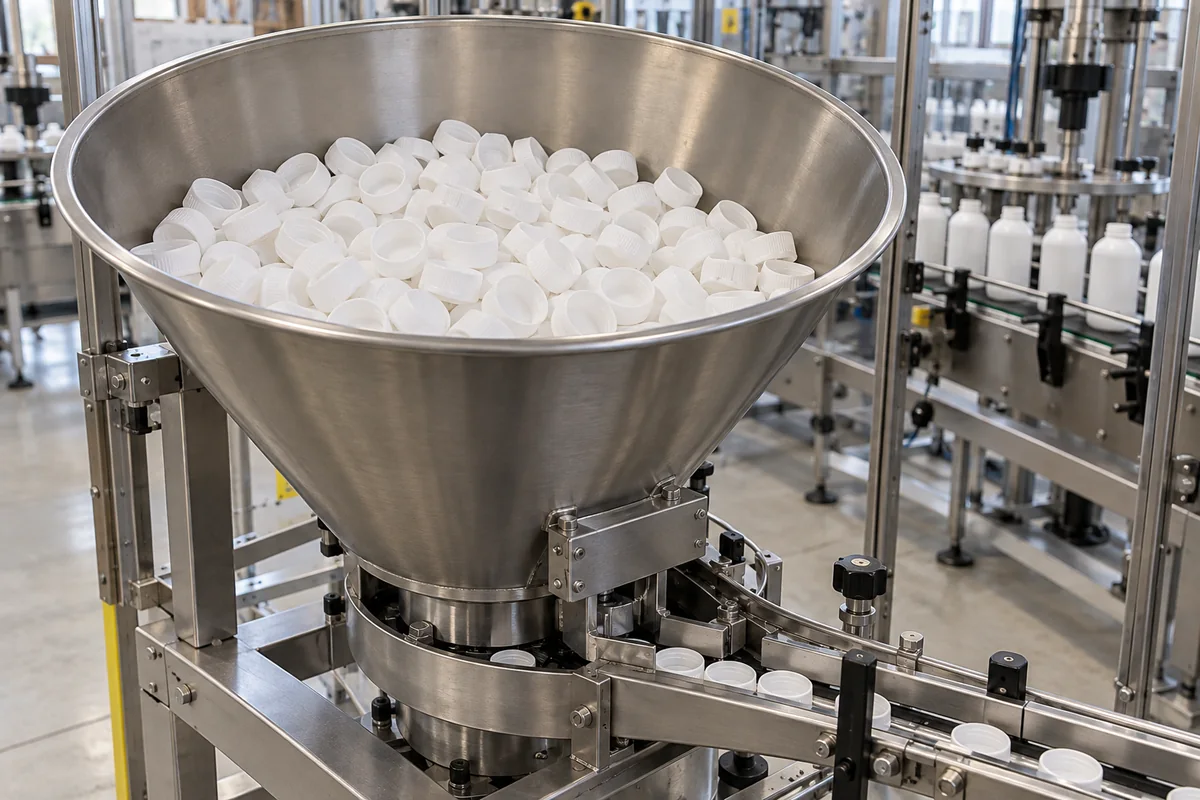
A storage and feeding component that holds and dispenses lids in automated packaging systems.
Product Specifications

Technical details and manufacturing context for Lid Hopper

Definition
The Lid Hopper is a critical component within the Lid Positioning & Feeding Mechanism, designed to store a bulk quantity of lids and feed them individually or in batches to downstream positioning and placement stations. It ensures a continuous supply of lids to maintain packaging line efficiency.
Working Principle
Lids are loaded in bulk into the hopper. Through vibration, gravity, or mechanical agitation, the hopper orients and separates the lids, feeding them one-by-one onto a conveyor, chute, or pick-up mechanism for transfer to the capping or sealing station.
Common Materials
Stainless Steel, Food-Grade Plastic
Technical Parameters
  • Hopper capacity, indicating the maximum volume of lids it can hold. (L) Customizable
Components / BOM
  • Hopper Body
    Main storage vessel for bulk lids.
    Material: Stainless Steel
  • Vibratory Tray/Feeder Bowl
    Uses vibration to orient and separate lids for singular feeding.
    Material: Stainless Steel
  • Discharge Chute/Outlet
    Channel through which oriented lids exit the hopper.
    Material: Stainless Steel or Polymer
Engineering Reasoning
0.5-2.0 m³ capacity, 10-100 lids/min feed rate, 0.1-0.5 MPa pneumatic pressure
Material fatigue at 10⁶ cycles for polycarbonate components, 0.8 MPa burst pressure for pneumatic lines, 50°C thermal deformation threshold for polymer parts
Design Rationale: Stress concentration at 2.5 mm radius fillets causing crack initiation, Bernoulli principle creating vacuum pockets at 15 m/s air velocity, differential thermal expansion (α=70×10⁻⁶/°C for polycarbonate vs α=12×10⁻⁶/°C for aluminum) causing binding
Risk Mitigation (FMEA)
Trigger Electrostatic discharge accumulation exceeding 15 kV at 30% relative humidity
Mode: Polymer surface degradation creating 0.05 mm particulate contamination
Strategy: Integrate 10⁸ Ω surface resistivity conductive polymer with grounded copper mesh at 5 mm spacing
Trigger Resonant vibration at 120 Hz matching hopper natural frequency
Mode: Amplitude magnification to 2.5 mm peak-to-peak causing lid jamming
Strategy: Implement tuned mass damper with 2 kg mass and 500 N·s/m damping coefficient offset by 45° phase

Industry Taxonomies & Aliases

Commonly used trade names and technical identifiers for Lid Hopper.

Applied To / Applications

This component is essential for the following industrial systems and equipment:

Industrial Ecosystem & Supply Chain DNA

Complementary Systems
Downstream Applications
Specialized Tooling

Application Fit & Sizing Matrix

Operational Limits
pressure: Atmospheric to 0.5 bar gauge
flow rate: Up to 60 lids/min
temperature: -20°C to 80°C
slurry concentration: Not applicable (dry material handling)
Media Compatibility
✓ Plastic lids (PP, PET, HDPE) ✓ Metal lids (aluminum, tinplate) ✓ Composite lids (paper/foil laminates)
Unsuitable: Corrosive chemical environments (acids, strong solvents)
Sizing Data Required
  • Lid dimensions (diameter, thickness)
  • Required throughput (lids per minute)
  • Hopper capacity (number of lids to store)

Reliability & Engineering Risk Analysis

Failure Mode & Root Cause
Structural fatigue cracking
Cause: Cyclic loading from repeated lid operation and material handling impacts, exacerbated by stress concentrations at hinge or latch points.
Seal degradation and leakage
Cause: Chemical attack from processed materials, thermal cycling, or mechanical wear compromising gasket integrity, leading to contamination or spillage.
Maintenance Indicators
  • Visible cracks or deformation around hinge mounts or sealing surfaces
  • Unusual grinding or scraping noises during lid operation indicating misalignment or bearing failure
Engineering Tips
  • Implement regular torque checks on fasteners and hinge components to maintain structural integrity and prevent loosening from vibration.
  • Establish a preventive lubrication schedule for moving parts using compatible lubricants, and inspect seals for wear or chemical degradation during routine maintenance.

Compliance & Manufacturing Standards

Reference Standards
ISO 9001:2015 - Quality management systems ASTM A36/A36M - Standard specification for carbon structural steel CE Marking - Conformity with EU directives for machinery safety
Manufacturing Precision
  • Flatness: +/-0.1mm across sealing surface
  • Diameter tolerance: +/-0.05mm for mating components
Quality Inspection
  • Dimensional verification using CMM (Coordinate Measuring Machine)
  • Leak test with pressure decay method

Factories Producing Lid Hopper

Verified manufacturers with capability to produce this product in China

✓ 94% Supplier Capability Match Found

T Technical Director from United Arab Emirates Jan 30, 2026
★★★★★
"The Lid Hopper we sourced perfectly fits our Machinery and Equipment Manufacturing production line requirements."
Technical Specifications Verified
P Project Engineer from Australia Jan 27, 2026
★★★★☆
"Found 50+ suppliers for Lid Hopper on CNFX, but this spec remains the most cost-effective. (Delivery took slightly longer than expected, but technical support was excellent.)"
Technical Specifications Verified
S Sourcing Manager from Singapore Jan 24, 2026
★★★★★
"The technical documentation for this Lid Hopper is very thorough, especially regarding technical reliability."
Technical Specifications Verified
Verification Protocol

“Feedback is collected from verified sourcing managers during RFQ (Request for Quote) and factory evaluation processes on CNFX. These reports represent historical performance data and technical audit summaries from our B2B manufacturing network.”

8 sourcing managers are analyzing this specification now. Last inquiry for Lid Hopper from Poland (11m ago).

Supply Chain Compatible Machinery & Devices

Hydraulic Press

Industrial machine using hydraulic pressure to compress, form, or assemble materials

Explore Specs →
Heavy-Duty CNC Plasma Cutting Machine

Industrial machine for precision metal cutting using plasma arc technology

Explore Specs →
Automated Assembly Line System

Integrated production system for sequential component assembly operations

Explore Specs →
Automated Powder Coating System

Integrated industrial system for applying dry powder coatings to metal substrates.

Explore Specs →

Frequently Asked Questions

What materials are used in the lid hopper construction?

The lid hopper is constructed from durable stainless steel for the main body and food-grade plastic components, ensuring hygiene and corrosion resistance in packaging environments.

How does the lid hopper dispense lids in automated systems?

The hopper uses a vibratory tray or feeder bowl to gently separate and orient lids, then discharges them through a controlled outlet chute into your packaging machinery.

What are the main components of the lid hopper?

Key components include the hopper body for storage, vibratory tray/feeder bowl for lid orientation, and discharge chute/outlet for controlled dispensing to downstream equipment.

Can I contact factories directly on CNFX?

CNFX is an open directory, not a transaction platform. Each factory profile provides direct contact information and production details to help you initiate direct inquiries with Chinese suppliers.

Get Quote for Lid Hopper

Request technical pricing, lead times, or customized specifications for Lid Hopper directly from verified manufacturing units.

Your business information is encrypted and only shared with verified Lid Hopper suppliers.

Thank you! Your message has been sent. We'll respond within 1–3 business days.

Need to Manufacture Lid Hopper?

Connect with verified factories specializing in this product category

Add Your Factory Contact Us
Previous Product
Leveling System
Next Product
Lid Positioning & Feeding Mechanism