Industry-Verified Manufacturing Data (2026)

Lift Platform

Based on aggregated insights from multiple verified factory profiles within the CNFX directory, the standard Lift Platform used in the Machinery and Equipment Manufacturing sector typically supports operational capacities ranging from standard industrial configurations to heavy-duty production requirements.

Technical Definition & Core Assembly

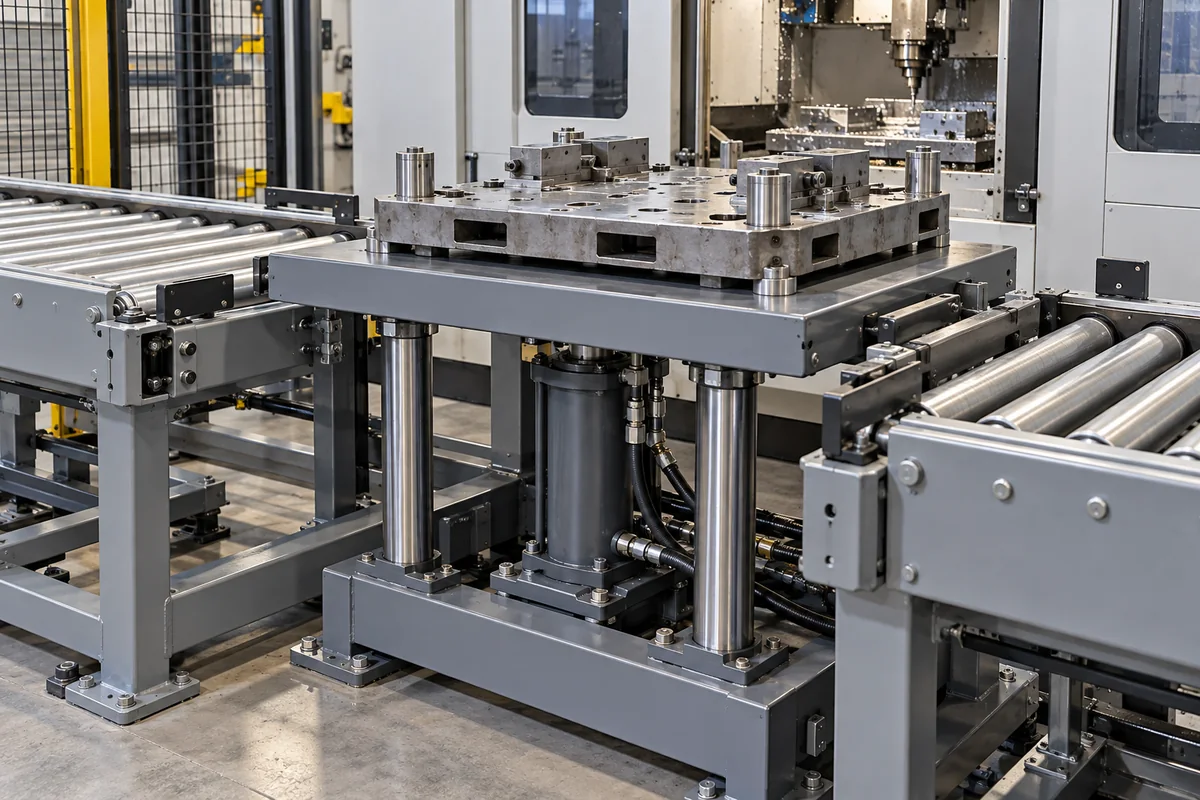
A canonical Lift Platform is characterized by the integration of Platform Plate and Lift Actuator. In industrial production environments, manufacturers listed on CNFX commonly emphasize Structural steel construction to support stable, high-cycle operation across diverse manufacturing scenarios.

A mechanical platform that raises and lowers pallets within a pallet changer system.
Product Specifications

Technical details and manufacturing context for Lift Platform

Definition
The lift platform is a critical component of the pallet changer mechanism, responsible for vertically positioning pallets to facilitate transfer between different stations or conveyors. It ensures precise alignment and smooth material handling in automated manufacturing processes.
Working Principle
The lift platform operates using hydraulic, pneumatic, or electromechanical actuators to provide controlled vertical movement. It typically includes guide rails for stability, position sensors for accurate height control, and safety interlocks to prevent operation during transfer cycles.
Common Materials
Structural steel, Aluminum alloy
Technical Parameters
  • Platform dimensions (length × width) (mm) Customizable
Components / BOM
  • Platform Plate
    Surface that directly supports the pallet during lifting operations
    Material: steel
  • Lift Actuator
    Provides the mechanical force for vertical movement
    Material: steel
  • Guide Rails
    Ensures stable and aligned vertical movement of the platform
    Material: steel
  • Position Sensors
    Detects platform height for precise control and positioning
    Material: electronic components
Engineering Reasoning
0.5-2.5 m/s vertical velocity, 500-2000 kg load capacity, 0.1-1.0 m vertical stroke
Hydraulic pressure exceeding 210 bar causes seal extrusion, ball screw deflection exceeding 0.15 mm/m induces buckling, motor temperature surpassing 155°C triggers insulation breakdown
Design Rationale: Hydraulic fluid compressibility (bulk modulus 1.4 GPa) creates pressure spikes, Hertzian contact stress at ball screw-nut interface exceeds 1.2 GPa yield strength, copper winding resistivity (1.68×10⁻⁸ Ω·m) generates joule heating
Risk Mitigation (FMEA)
Trigger Hydraulic fluid contamination exceeding ISO 4406 18/16/13 cleanliness level
Mode: Spool valve stiction causing platform drift of 5 mm/min
Strategy: Install 3 μm absolute filtration with differential pressure monitoring at 0.8 bar
Trigger Ball screw preload loss below 5% of dynamic load rating
Mode: Positional accuracy degradation beyond ±0.5 mm repeatability
Strategy: Implement double-nut preload adjustment with 50 N·m torque monitoring

Industry Taxonomies & Aliases

Commonly used trade names and technical identifiers for Lift Platform.

Applied To / Applications

This component is essential for the following industrial systems and equipment:

Industrial Ecosystem & Supply Chain DNA

Complementary Systems
Downstream Applications
Specialized Tooling

Application Fit & Sizing Matrix

Operational Limits
pressure: Ambient atmospheric pressure only
temperature: -20°C to +80°C
lifting speed: 0.1-0.3 m/s
load capacity: Up to 5000 kg
operating voltage: 24V DC or 400V AC, 3-phase
Media Compatibility
✓ Standard wooden pallets ✓ Plastic pallets ✓ Metal skids
Unsuitable: Corrosive chemical storage environments (e.g., acid spill zones)
Sizing Data Required
  • Maximum load weight (kg)
  • Required lifting height (mm)
  • Available floor space dimensions (L×W in mm)

Reliability & Engineering Risk Analysis

Failure Mode & Root Cause
Hydraulic cylinder seal failure
Cause: Contamination of hydraulic fluid with particulate matter leading to abrasive wear, or degradation due to chemical incompatibility or excessive heat.
Structural fatigue cracking in platform or boom welds
Cause: Cyclic loading from repeated lifting operations, especially with dynamic loads or impacts, leading to crack initiation and propagation at stress concentrations.
Maintenance Indicators
  • Unusual grinding, knocking, or hissing noises during operation, indicating mechanical interference, bearing failure, or hydraulic leaks.
  • Visible hydraulic fluid leaks, especially at cylinder rod seals or hose fittings, or erratic, jerky, or slow platform movement.
Engineering Tips
  • Implement a strict contamination control program for the hydraulic system, including regular fluid analysis, use of high-quality filters, and proper sealing during maintenance.
  • Establish and enforce load limits and smooth operating procedures to minimize shock loads, and conduct periodic non-destructive testing (e.g., ultrasonic or dye penetrant) on critical welds and structural joints.

Compliance & Manufacturing Standards

Reference Standards
ISO 12100:2010 - Safety of machinery - General principles for design - Risk assessment and risk reduction ANSI/ASME B30.20 - Below-the-Hook Lifting Devices EN 280:2013+A1:2015 - Mobile elevating work platforms - Design calculations - Stability criteria - Construction - Safety - Examinations and tests
Manufacturing Precision
  • Platform levelness: +/- 1 degree from horizontal under full rated load
  • Structural weld alignment: +/- 2 mm over 1 meter length
Quality Inspection
  • Load test at 125% of rated capacity for structural integrity verification
  • Non-destructive testing (NDT) of critical welds using magnetic particle or ultrasonic methods

Factories Producing Lift Platform

Verified manufacturers with capability to produce this product in China

✓ 98% Supplier Capability Match Found

P Project Engineer from Singapore Jan 09, 2026
★★★★★
"The Lift Platform we sourced perfectly fits our Machinery and Equipment Manufacturing production line requirements."
Technical Specifications Verified
S Sourcing Manager from Germany Jan 06, 2026
★★★★★
"Found 31+ suppliers for Lift Platform on CNFX, but this spec remains the most cost-effective."
Technical Specifications Verified
P Procurement Specialist from Brazil Jan 03, 2026
★★★★★
"The technical documentation for this Lift Platform is very thorough, especially regarding technical reliability."
Technical Specifications Verified
Verification Protocol

“Feedback is collected from verified sourcing managers during RFQ (Request for Quote) and factory evaluation processes on CNFX. These reports represent historical performance data and technical audit summaries from our B2B manufacturing network.”

16 sourcing managers are analyzing this specification now. Last inquiry for Lift Platform from USA (1h ago).

Supply Chain Compatible Machinery & Devices

Hydraulic Press

Industrial machine using hydraulic pressure to compress, form, or assemble materials

Explore Specs →
Heavy-Duty CNC Plasma Cutting Machine

Industrial machine for precision metal cutting using plasma arc technology

Explore Specs →
Automated Assembly Line System

Integrated production system for sequential component assembly operations

Explore Specs →
Automated Powder Coating System

Integrated industrial system for applying dry powder coatings to metal substrates.

Explore Specs →

Frequently Asked Questions

What materials are used in the construction of this lift platform?

This lift platform is constructed using high-strength structural steel for the frame and platform plate, combined with lightweight aluminum alloy components to optimize durability and performance in industrial environments.

How does the position sensor system work on this lift platform?

The lift platform incorporates precision position sensors that monitor platform height in real-time, ensuring accurate alignment with pallet changer systems and providing feedback for automated control systems.

What maintenance is required for the lift actuator and guide rails?

Regular lubrication of the guide rails and periodic inspection of the lift actuator's mechanical components are recommended. The system is designed for minimal maintenance with sealed bearings and corrosion-resistant materials.

Can I contact factories directly on CNFX?

CNFX is an open directory, not a transaction platform. Each factory profile provides direct contact information and production details to help you initiate direct inquiries with Chinese suppliers.

Get Quote for Lift Platform

Request technical pricing, lead times, or customized specifications for Lift Platform directly from verified manufacturing units.

Your business information is encrypted and only shared with verified Lift Platform suppliers.

Thank you! Your message has been sent. We'll respond within 1–3 business days.

Need to Manufacture Lift Platform?

Connect with verified factories specializing in this product category

Add Your Factory Contact Us
Previous Product
Lift Cylinders
Next Product
Lifter Actuator