Industry-Verified Manufacturing Data (2026)

Lifting Frame / Column

Based on aggregated insights from multiple verified factory profiles within the CNFX directory, the standard Lifting Frame / Column used in the Machinery and Equipment Manufacturing sector typically supports operational capacities ranging from standard industrial configurations to heavy-duty production requirements.

Technical Definition & Core Assembly

A canonical Lifting Frame / Column is characterized by the integration of Guide Rails and Support Brackets. In industrial production environments, manufacturers listed on CNFX commonly emphasize Structural steel construction to support stable, high-cycle operation across diverse manufacturing scenarios.

Structural support and lifting mechanism component of a lance manipulator

Product Specifications

Technical details and manufacturing context for Lifting Frame / Column

Definition
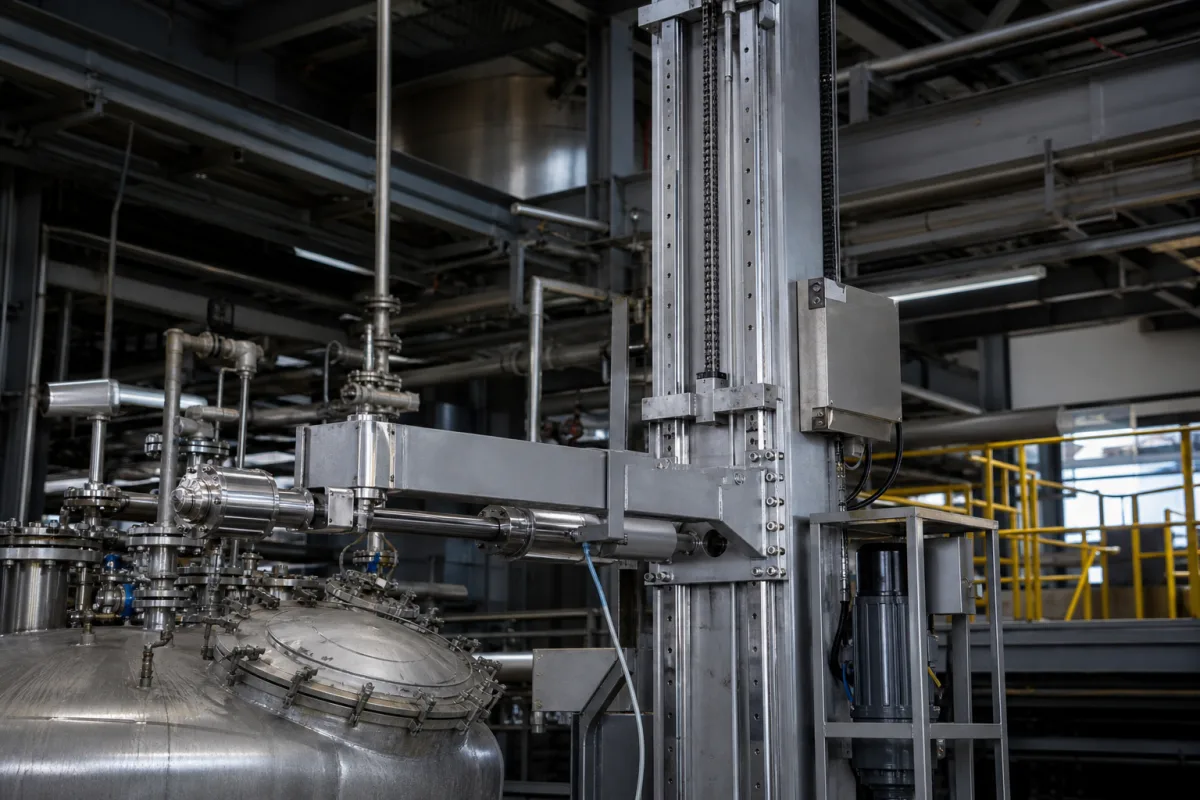
The lifting frame/column is a critical structural component of a lance manipulator system that provides vertical support and enables controlled lifting/lowering movements. It serves as the main load-bearing element that positions and stabilizes the lance during operations in industrial processes such as steelmaking, where lances are used for oxygen injection or other treatments.
Working Principle
The lifting frame/column operates through mechanical or hydraulic actuation systems that convert rotational or linear input into controlled vertical motion. It typically consists of a rigid structural frame with guide rails or columns that ensure precise vertical alignment while supporting the weight of the lance assembly. The system maintains stability during both stationary positioning and dynamic lifting operations.
Common Materials
Structural steel, Alloy steel
Technical Parameters
  • Vertical travel distance of the lifting mechanism (mm) Customizable
Components / BOM
  • Guide Rails
    Provide precise vertical guidance and alignment for the lifting mechanism
    Material: hardened steel
  • Support Brackets
    Connect the lifting frame to the main manipulator structure and distribute loads
    Material: structural steel
  • Lifting Mechanism
    Actuation system (hydraulic cylinder, ball screw, or chain drive) that provides vertical movement
    Material: steel/alloy components
  • Mounting Plates
    Interface points for attaching the frame to the manipulator base and lance carriage
    Material: steel plate
  • Vertical Column
    Primary load-bearing member providing structural support and guidance for vertical movement
    Material: Structural steel
  • Cross Bracing
    Diagonal or horizontal members that provide lateral stability and prevent frame deformation under load
    Material: Steel plate
  • Mounting Plate
    Interface component for attaching the frame to the manipulator base and lance mechanism
    Material: Steel
Engineering Reasoning
5-150 kN vertical load capacity, 0.5-3.0 m lifting height, -20°C to 80°C ambient temperature
Material yield strength exceedance at 355 MPa (S355 structural steel), Euler buckling critical load threshold at 1.5×design load, fatigue crack initiation at 1×10^6 cycles under 0.7×yield stress amplitude
Design Rationale: High-cycle fatigue from cyclic bending stresses during lance insertion/extraction cycles, stress concentration at weld joints (Kt=2.5-3.5), column buckling instability under eccentric loading conditions
Risk Mitigation (FMEA)
Trigger Corrosion-induced wall thickness reduction exceeding 15% of nominal 12 mm thickness
Mode: Localized plastic collapse at stress concentration points during maximum 150 kN lifting operation
Strategy: Hot-dip galvanizing with 85 μm zinc coating, ultrasonic thickness monitoring at 6-month intervals, cathodic protection system with -0.85 V reference electrode potential
Trigger Bearing surface wear exceeding 0.5 mm clearance in guide rail interface
Mode: Lateral instability causing 5° deflection exceeding 2° design limit during 3 m vertical travel
Strategy: Hardened 60 HRC steel wear plates with PTFE composite liners, laser alignment verification to 0.1 mm/m tolerance, automatic lubrication system delivering 2 ml/hour of Molykote G-4702 grease

Industry Taxonomies & Aliases

Commonly used trade names and technical identifiers for Lifting Frame / Column.

Applied To / Applications

This component is essential for the following industrial systems and equipment:

Industrial Ecosystem & Supply Chain DNA

Complementary Systems
Downstream Applications
Specialized Tooling

Application Fit & Sizing Matrix

Operational Limits
pressure: Max 10 bar
other spec: Max dynamic load: 50 kN, Max static load: 75 kN, Slurry concentration: ≤40% solids by weight
temperature: -20°C to 150°C
Media Compatibility
✓ Molten metal handling (e.g., steel, aluminum) ✓ High-temperature gas injection (e.g., oxygen lancing) ✓ Slag removal operations
Unsuitable: Chloride-rich or highly acidic environments (risk of stress corrosion cracking)
Sizing Data Required
  • Maximum lifting load (kN)
  • Required vertical stroke length (mm)
  • Lance diameter and weight (mm/kg)

Reliability & Engineering Risk Analysis

Failure Mode & Root Cause
Fatigue cracking
Cause: Cyclic loading from repeated lifting operations leading to stress concentration at weld joints or material imperfections, exacerbated by dynamic loads and inadequate design for fatigue resistance.
Structural deformation/buckling
Cause: Overloading beyond rated capacity, improper load distribution, or impact loads causing permanent deformation, often due to operator error, lack of load monitoring, or corrosion weakening structural integrity.
Maintenance Indicators
  • Visible cracks, especially at welded connections or stress points
  • Audible creaking, popping, or metallic grinding noises during operation
Engineering Tips
  • Implement regular non-destructive testing (e.g., ultrasonic or magnetic particle inspection) at high-stress areas to detect subsurface defects before catastrophic failure.
  • Enforce strict load limit adherence and balanced load distribution protocols, complemented by operator training and periodic load testing verification.

Compliance & Manufacturing Standards

Reference Standards
ISO 12100:2010 - Safety of machinery ANSI/ASME B30.20 - Below-the-Hook Lifting Devices DIN 15018 - Cranes; Steel Structures; Principles for Design, Calculation and Construction
Manufacturing Precision
  • Column perpendicularity: +/-0.5 mm per meter height
  • Frame weld seam alignment: +/-1.5 mm over total length
Quality Inspection
  • Magnetic Particle Inspection (MPI) for weld integrity
  • Load Testing to 125% of rated capacity

Factories Producing Lifting Frame / Column

Verified manufacturers with capability to produce this product in China

✓ 95% Supplier Capability Match Found

S Sourcing Manager from Brazil Feb 17, 2026
★★★★★
"As a professional in the Machinery and Equipment Manufacturing sector, I confirm this Lifting Frame / Column meets all ISO standards."
Technical Specifications Verified
P Procurement Specialist from Canada Feb 14, 2026
★★★★☆
"Standard OEM quality for Machinery and Equipment Manufacturing applications. The Lifting Frame / Column arrived with full certification. (Delivery took slightly longer than expected, but technical support was excellent.)"
Technical Specifications Verified
T Technical Director from United States Feb 11, 2026
★★★★★
"Great transparency on the Lifting Frame / Column components. Essential for our Machinery and Equipment Manufacturing supply chain."
Technical Specifications Verified
Verification Protocol

“Feedback is collected from verified sourcing managers during RFQ (Request for Quote) and factory evaluation processes on CNFX. These reports represent historical performance data and technical audit summaries from our B2B manufacturing network.”

5 sourcing managers are analyzing this specification now. Last inquiry for Lifting Frame / Column from Germany (31m ago).

Supply Chain Compatible Machinery & Devices

Hydraulic Press

Industrial machine using hydraulic pressure to compress, form, or assemble materials

Explore Specs →
Heavy-Duty CNC Plasma Cutting Machine

Industrial machine for precision metal cutting using plasma arc technology

Explore Specs →
Automated Assembly Line System

Integrated production system for sequential component assembly operations

Explore Specs →
Automated Powder Coating System

Integrated industrial system for applying dry powder coatings to metal substrates.

Explore Specs →

Frequently Asked Questions

What materials are used in the lifting frame/column construction?

Our lifting frames/columns are constructed from high-strength structural steel and alloy steel components, ensuring durability and load-bearing capacity for industrial applications.

What are the main components included in the lifting frame/column assembly?

The complete assembly includes cross bracing, guide rails, lifting mechanism, mounting plates, support brackets, and vertical column components for structural integrity and precise movement.

How does this lifting frame integrate with lance manipulator systems?

The lifting frame serves as the structural support and vertical movement mechanism for lance manipulators, with mounting plates and guide rails designed for seamless integration and stable operation.

Can I contact factories directly on CNFX?

CNFX is an open directory, not a transaction platform. Each factory profile provides direct contact information and production details to help you initiate direct inquiries with Chinese suppliers.

Get Quote for Lifting Frame / Column

Request technical pricing, lead times, or customized specifications for Lifting Frame / Column directly from verified manufacturing units.

Your business information is encrypted and only shared with verified Lifting Frame / Column suppliers.

Thank you! Your message has been sent. We'll respond within 1–3 business days.

Need to Manufacture Lifting Frame / Column?

Connect with verified factories specializing in this product category

Add Your Factory Contact Us
Previous Product
Lifting Frame
Next Product
Lifting Mechanism