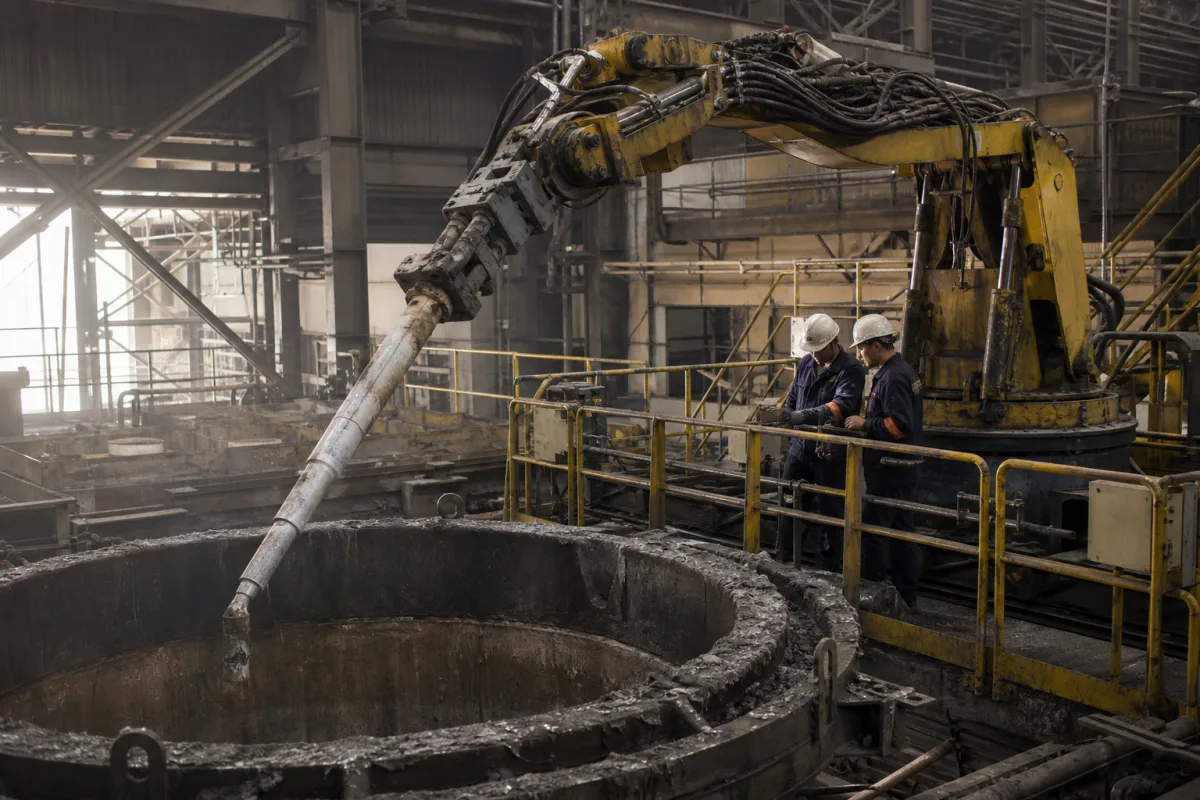
Lance manipulator for electric arc furnace oxygen and carbon lances
Furnace lance manipulators · hydraulic arm that swings, lifts and tilts an oxygen or carbon lance through the EAF slag door, strokes, angles, oxygen and carbon rates
A lance manipulator is the powered arm that holds an injection lance outside an electric arc furnace, drives it through the slag door or a wall opening, and keeps the lance tip at the right height and angle as scrap melts and the bath level changes. It carries water-cooled or consumable pipe lances that blow oxygen and inject carbon to form foaming slag. Ask three things first: which axes the arm moves and over what strokes and angles, what lance and media flows it must carry, and how it is protected from the heat and scrap at the door.
Manipulators that position oxygen, carbon and combined lances at electric arc furnace slag doors and side walls, including consumable-pipe and water-cooled lance types and lance mountings carried on charging machines. Hot metal desulfurization stations with their reagent lances and lance carriages are covered on the Molten metal desulfurization reactor page. Fixed wall-mounted burner-injectors, BOF top lances and lance tips as spare parts are outside this page.
CNFX editorial research · Sources checked October 12, 2026 · 4 sources
Set the axes, strokes and angles the arm must cover
CHNZBTECH's technical table for its oxygen lance manipulator lists mounting at the EAF slag door or furnace side wall on a fixed or tilting platform, hydraulic cylinders or electric motors as drives (hydraulic as standard for heavy-duty EAF duty), and 3 or 4 degrees of freedom: swing in and out, lift, pitch and optionally side sway. Its typical ranges are 800–1,500 mm swing or reach stroke, 0–93° entry swing and ±15° side sway, 400–800 mm vertical lift to follow the molten steel level during meltdown, and 0–25° pitch to set the injection angle at the bath. [1]
The maker describes the lance in the furnace door being inserted gradually as the scrap melts, and lists remote control and up-and-down height adjustment for different process stages among the reasons for a manipulator. Control is by manual joystick or remote PLC. [1]
An earlier patent by Otto Hummler describes a lance mounting hung on the supporting arm of a charging machine, rotatable about a swivel axis and a tilting axis at right angles, driven by separate hydraulic cylinders in the machine; its example tilts the mounting by 20°, for a furnace whose bottom can tilt about 10° either way. It explains that moving the pivot axes up into the furnace throat lets the lance tip cover larger angular areas of the bath than tilting the whole charging-machine arm. [4]
Editorial calculation: the maker's 400–800 mm lift range is a twofold spread (800 ÷ 400), and the 800–1,500 mm reach range spans 700 mm; ask which values the offered arm actually has and match them to your door opening, bath level change and furnace tilt.
Give the supplier the furnace type and capacity, door or wall opening size and position, platform type (fixed or tilting), bath level change during the heat, furnace tilt angles, lance type and length, oxygen and carbon flows, hydraulic or electric drive preference, and control integration.
02
Match the lance, media flows and heat protection
CHNZBTECH lists the manipulator as compatible with water-cooled oxygen or carbon lances, single-function or dual-nozzle (O₂ + C); oxygen lance pipe of 1-1/4 in (DN32) or 2 in (DN50); oxygen flow of 800–3,000 Nm³/h depending on subsonic or supersonic nozzle design; carbon injection of 10–60 kg/min; hydraulic pressure of 10–16 MPa; and cooling water at 0.4–1.0 MPa for water-cooled lances and manipulator armour. It rates the working environment as radiant heat above 200 °C with dust, handled by water-cooled shields and fire baffles. [1] The same page describes oxygen injected at Mach 2 for foaming-slag practice and names China's first self-consuming lance manipulator, applied in Turkey. [1]
Tenova's patent on a movable injection device sets out the limits of the door lance: a few metres long, entering through the slag door so that the thermal load falls on the lance tip, but with limited reach in the furnace, an opening kept open for the whole blowing time that lets in cold air, vapours and heat, high water use to cool a 4-metre lance, and an arm that scrap still stacked or collapsing can damage, which makes use other than on a flat bath inadvisable. [2]
For consumable lances, a Mannesmann patent notes that lances are replaced after they burn down beyond a permissible length, and that an earlier tower-and-arm manipulator required a furnace platform with a relatively high freedom of movement; it proposes feeding the pipe tangentially and bending it through the wall so new pipe sections can be added between hose and lance during breaks. [3]
Editorial calculation: at the maker's upper figures, 3,000 Nm³/h of oxygen is 50 Nm³/min, and 60 kg/min of carbon over a 10-minute injection period (assumed) is 600 kg. [1]
03
Where the lance is mounted: door arm, charging machine or feeder
The supplier linked to this page lists a furnace door carbon-oxygen lance manipulator; its card links to the page reviewed.
Ask each supplier for a drawing with all strokes and angles, the lance types it can carry, and how hoses and cooling lines are routed along the arm.
Design
How the lance is positioned
Source
Door or side-wall manipulator (3–4 axes)
Swing, lift, pitch and optional sway by hydraulic cylinders or motors. [1]
Maker table
Lance mounting on a charging machine
Swivel and tilt axes at the arm head, driven from the machine's hydraulics. [4]
Patent
Tangential consumable-lance feeder
Pipe fed along the vessel and bent through a wall slot; new sections added as it burns. [3]
Patent
Movable device in the furnace step
Lance moved inside a cooled housing on the crucible step instead of through the door. [2]
Patent
04
Column, swing arm, lance clamp and hydraulics that position a furnace lance
Component
Role
Fix in the order
Base or column
Mounts on a fixed or tilting platform at the door or side wall. [1]
Mounting and footprint.
Swing and lift arm
Reach 800–1,500 mm; lift 400–800 mm on one maker's range. [1]
This company lists a furnace door carbon-oxygen lance manipulator.
CHNZBTECH
Manufacturing site to be confirmed for the order
Lists an oxygen lance manipulator for EAF slag door or side wall with a technical parameter table, alongside electric arc furnaces, lance tips and other furnace parts.
Explore company information and manufacturing capabilities, then discuss the scope of your project with a relevant supplier.
Share this page
Compiled and source-reviewed by the CNFX editorial team.
Each manufacturer above links to the page on that company's own website where the product is listed, with the date we checked it. How we source and review
· Page last updated 13 October 2026
Buyer questions
What does an EAF lance manipulator do?
It drives an oxygen and carbon lance through the slag door or side wall and adjusts its reach, height and angle as scrap melts and the bath level changes. [1]
What oxygen and carbon rates does a door lance manipulator handle?
One maker lists 800–3,000 Nm³/h oxygen, depending on nozzle design, and 10–60 kg/min carbon. [1]
What are the drawbacks of door lances?
Tenova's patent lists limited reach, an opening that admits cold air while blowing, high cooling water use for a 4-metre lance, and risk of damage from scrap. [2]
Sources and what still needs a direct check
Sources checked 2026-10-12. CHNZBTECH publishes data for its own manipulator; the three patents (Tenova, Mannesmann, and an individual inventor) describe door-lance limits and manipulator designs. Patents describe inventions, not tested products.