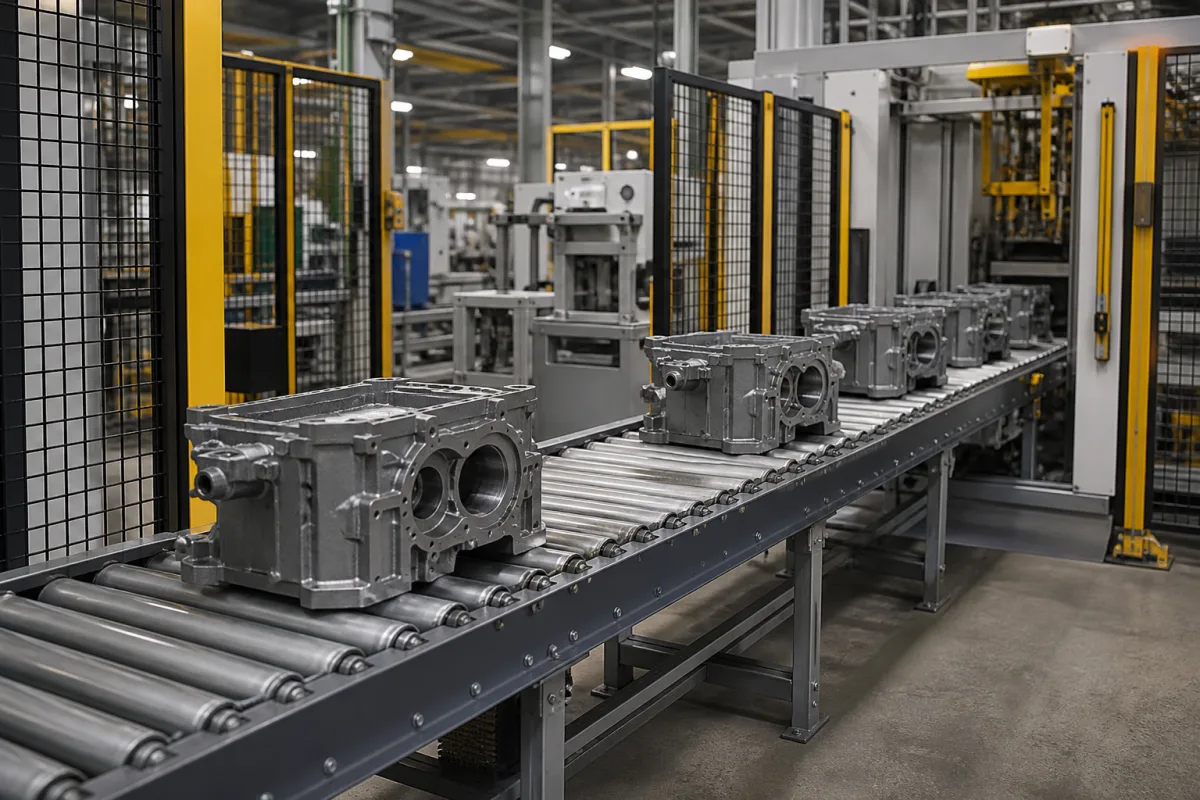
Main line conveyor between machining cells: 24/48 V motor-driven roller zones that carry and buffer cast housings
The powered roller line that carries cast housings from one machining cell to the next · 24 V or 48 V motor-driven roller zones, gear ratios from 2.41 m/s down to 0.20 m/s, 2,500 or 5,000 N per zone, and zone-by-zone accumulation that either keeps a gap between parts or releases them as a slug
Between the cells of a machining line for engine or gearbox housings, the main line is what parts wait on. Each machine takes castings at its own rhythm, so the conveyor that joins them has to move a part, stop it without pushing it into the one ahead, and hold a queue until the next cell calls. Building that line from motor-driven rollers splits it into short zones, each with its own drive and sensor, and the choices that matter are the gear ratio of each drive, how much each zone can carry, and how the zones hand parts down the line.
Powered roller main lines that link machining or assembly cells and buffer parts between them, built from 24 V and 48 V motor-driven rollers in individually controlled zones with zero-pressure accumulation, carrying parts such as cast housings directly on the rollers. Conveyor systems as a plant-wide category are covered on the Conveyor systems page; short belt and roller sections inside a fabrication cell, with roller pitch for stampings, on the Part transfer conveyor for metal fabrication cells page; chain-driven heavy carrier lines for switchgear on the Cabinet assembly transport line page; stop gates for pallet lines on the Pallet stop module page; modular section joints on the Conveyor section page.
CNFX editorial research · Sources checked October 12, 2026 · 4 sources
Gear ratio in the roller: from 2.41 m/s at 0.63 Nm to 0.20 m/s at 7.07 Nm
The motor and gearbox of a motor-driven roller sit inside the tube, so the gear ratio chosen at order fixes the zone's speed range and the torque it can put into a casting. Interroll's 50 W, 60 mm RollerDrive EC5000: [1]
Interroll warns that before run-in the values may differ by up to ±20 %, and afterwards by ±10 % for 95 % of RollerDrives. The same drive is rated 50 W at 24 V or 48 V, drawing 3.4 A rated and 7.5 A starting at 24 V against 1.7 A and 3.8 A at 48 V; a zone with RollerDrive carries up to 2,500 N with a polyamide drive head or 5,000 N with a welded steel head, while a single RollerDrive carries 550 N with a polyamide PolyVee head and 1,100 N with a welded steel head. These ratings assume load spread over the tube; on narrow contact such as pallet runners not every roller carries the load. [1]
Editorial calculation on current: a main line of 20 zones at 24 V draws about 68 A if every drive runs at rated current and 150 A if all start at once; at 48 V the same line draws about 34 A and 76 A. Staggering starts, or choosing 48 V, sets the size of the power supplies and cables.
Editorial calculation on load: a 30 kg casting weighs about 294 N, within the 550 N of a polyamide-headed roller even if it rests on one roller, but its bottom face may be irregular; Frain Group's rule is at least three rollers under the object at all times, which also applies loosely to irregular running surfaces. [4] For a casting 400 mm long that means a roller pitch of no more than about 133 mm.
Gear ratio
Max. / min. conveying speed
Rated torque
Acceleration torque (= zero-motion hold)
Editorial: rated / acceleration force at the 30 mm tube radius
State the heaviest casting, its length and bottom face, the line speed and the acceleration needed at each zone, and whether the supply is 24 V or 48 V.
02
Zone-by-zone accumulation: singulation keeps a zone-length gap, slug mode releases parts nose to tail
Hytrol Conveyor's patent US 5,862,907 describes the control behind zero-pressure accumulation: one module per accumulating zone, each with a sensor for an item in its zone, daisy-chained to its neighbours, and each switching the drive force of its own zone. [3]
Each module sends a product-detect signal to the modules immediately upstream and downstream, and the patent describes delaying that signal by a predetermined time; wiring a dry contact, relay or programmable switch to the module's terminals selects singulation or slug mode. [3] Editorial note: in a machining line, singulation leaves room for a robot or gantry to reach each casting, while slug release empties a buffer faster.
The drive card has to carry that logic or receive it from outside. Interroll's DriveControl 2248 for the EC5000 contains no zero-pressure accumulation logic and needs external signals; it sets speed in 15 increments by DIP switch or seven through digital inputs, offers eight acceleration and braking ramps, runs on 19–26 V DC or 38–55 V DC, draws about 0.5 A plus the RollerDrive's current, and is rated IP22 for 0 to 40 °C. [2] The EC5000 itself holds goods in position with an electronic zero-motion hold and returns energy when braking. [1]
Condition seen by a zone's module
Result in the patent
Item in own zone and item reported in the zone downstream
Drive to own zone stopped; parts queue without contact pressure [3]
Own zone empty, or downstream zone reports no item
Items separated while travelling and on release, keeping or creating a zone-length gap [3]
Slug mode
Items not separated, either in free travel or on release from stopped zones [3]
Specify whether the line needs singulation, slug release or both, where the release signal comes from, and whether the drive cards or a PLC carry the zone logic.
03
What to send when specifying a motor-driven roller main line
Paste it into your enquiry below or into an email to a maker, then replace every bracket.
Parts: [casting type; mass; length and width; bottom face; wet with coolant or dry]
Layout: [cells linked; line length; curves; transfers; buffer length per cell]
Zones: [zone length; parts per zone; load per zone]
Drive: [24 V or 48 V; gear ratio; speed; acceleration; hold on incline]
Control: [singulation / slug; zone logic on card or PLC; interface to cells]
Environment: [temperature; coolant and chips; required IP rating]
Explore company information and manufacturing capabilities, then discuss the scope of your project with a relevant supplier.
Share this page
Compiled and source-reviewed by the CNFX editorial team.
Each manufacturer above links to the page on that company's own website where the product is listed, with the date we checked it. How we source and review
· Page last updated 13 October 2026
Buyer questions
How fast can a 24 V motor-driven roller run?
Interroll's 60 mm, 50 W EC5000 reaches 2.41 m/s at a 9:1 gear ratio and 0.20 m/s at 108:1, trading speed for rated torque from 0.63 to 7.07 Nm. [1]
How much can one roller zone carry?
Up to 2,500 N per zone with a polyamide drive head or 5,000 N with a welded steel drive head on the EC5000, with lower values when the load bears on narrow runners. [1]
What is the difference between singulation and slug release?
Hytrol's patent defines singulation as keeping a zone-length gap between items, and slug mode as releasing them without separation. [3]
How many rollers should be under a part?
Frain Group's rule is at least three at all times, applying loosely to irregular running surfaces too. [4]
Sources and what still needs a direct check
Sources checked 2026-10-12. Drive ratings come from Interroll's RollerDrive EC5000 and DriveControl 2248 data sheets; accumulation logic from a Hytrol Conveyor patent; the three-roller rule from Frain Group's roller conveyor guide.