Centralized Control System
View system integration details
This page explains how Main Control Processor is classified within Machinery and Equipment Manufacturing. Technical values and manufacturer relationships are research references; confirm the current specification and supplier evidence for each order.
The central computing unit within a Centralized Control System that executes control algorithms, processes sensor data, and coordinates subsystem operations.
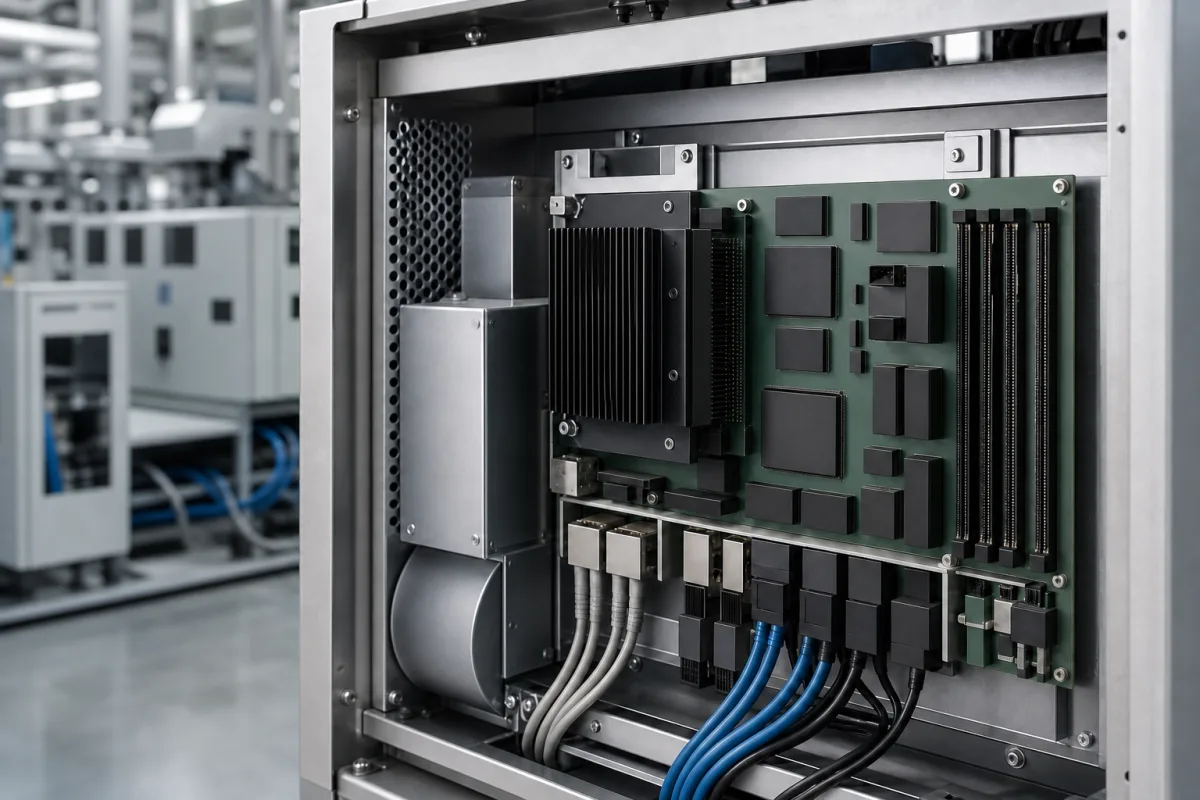
Technical details and manufacturing context for Main Control Processor
| Parameter | Typical range | Notes & selection driver |
|---|---|---|
| Processor Clock Speed | 1.2–2.0 GHz | Higher speed for complex control algorithms |
| RAM Capacity | 4–16 GB | Sufficient for data buffering and multitasking |
| Flash Storage | 32–256 GB | For OS and application storage |
| Operating Temperature | -40–85 °C | Industrial grade; outside range may cause failureIEC 60068-2-1 |
| Supply Voltage | 24 ±10% V DC | Wide input range for industrial power |
| Power Consumption | 15–60 W | Depends on CPU load and peripherals |
| Ingress Protection | IP54–IP65 | Protects against dust and water jetsIEC 60529 |
| Relative Humidity | 10–95 % RH | Non-condensing; condensation may cause shortsIEC 60068-2-78 |
| Vibration Resistance | 5–500 Hz | Sinusoidal vibration; higher range for harsh environmentsIEC 60068-2-6 |
| Shock Resistance | 30 g | Peak acceleration; 11 ms half-sine pulseIEC 60068-2-27 |
| Weight | 1.5–3.5 kg | Depends on enclosure and interfaces |
| Dimensions (W×H×D) | 200×150×60 mm | Typical DIN rail mount; custom sizes available |
| Communication Interfaces | 2×Ethernet, 4×RS-485, 2×CAN | For fieldbus and network connectivityIEC 61158 |
| Real-Time Clock Accuracy | ±5 ppm | Maintains time synchronization |
Ranges are indicative industry figures for RFQ preparation, not a supplier commitment. Confirm every value and standard with the legal manufacturer before ordering.
This component is essential for the following industrial systems and equipment:
| pressure: | N/A (enclosed unit) |
| other spec: | Humidity: 5% to 95% non-condensing, Vibration: 5g max, Shock: 50g, 11ms |
| temperature: | 0°C to 70°C (operating), -40°C to 85°C (storage) |
Indicative industry ranges for design and RFQ preparation. Confirm the exact figures and applicable standard with the manufacturer before specifying.
Quoted from the published standard.
Manufacturer profiles associated with Main Control Processor.
Manufacturer listings support early research and capability understanding. They are not certification, ranking, or transaction guarantees.
A practical evidence checklist for RFQ preparation and supplier evaluation.
CNFX does not score or rank suppliers. Buyers must verify all claims and documents with the legal manufacturer before ordering.
The Main Control Processor is the central computing unit that executes control algorithms, processes sensor data, and coordinates subsystem operations. It receives inputs from sensors and operator interfaces, processes them according to predefined algorithms, and outputs control signals to actuators and other components, ensuring coordinated operation of the entire system.
The processor is designed for industrial environments with an operating temperature range of -40 to 85 °C (per IEC 60068-2-1) and relative humidity of 10–95% non-condensing (per IEC 60068-2-78). Exceeding these ranges may cause failure. Always verify the specific model's ratings with the manufacturer.
The processor typically includes 2×Ethernet, 4×RS-485, and 2×CAN interfaces, per IEC 61158. These allow connection to fieldbus and network systems for data exchange with other control components. Confirm the exact interfaces for your model.
The processor is tested for sinusoidal vibration from 5 to 500 Hz (per IEC 60068-2-6) and shock resistance up to 30 g with an 11 ms half-sine pulse (per IEC 60068-2-27). These ratings indicate suitability for harsh industrial environments, but actual performance depends on installation and enclosure.
Editorial classification, named public sources where available, and source-reviewed manufacturer records.
Ask for use case, specification boundaries, supplier type, and RFQ preparation information for this product.
Compare manufacturer profiles with relevant product and process capability.