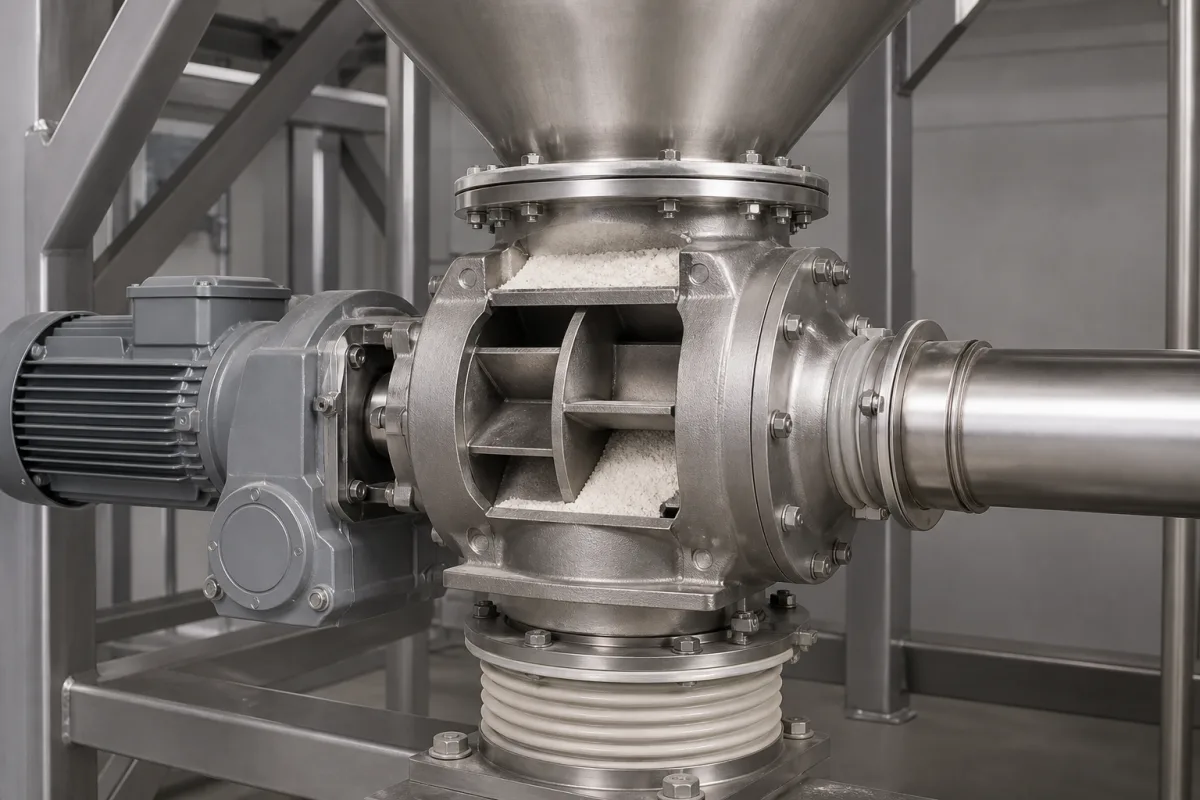
Material feeder for pneumatic conveying of pellets (the rotary valve that meters granules into the line without cutting them)
The rotary feeder that meters plastic pellets into a pneumatic conveying line · drop-through, side-entry and blow-through types, inlet plows and offset inlets against pellet shearing, relieved blade tips, vent ports for carry-over air, rotor clearances and speed
Where pellets drop from a hopper into a conveying line, a rotary valve meters them and holds back the conveying air. Plastic pellets do not shear easily: pellets caught between a rotor blade and the housing can jam or seize the rotor and put shock loads on the drive. The choice of valve type and inlet, the blade tips and the venting decide how often that happens.
Rotary valve feeders that meter pellets and granules into pneumatic conveying lines, with their inlet geometry, rotor, venting and clearances. Complete conveying systems are covered on the Pneumatic conveyor for powders and granules page; general hopper and silo outlet valves and rotary valve sizing on the Powder hopper valve page; dust collector discharge airlocks on the Dust-collector discharge rotary valve: the airlock that seals and empties a baghouse or cyclone hopper page; screw feeders on the Screw feeder page; gravimetric powder feeders on the Powder feeder with loss-in-weight control: a feed screw on a weigh hopper that meters powder by weight and is refilled without stopping page.
CNFX editorial research · Sources checked October 13, 2026 · 3 sources
Drop-through, side-entry or blow-through, and keeping pellets whole
Amrit Agarwal of Pneumatic Conveying Consulting, writing in Chemical Engineering (July 2013), says that in a side-entry valve "the solids inlet is offset from the vertical, solids-gravity-flow line by 30 deg", so the empty pocket fills only partly, which "minimizes shearing of the solid particles" and prevents jamming. Pocket fill efficiency "is generally about 60%", and an adjustable slide plate in the inlet changes it. [1]
The same article's figure caption gives the side-entry offset as 30–45 degrees, against 30 deg in the text; confirm the angle on the supplier's drawing. [1]
For coarse particles such as plastic pellets, drop-through valves are given a V-shaped inlet plow on the downstream side of the inlet to keep solids out of the rotor-to-housing clearance, and blade tips are "generally relieved at a 45-deg angle on their trailing edge to prevent clipping of the pellets". Blow-through valves sit directly in the conveying line, with the gas passing through the emptying pocket, and are used for sticky materials that do not flow out of the pocket. [1]
Rotolok says that a pellet product, "especially if it is a plastic type, polythene or nylon etc., does not shear easily", so a standard drop-through valve can seize and take considerable shock loadings; its offset valve fills the rotor on the upward stroke and uses a "pelican beak" to spread product across the rotor width. Meyer Industrial describes its side-entry valve's offset V-type inlet as one that "minimizes shearing action at the housing entry" and, further down the same page, as a design "to eliminate shearing"; treat the stronger claim with care. [2][3]
Name the pellet material, size and temperature, ask which inlet geometry, plow or deflector and blade-tip profile the valve has, and ask for the fill factor used in the capacity figure.
02
Carry-over air, vents, clearances and speed
In pressure conveying, the conveying air that fills each returning empty pocket would otherwise reach the inlet and interfere with incoming solids. Agarwal places a vent port on the return side "so that there are at least two rotor pockets between the valve bottom and the vent port", sized to vent the whole pocket volume; with powders, the vented solids are returned through a vent hopper. [1]
He gives circumferential clearances of 0.004 to 0.008 in., and end clearances printed as "0.006 to 0.0010 in.", a range whose upper figure is below its lower one; ask the supplier for both clearances in writing. He recommends the lower values to limit leakage and asks the vendor to measure clearances and air leakage against valve speed under operating temperature and pressure before acceptance. [1]
The article gives a normal speed range of 15 to 22 rpm and 16 rpm for sizing, a zero-speed motion switch on the driven shaft, rotor deflection not over 0.001 in. at the design differential pressure, and housings rated 10% above the maximum operating pressure or vacuum. Rotolok lists "Maximising valve speed to 25 RPM" for its offset valve, and Meyer lists a 15 PSI pressure rating and 400 °F maximum temperature for its side-entry model. [1][2][3]
Give the conveying pressure, material temperature range and capacity, and ask for the vent arrangement, clearances, speed and the measured air leakage at that speed.
03
Pellet rotary feeder details
Paste it into your enquiry below or into an email to a maker, then replace every bracket.
Explore company information and manufacturing capabilities, then discuss the scope of your project with a relevant supplier.
Share this page
Compiled and source-reviewed by the CNFX editorial team.
Each manufacturer above links to the page on that company's own website where the product is listed, with the date we checked it. How we source and review
· Page last updated 13 October 2026
Buyer questions
Why use a side-entry valve for pellets?
The offset inlet fills each pocket only partly, which reduces shearing of pellets and jamming, per the Chemical Engineering article. [1]
When is a blow-through valve used?
For sticky materials that do not flow out of the rotor pocket; the conveying gas passes through the pocket. [1]
Why are blade tips relieved?
A 45° relief on the trailing edge prevents clipping pellets and the rotor binding. [1]
Where does the carry-over air go?
Out through a vent port on the return side, at least two pockets from the valve bottom. [1]
Sources and what still needs a direct check
Sources checked 2026-10-13. Chemical Engineering published Amrit Agarwal's article on rotary valves in pneumatic conveying; Rotolok and Meyer Industrial publish product pages for their offset and side-entry valves.