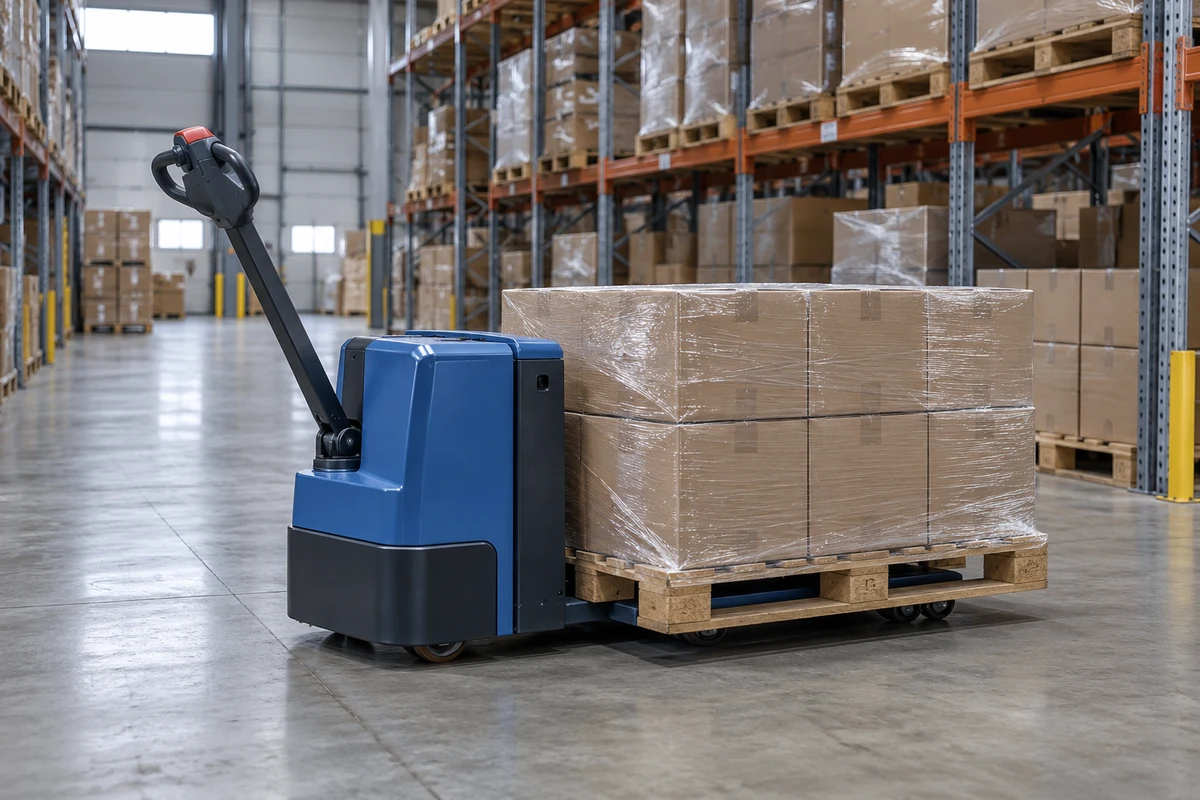
A pedestrian electric pallet truck moves a pallet on powered wheels and lifts it just clear of the floor. Follow the lift and drive components, match the forks to your pallet and check the route through your building. The XILIN CBD15/CBD20 sheets provide a model reference; battery versions and the delivered manual still need agreement.
Material handling also includes conveyors, bulk-solid systems and production-line handlers. This guide examines pedestrian pallet transport.
CNFX editorial research · Sources checked October 9, 2026 · 4 sources
VDI 2198:2019-11 describes how to present industrial-truck technical data for comparison and detailed specification. Its public abstract covers truck types in ISO 5053-1; a type sheet is a data format, not a safety certificate [2].
A Chinese example that follows the layout
Ningbo Ruyi publishes its XILIN CBD15/CBD20 lithium pallet trucks with the familiar numbered type-sheet lines, from drive and operator type through load centre, axle loads, aisle width and motor ratings [1]. If a supplier only sends a brochure, ask for the type sheet.
Compare like with like
Use the same line on each quotation, for example aisle width for the same pallet orientation, rather than headline capacity alone.
02
Separate the lift circuit from the drive circuit
The factory sheet identifies separate drive and lift motors. The March 2023 CBD15/20 manual shows a hydraulic power unit, a mechanical lowering control and a handle-controlled traction circuit. Pressing lift and commanding travel use different parts of the truck [1][3]. The manual is a March 2023 model document hosted on the XilinAmerica store; its exact match to a current factory delivery is not established.
Functional structure / BOM reference
Job on the truck
Published material or configuration
Frame and forks
Support the pallet and transfer its load to the wheel groups.
The sheet gives fork dimensions and spread; it does not identify a steel grade, aluminium frame or a manufacturing parts list [1].
Hydraulic lift and linkage
Raise the fork assembly; the lowering control releases it down.
The manual identifies the hydraulic power unit, cylinder and manual lowering valve. No chain or cable lift is established for this configuration [3].
Drive motor and driven wheel
Turn the traction wheel to move the truck.
Horizontal motor mounting; 0.75 kW S2 60 min. Front tyre Ø210 × 75 mm, PU; wheel-core and motor materials are not specified [1].
Load rollers
Carry the fork end and roll beneath the pallet.
PU Ø80 × 93 / Ø80 × 70 mm; single roller listed as standard and double roller as an option. Match the actual arrangement to the load assessment [1].
Battery and charger connection
Supply electrical energy and provide a charging connection.
Lithium, nominal 24 V; the factory and March 2023 manual disagree on CBD20 ampere-hours. Pack chemistry, cell supplier and connector compatibility require confirmation [1][3].
Handle, controller and controls
Command direction/speed and lifting; operate the lowering control.
The manual shows accelerator, lifting button, lowering knob and separate controller diagrams. It does not establish a PLC, autonomous programming or interchangeable controller part numbers [3].
Brake and emergency controls
Stop traction and respond to emergency commands.
The factory lists an electromagnetic brake, handle reverse switch and emergency switch. This does not establish an automatic stability system, warning beacon or every claimed safety function [1][3].
This is a functional breakdown of documented configurations, not an orderable manufacturing BOM. Obtain the parts catalogue matched to the serial number, especially the controller, fuse, wheel group and hydraulic unit. The March 2023 manual’s spare-fuse table and circuit diagrams are not fully consistent; do not choose replacements from this guide [3].
03
Check rated load, load centre and forks against your pallets
The figures below are from the CBD15/CBD20 type sheet [1].
Rated load holds at the stated load centre
Both models are rated with the load centre at 600 mm [1]. Long or unevenly packed loads that move the centre outward should be discussed with the supplier.
Lowered height must clear your pallet
Forks lowered to 80 mm and 53 mm thick [1] have to enter your pallet's openings; measure the lowest pallet you handle, including damaged ones.
This is a transport truck, not a stacker
The sheet labels h3 as 110 mm; the dimension drawing identifies the lift travel separately from the 80 mm lowered fork height h13. Do not read 110 mm as the maximum fork-top height above the floor. This is a low-lift pallet transporter, not equipment for placing loads in racks [1][3].
Keep each dimensional combination together
Both model columns contain paired fork, overall-length, turning-radius and aisle-width values. A slash is not automatically a CBD15/CBD20 comparison. Ask for the drawing for the chosen fork length and spread, including the pallet orientation used for Ast [1].
Type-sheet line
CBD15
CBD20
Rated load Q
1500 kg
2000 kg
Load centre c
600 mm
600 mm
Fork dimensions s/e/l (DIN ISO 2331)
53/160/1150 (1220) mm
53/160/1150 (1220) mm
Fork spread b5
550 / 685 mm
550 / 685 mm
Lowered height h13
80 mm
80 mm
Lift travel h3 (check drawing)
110 mm
110 mm
Service weight
114 kg
120 kg
04
Check aisles, ramps and floors
Map the actual route: pallet pickup, the narrowest turn, ramp transitions, lift and dock plate. The published dimensions answer different questions.
Aisle width
Both models list Ast 2180 / 2250 mm for 1000 × 1200 mm pallets crossways and 2050 / 2085 mm for 800 × 1200 mm pallets lengthways; Wa is 1380 / 1450 mm. These are configuration pairs within each model column, not values assigned one to each model. Match the selected fork and pallet drawing [1].
Ramps and dock plates
Maximum gradeability 5% laden and 20% unladen [1]. A loaded ramp steeper than 5% is outside the published rating.
Floor and dock plate loading
Laden front/rear axle totals are 410 / 1204 kg for CBD15 and 538 / 1582 kg for CBD20. Their sums are 1614 and 2120 kg, matching rated load plus the published truck weight. They are not individual-wheel contact loads. Obtain the selected single/tandem roller arrangement, wheel load and contact conditions for the floor or dock-plate assessment; an 80 mm roller diameter does not establish contact area [1][3].
Floor surface
The factory describes an indoor truck with PU tyres and 27 mm clearance at the wheelbase centre. The March 2023 CBD15/20 manual requires hard, flat indoor surfaces and excludes rainy outdoor, gravel and corrosive/explosive conditions. Check joints, lips and ramp transitions with the actual truck; centre clearance alone does not prove it can pass them [1][3].
Speed and noise
Travel speed is 4.3 / 4.5 km/h laden / unladen. The sheet reports 70 dB(A), while the March 2023 manual identifies measurement at the operator’s ear according to DIN 12053. Obtain the actual test conditions; this pedestrian truck has no driver’s seat [1][3].
05
Check the battery, charger and motor duty
The voltage and ampere-hours describe nominal battery energy; the S2/S3 lines describe motor heating duty. Neither gives a verified shift runtime.
Estimate shift energy
Count pallet moves per shift and travel distance; ask the supplier for the runtime per charge at your load.
Plan charging
Agree the charging window, battery change procedure and compatible spare pack. The sheet does not establish a charge time or approval for opportunity charging; do not infer either from nominal energy [1][3].
Match duty to use
ABB defines S2 as operation shorter than needed to reach thermal equilibrium, followed by a de-energised rest until the motor cools [4]; if your cycle drives the truck for longer than 60 minutes without that rest, ask whether the S2 60 min rating fits.
Battery
The factory table lists 24 V / 20 Ah for both models; its features identify the 30 Ah option for CBD15. The March 2023 manual instead lists CBD20 at 24 V / 30 Ah. Confirm the delivered battery version. 24 V × 20 Ah = 0.48 kWh nominal; it is not usable energy or a runtime promise [1][3].
Charging
The factory lists an external charger connection. The March 2023 manual specifies a matched lithium charger (24 V working voltage, 29 V maximum charging voltage, 5 A) and prohibits charging below 0 °C. Those are manual-version details, not an interchangeable charger specification for every CBD15/20. Confirm the battery/charger labels and permitted charging temperature [1][3].
Drive motor
0.75 kW at S2 60 min in the factory sheet. ABB explains S2 as short-time operation followed by sufficient de-energised cooling; it does not mean a continuous shift or 60 minutes of battery runtime. Match the truck’s motor and control limits to your travel cycle [1][4].
Lift motor
0.5 kW for CBD15 or 0.8 kW for CBD20, at S3 15%. S3 denotes repeating loaded and de-energised rest periods; the percentage is a cyclic duration factor, not battery capacity or a licence to lift continuously. Ask for the applicable cycle and thermal limits [1][4].
Brake and controls
Electromagnetic service brake; handle with belly switch and emergency switch [1]
06
Keep the original specification fields tied to the selected truck
Use the fields below to finish the quotation. The published type sheet covers some of them; unlisted protection and charging data still need a matched answer.
Parameter
Unit / meaning
Model evidence or order requirement
Load capacity
kg / stated load centre
1500 kg CBD15 or 2000 kg CBD20 at c = 600 mm. Check an outward or uneven load centre with the supplier [1].
Lift height
mm / travel and fork height
h3 = 110 mm lift travel, h13 = 80 mm lowered fork height; distinguish both from racking height [1][3].
Power source
Type / complete pack
Electric lithium-battery pedestrian truck. This sheet does not describe diesel, manual-only or a rider model [1].
Operating speed
km/h travel; m/s lift
4.3 / 4.5 km/h travel and 0.016 / 0.02 m/s lift, laden / unladen. Do not merge travel and lifting speed [1].
Turning radius
mm / Wa
1380 / 1450 mm within each model column. Wa is a turning radius, not the full aisle width Ast; match the fork configuration [1].
Overall dimensions
mm / named axes and positions
Overall length 1580 / 1650, width 550 / 685; tiller height in driving position 635 / 1200. The tiller range is not a fixed packaged L×W×H; request the selected envelope drawing [1].
Weight
kg / service versus laden
114 kg CBD15, 120 kg CBD20; the manual calls this service weight with battery. Floor and lift checks must also include the load and any accompanying people, as applicable [1][3].
Maximum gradeability
% / laden and unladen
5% / 20% in the sheet, with the loaded and empty cases separate. Obtain permitted travel direction, ramp length, transitions and braking conditions [1][3].
Battery voltage
V / paired capacity
24 V nominal; CBD20 is 20 Ah on the factory page but 30 Ah in the March 2023 manual. Confirm the selected pack; voltage alone does not specify stored energy [1][3].
Charging time
h / pack and charger
Not established in the factory type sheet or March 2023 manual. Obtain the actual current, starting state of charge, endpoint and temperature; do not import a CBD15-NEW retail claim.
Maximum ambient temperature
°C / operation
March 2023 manual gives +40 °C for this configuration, with 50% maximum relative humidity at that temperature. Match the delivered manual and site [3].
Minimum ambient temperature
°C / operation versus charging
Manual gives −10 °C operation but excludes freezer/low-temperature use in its safety section; resolve the application. Charging below 0 °C is expressly prohibited [3].
Ingress protection
IP / identified enclosure
No verified IP rating in these two sources. Indoor use and a protective cover are not an IP code. Require the named component/enclosure rating for the site.
Noise level
dB(A) / operator test
70 in the factory table; the manual identifies operator-ear measurement according to DIN 12053. Require the matching report and conditions [1][3].
A service weight, an axle total and a wheel contact load answer different questions. A nominal battery figure, a charging limit and a motor duty rating also need separate evidence.
07
Inspect the parts that carry, lift and stop the pallet
The March 2023 CBD15/20 manual separates daily, weekly and periodic work. Use these documented examples to obtain the plan for the delivered serial number; they are not a maintenance schedule for all material-handling equipment [3].
Before returning it to work
The manual requires stopping use when the truck is damaged or has a safety problem. Have the brake, emergency reverse and lift/lower functions checked under the delivered instructions; a functioning travel motor does not prove that the truck is ready [3].
Daily and weekly attention
It calls for daily cleaning and checking the power cable; weekly checks include operating parts, fasteners, oil leakage, unusual wear and electrical heating. Record the affected part rather than replacing a guessed assembly [3].
Scheduled service
The manual specifies mechanical and electrical checks every three months, with yearly hydraulic checks; for the hydraulic oil it says "which is usually replaced once in 12 months". Match the oil, intervals and service procedure to the exact truck and operating conditions [3].
Battery and spares
Follow the matched battery isolation and charging procedure; hold the connector rather than pulling the wiring. Obtain compatible pack/charger and serial-specific wheel, hydraulic and controller parts. The manual’s fuse list and diagrams require clarification before ordering replacements [3].
08
Copy this RFQ and fill in the brackets
Paste it into your enquiry below or into an email to a maker, then replace every bracket.
Product: pedestrian lithium electric pallet truck; complete model/version [ ], quantity [ ]
Load: maximum [kg], load centre [mm], load distribution [ ]; pallet dimensions/orientation [ ], lowest entry [mm]
Forks: length [mm], outer spread [mm], required lift travel [mm]; matching drawing [ ]
Route: narrowest working aisle [mm], turning space [ ], joints/lips [ ], ramps [%/length/transitions]
Floor and dock: total mass limit [kg], wheel/contact-load assessment [ ], lift capacity including personnel [kg]
Work cycle: moves per shift [ ], travel distance [m], loaded travel/rest pattern [ ], lifts per cycle [ ]
Battery: nominal [V/Ah], exact pack/version [ ], usable energy/runtime test at this load [ ]
Charger: matched model/input [V/Hz/plug], output and temperature limits [ ], required charge window [h]
Environment: operation [°C/RH], charging [°C], indoor surface [ ], site restrictions [ ]
Documents: matched VDI 2198 sheet/drawing, serial-specific operation and parts manuals, applicable destination conformity documents [ ]
Service: inspection schedule, wheel group, hydraulic parts, brake/controller and fuse clarification [ ]
Delivery [country/date], spare packs and local support [ ]
12 companies list this product among what they make. Company figures are quoted from each
company's own website; every card states where the relationship came from.
Ningbo Ruyi Joint Stock Co., Ltd. (XILIN)
Ninghai, Zhejiang (contact address), CN
The current XILIN factory page lists CBD15/CBD20 pedestrian lithium pallet trucks. Its configuration pairs and battery table are the model reference above; confirm the selected pack against the delivered manual. These low-lift trucks do not place pallets in racks.
Its current catalogue lists bulk-handling conveyors, stackers, reclaimers, ship loaders and hoppers. A bulk-material stacker is a different machine from a pallet stacker or pedestrian pallet truck.
The fertilizer equipment range includes bucket elevators, belt, scraper-chain and screw conveyors, and belt weighing. This is bulk-solid transport, without a pedestrian pallet-truck model established on the reviewed page.
The handling catalogue shows wood-panel vacuum lifters, roller/belt lifting and turning equipment, hydraulic platforms and CNC loading aids. Specify a panel-handling task; the category alone does not establish a pallet truck.
The catalogue lists hand/electric pallet trucks, DS-EPPT stainless electric trucks, stackers and lift tables, including destination-specific configurations. Obtain a model sheet and identify the legal manufacturer rather than transferring XILIN ratings.
Its current electric-pallet category presents CTXY-30Q, separately from EPT and ride-on products. The displayed dimensional and wheel descriptions need a matched drawing before quotation; this page does not adopt its headline dimensions, price, IP or gradeability as generic pallet-truck data.
The current PCB-handling catalogue lists magazine loaders/unloaders, inspection/cooling conveyors and a PCB flip conveyor. This equipment transfers circuit boards on an assembly line; it is not warehouse pallet transport.
The food-processing handling category lists totebins, meat trolleys, tables, racks, bin hoists, tippers and conveyor systems. Its handling scope concerns food-process containers; no CBD-style electric pallet truck is established here.
The battery-production catalogue lists an AGV intelligent handling logistics system under material handling. That is an automated line/logistics product, not evidence of a pedestrian pallet-truck model. The tubular-furnace item in the same category does not make the category a uniform product range.
Explore company information and manufacturing capabilities, then discuss the scope of your project with a relevant supplier.
Share this page
Compiled and source-reviewed by the CNFX editorial team.
Each manufacturer above links to the page on that company's own website where the product is listed, with the date we checked it. How we source and review
· Page last updated 13 October 2026
Buyer questions
What is a VDI 2198 type sheet?
A standard layout for truck technical data, so trucks from different makers can be compared line by line. It covers all truck types in ISO 5053-1. [2]
Can a walkie pallet truck climb a loading ramp?
The reviewed truck publishes maximum gradeability of 5% laden and 20% unladen. That rating alone does not approve every loading ramp: obtain the permitted route, travel direction, transitions and braking procedure for the delivered truck. [1]
How wide must the aisle be?
The sheet gives configuration pairs in both model columns: 2180 / 2250 mm for 1000 × 1200 mm pallets crossways and 2050 / 2085 mm for 800 × 1200 mm pallets lengthways. Use the drawing for the selected forks and pallet orientation; do not assign one number to each model. [1]
How much energy is in a 24 V / 20 Ah battery?
About 0.48 kWh nominal. Ask the supplier for runtime at your load and duty. [1]
Sources and what still needs a direct check
Sources checked 2026-10-09. Standards bodies and regulations define the requirements; manufacturer pages show published ranges for those models only. CNFX does not certify products or suppliers.