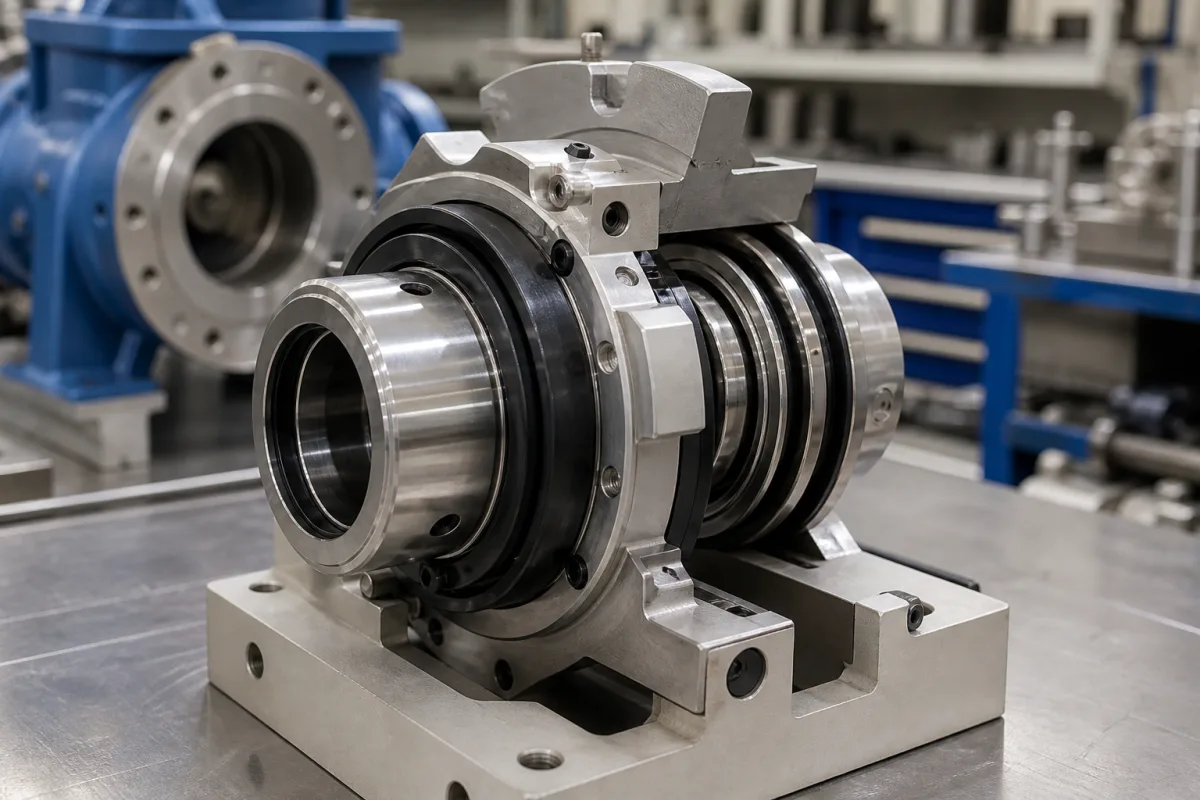
Dry-running mechanical seal assembly for agitators: contacting carbon faces under nitrogen instead of a barrier liquid
Agitator shaft seals without barrier liquid · carbon-on-silicon-carbide faces running dry, nitrogen-pressurised dual cartridges, vacuum to 6 bar and sliding speeds of 1.5–2 m/s
On a slow agitator, dryer or mixer shaft the seal faces do not need a liquid film to survive. A dry-running seal assembly lets a carbon face rub directly on a hard seat, and in its dual form fills the space between the two seals with nitrogen at a pressure above the vessel, so there is no barrier liquid to leak into the batch and no liquid support system to run. The price is a lower pressure and speed envelope than a liquid-lubricated cartridge of the same size, which is what this page is about.
Dry-running (contacting, gas-buffered) mechanical seal assemblies for agitator, mixer, reactor, kneader and dryer shafts: single outboard seals and nitrogen-pressurised dual cartridge seals with carbon faces, with or without an integrated bearing, including their gas supply and cooling or wear-trap options. Single and dual mechanical seals for centrifugal pumps, mixers and agitators, with their face, spring and piping-plan choices, are covered on the Mechanical seal page; liquid-lubricated cartridge seals on a reactor nozzle, as part of the drive stack, on the Agitator head assembly page; packed stuffing boxes on the Chemical reactor sealing gland page; and rotary seal kits for liquid ring pumps on the Shaft seal kit for close-coupled liquid ring vacuum pumps page. Non-contacting gas-lubricated seals and lip seals are outside this page.
CNFX editorial research · Sources checked October 13, 2026 · 7 sources
What going dry costs: pressure and speed limits next to the liquid-lubricated version
John Crane sells the same dual cartridge to DIN 28138 in two face versions, and its published limits show the trade directly: the liquid-lubricated CK725 runs from vacuum to 16 bar(g) at up to 2 m/s, while the dry-running CK725D is limited to 6 bar(g) and 1.5 m/s; the data sheet adds 0–570 rpm overall and up to 430 rpm for dry running, with –40 to +200 °C. John Crane states that exchanging the seal faces converts the wet seal into a contacting dry-running seal. [6]
EagleBurgmann notes on each data sheet that the extreme values of the operating parameters cannot be applied at the same time because they interact, and that the figures are guide values to be confirmed for the exact application. [1] The Saisi listing, offered as an equivalent to the SeccoMix design, gives a lower temperature ceiling without cooling flange (150 °C against 200 °C) and a smaller shaft range than the EagleBurgmann sheet, so an equivalent design should be checked against its own data sheet, not the original's. [7][2]
The face pair on the EagleBurgmann and Saisi sheets is FDA-conform carbon graphite running against silicon carbide. [1][7] John Crane lists the advantages of contacting dry-running faces as freedom from contamination by barrier liquid, low face wear and a simple gas supply system. [6]
Dry-running assembly
Shaft range
Pressure
Sliding speed
Temperature
EagleBurgmann SeccoMix 481, nitrogen-pressurised dual or single cartridge
The image shows a stainless cartridge seal assembly with flange, shaft sleeve and stacked seal rings on a bench fixture. Ask whether a quoted cartridge has wet or dry faces: on the CK725 the housing is shared and the face version sets the limits.
02
Turning agitator rpm into face speed before choosing a dry seal
Dry-running limits are given as sliding velocity, and on large shafts that, not rpm, sets the ceiling. Editorial calculation (shaft surface speed = π × d × n ÷ 60): at John Crane's 430 rpm, a 40 mm shaft runs at about 0.90 m/s and a 160 mm shaft at about 3.6 m/s, above the 1.5 m/s dry-running limit; 1.5 m/s on 160 mm corresponds to about 179 rpm, and the two limits meet at a shaft of about 67 mm. [6]
Editorial calculation for the EagleBurgmann range: 2 m/s on a 220 mm shaft is about 174 rpm, and on a 40 mm shaft about 955 rpm. [1] The face diameter is larger than the shaft, so the real sliding speed is somewhat higher than these shaft-surface figures; ask the supplier for the speed at the face.
EagleBurgmann's paddle-dryer case gives a working point well inside these envelopes: a 200 mm shaft at 20 min⁻¹, vacuum to 1 barg, –20 to +90 °C in operation and up to 160 °C for short periods during cleaning or sterilisation; the case states 0.1 m/s sliding speed, while the editorial calculation from 200 mm and 20 rpm gives about 0.21 m/s at the shaft surface. Either figure is far below 2 m/s; confirm the basis with the supplier. [4]
A Hosokawa Micron conical dryer at F. Hoffmann-La Roche, described by EagleBurgmann, ran at 5 min⁻¹ and 0.5 to 5 mbar absolute at the seal, 50 °C, where lip seals had leaked under shaft wobble and could not hold high vacuum; a single dry-running seal with nitrogen quench, fitted in 2004 inside the existing space, cut nitrogen consumption against the lip seals. [5]
03
Nitrogen pressure, axial shaft growth and explosion-protection temperature
In the paddle-dryer case, the dual SeccoMix R seals are fed with a barrier gas, named as nitrogen, to keep product from leaking to atmosphere; the seal's process side protrudes into the vessel for cleaning, and product-contact materials are FDA-approved with NSF H1 bearing grease. [4] EagleBurgmann names its GSS4015 gas supply for dual SeccoMix 481 seals and states that the 481 tolerates pressure reversal, for example if barrier pressure fails. [1]
Long dryer shafts grow with temperature. At the non-drive end of the same dryers, thermal expansion moved the shaft further than the seal could absorb, so that seal was fitted with a fixed bearing and wipers that let the shaft slide in the seal sleeve; after this change EagleBurgmann reports three years or more of service life at the site. [4] The SeccoMix R sheet allows ±1.5 mm axial offset on 35–60 mm shafts and ±2.0 mm above 60 mm, and SeccoMix 481 offers an axial expansion joint and wiper ring as options. [3][1]
The dryers handled solvents, so the seal had to suit ATEX category 2 (zone 1) and temperature class T3, which EagleBurgmann gives as a maximum product-side surface temperature of 200 °C; T4 would limit it to 135 °C and needs the operating conditions checked. [4] John Crane notes that explosion-protection requirements can narrow the published limits and may call for extra monitoring. [6]
04
DIN 28138 cartridges on a DIN 28141 flange: swapping wet for dry
Both the SeccoMix 481 and the CK725 are built to DIN 28138 for steel vessels to DIN 28136, with the mounting flange to DIN 28141 and the shaft end to DIN 28154. Their published flange tables match for the smaller sizes: for a 40 mm shaft both give a 175 mm flange diameter, 145 mm bolt circle and 4 × 18 mm holes, and for 100 mm both give 305 mm, 270 mm and 8 × 22 mm. [1][6]
Editorial note: matching flange data means a dry-running cartridge can be specified for an existing DIN nozzle, but the cartridge length dimensions in the two tables are given under different designations and values, so check the space between flange and gear unit or bearing lantern before ordering. [1][6] SeccoMix 481 is offered with or without an integrated floating bearing (481L) and as SeccoMix 451 for unstepped shafts; the CK726 adds a radial bearing to the CK725 cartridge. [1][6]
05
Shaft and duty data for a dry-running agitator seal
Paste it into your enquiry below or into an email to a maker, then replace every bracket.
Machine: [agitator, dryer, mixer; top, side or bottom entry]
Shaft: [diameter; stepped or unstepped; speed in rpm; axial and radial movement]
Vessel: [pressure range incl. vacuum; temperature incl. cleaning/sterilisation; nozzle standard]
Seal: [single or nitrogen-pressurised dual; bearing; cooling flange; wear trap]
Gas: [nitrogen pressure available; supply panel]
Approvals: [FDA/USP; ATEX category and temperature class]
Saisi Mechanical Seal publishes a dry-running agitator seal for shafts of 25–160 mm alongside liquid-lubricated DIN cartridge agitator seals.
Saisi Mechanical Seal Co., Ltd.
Manufacturing site to be confirmed for the order
Lists a dry-running, balanced agitator seal for top-entry drives in single and double versions (shaft 25–160 mm, vacuum to 6 bar, up to 2 m/s, carbon graphite against silicon carbide) as an equivalent to the SeccoMix design, and liquid-lubricated agitator cartridge seals.
Explore company information and manufacturing capabilities, then discuss the scope of your project with a relevant supplier.
Share this page
Compiled and source-reviewed by the CNFX editorial team.
Each manufacturer above links to the page on that company's own website where the product is listed, with the date we checked it. How we source and review
· Page last updated 13 October 2026
Buyer questions
How do dry-running agitator seal limits compare with liquid-lubricated ones?
On John Crane's CK725 the dry face version is limited to 6 bar(g), 1.5 m/s and 430 rpm, against vacuum to 16 bar(g), 2 m/s and 570 rpm for the liquid-lubricated version. [6]
What faces does a dry-running agitator seal use?
The EagleBurgmann and Saisi data sheets list FDA-conform carbon graphite faces against silicon carbide seats. [1][7]
Can a dry-running cartridge replace a wet one on the same nozzle?
Both EagleBurgmann's SeccoMix 481 and John Crane's CK725 fit the DIN 28141 flange and DIN 28154 shaft end, and their published flange dimensions match for 40 and 100 mm; cartridge length dimensions differ. [1][6]
What surface temperature limits apply in explosive atmospheres?
In EagleBurgmann's paddle-dryer case, ATEX temperature class T3 allowed 200 °C at the product-side surface, and T4 would allow 135 °C. [4]
Sources and what still needs a direct check
Sources checked 2026-10-13. Data sheets and application reports from EagleBurgmann, the technical specification and product page of John Crane's CK725, and the product listing of a Chinese seal maker for an equivalent dry-running design.