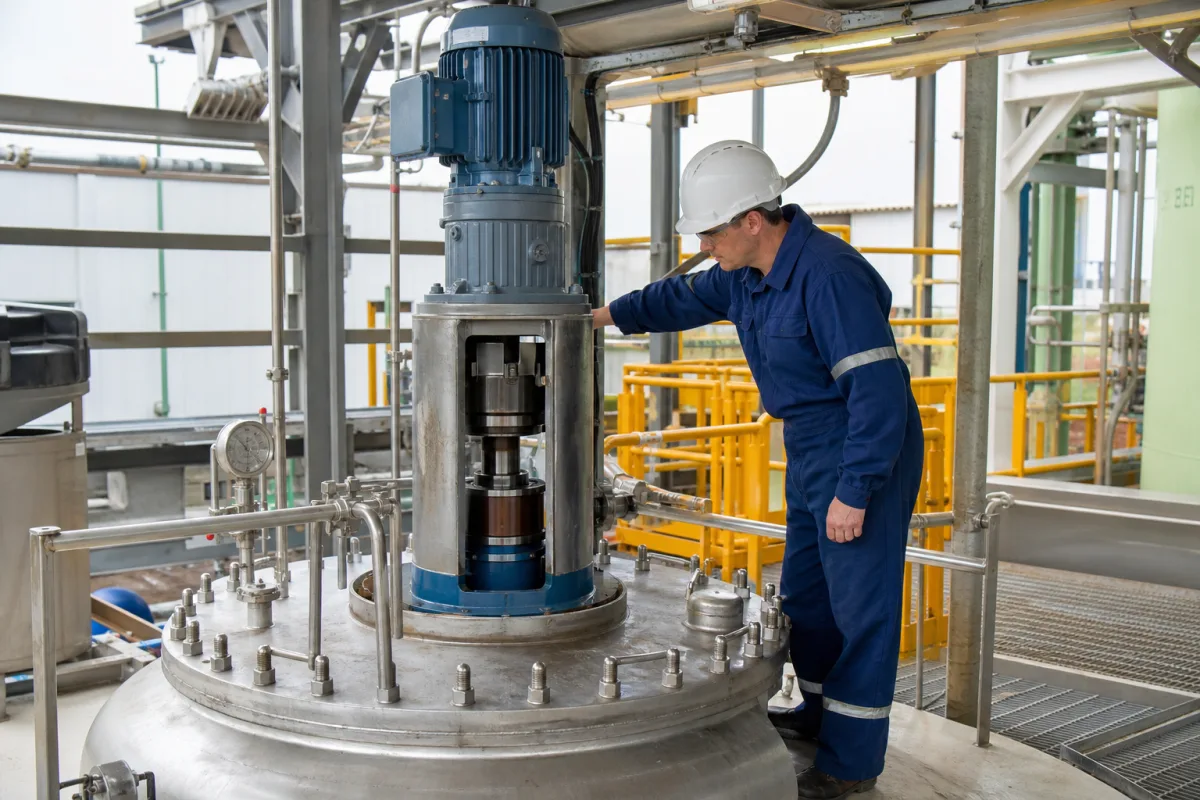
Agitator head assembly: the top-entry drive stack of gear unit, output bearings, drywell and shaft seal on a reactor nozzle
Everything that sits on the vessel nozzle above the impeller · gear unit with extended output bearing spacing, drywell oil protection, coupling and the cartridge seal that closes the shaft passage
Above the impeller, a top-entry agitator is a stack of parts that must work as one: the motor and gear unit set the speed and torque, the gear unit's output bearings (or a separate bearing lantern) take the bending and thrust that the impeller puts on a long overhung shaft, a drywell keeps gear oil from dripping into the batch, and a cartridge mechanical seal closes the shaft passage on the vessel nozzle. Buying the head means matching these four to the impeller loads and the vessel pressure, not choosing them one at a time.
Top-entry agitator drive heads for reactors and process vessels: the gear unit and motor, the output bearing arrangement (extended bearing spacing or a separate agitator bearing), drywell oil protection, the coupling to the agitator shaft and the cartridge shaft seal on the vessel flange. Impellers and agitator blades are covered on the Chemical reactor agitator blade (agitator impeller) page; packed stuffing boxes on the Chemical reactor sealing gland page; single and dual mechanical seals for pumps and mixers on the Mechanical seal page; hygienic food-tank agitators on the Top-entry hygienic agitator for food mixing tanks page; drum tumblers and rollers on the Automated chemical drum agitation and homogenization system page. Other motor-and-bearing drive stacks — machine-tool spindle units on the Spindle assembly page and belt-conveyor drives on the Conveyor drive unit page — do not carry an overhung shaft through a vessel seal and are outside this page.
CNFX editorial research · Sources checked October 12, 2026 · 3 sources
Output bearings that carry the impeller: standard versus extended bearing spacing in the gear unit
An overhung agitator shaft loads the gear unit's output with a radial force, an axial force and a bending moment. NORD's MAXXDRIVE brochure for mixing and agitating sets out what extending the output bearing spacing (options VL.. and KL..) changes: higher permissible radial loads FR and axial loads FA, lower bending torque MB, lower bearing load, less shaft deflection w and longer bearing life. [1]
SEW-EURODRIVE notes that, depending on how the agitating element is supported, the agitator gear unit must absorb the very high radial and axial forces some media and processes generate, and that its thermally optimised housing lets the agitator units run without external cooling even in high-performance agitating duty. [2]
Editorial note: when the gear unit's bearings carry the shaft directly, the shaft runs as a cantilever from the gear unit down through the seal. Ask the drive supplier for the permissible FR, FA and MB at the output flange and compare them with the agitator designer's calculated loads at the impeller's worst operating case, including start-up and running through the liquid surface during filling and draining.
Output arrangement
What the maker states
Standard bearing spacing
Base design; radial and axial capacity of the gear unit's own output bearings [1]
Send the drive supplier: impeller type, diameter and position on the shaft, shaft length below the flange, speed, absorbed power, and the radial and axial loads calculated by the agitator designer; ask for permissible FR, FA and MB with the bearing arrangement offered.
02
Keeping gear oil out of the batch: NORD's VL3, VL4 and VL6 drywell options
A vertical gear unit standing over an open product nozzle holds oil above the batch. NORD's options build on the VL2 extended-spacing design: [1]
NORD also offers SAFOMI, a sealless IEC/NEMA motor adapter with its own oil compensation volume, so that an oil tank and the drive shaft sealing ring at the motor input are not needed. [1] Its output shaft can be a hollow shaft with parallel key or shrink disc, or a solid shaft with parallel key, each also available in stainless steel. [1]
Editorial note: the drywell protects the product from the gear unit; the shaft seal in the next section protects the vessel atmosphere. They are separate parts with separate leak paths, and a head for a pharmaceutical or food-contact batch should specify both.
NORD option
Leak protection described
VL3 (DRYWELL)
As VL2 with an oil splasher disc; additional catchment spacer in the flange and visual leak indicator; sensor optional [1]
Cartridge seal on the vessel flange: shaft 40–220 mm, vacuum to 16 bar, sliding velocity up to 5 m/s
EagleBurgmann's M481K is a liquid-lubricated double mechanical seal built as a ready-to-fit cartridge for top-entry drives, supplied with or without its own bearing. It is listed against DIN 28138 (mechanical seals for agitator shafts), DIN 28136 part 2 (steel vessels), DIN 28141 (flange connection for steel vessels) and DIN 28154 (shaft end for steel vessels). [3]
EagleBurgmann notes that the extreme values cannot be applied at the same time, that the seal stays closed during pressure variations or reversal, and that options include a cooling or heating flange, leakage drain, flush, polymerisation barrier, and an axial expansion joint or wiper ring for shaft movement. [3]
Editorial calculation: sliding velocity v = π × D × n. Using the shaft diameter as a lower bound for the seal face diameter, 5 m/s corresponds to about 434 rpm on a 220 mm shaft and about 2,390 rpm on a 40 mm shaft; because the faces run on a larger diameter than the shaft, the real speed limit is lower than these figures. [3]
Editorial note: a seal "with bearing" adds a support close to the seal faces, which is one way to limit shaft movement at the seal when the gear unit bearings sit far above it; ask the head supplier which arrangement is offered and who is responsible for shaft movement at the seal.
Give the seal supplier the shaft diameter at the seal, speed, vessel design pressure including vacuum, temperature, product (and whether it polymerises), the flange standard on the nozzle, and whether a barrier-fluid system is acceptable.
04
Heads for classified areas: Zone 1/2 gear units and motors
Reactors handling solvents sit in hazardous areas, so the drive head needs certified parts. NORD supplies explosion-protected gear units to categories 2G/3G or 2D/3D for Zones 1/2 (gas) or 21/22 (dust) under DIN ISO 80079-36/-37, ignition protection type h, and motors to EN 60079-7 or EN 60079-31, type Ex eb or tc. [1]
Editorial note: the zone, gas group and temperature class come from the plant's area classification, not from the drive supplier; give them in the enquiry so the gear unit, motor, seal and any leak sensor are certified to the same zone.
Part of the head
Published range or rating
MAXXDRIVE gear unit sizes
11 sizes; torque up to 282 kNm; ratios 5.54 to 30,000:1 [1]
Helical, 2-stage / 3-stage
15–255 kNm, ratio 5.6–28 / 15–280 kNm, ratio 22.4–400 [1]
Helical bevel, 3-stage / 4-stage
15–255 kNm, ratio 12.5–112 / 15–260 kNm, ratio 80–450 [1]
Standard motors
0.12–200 kW; IP55, optional IP66; efficiency IE1 to IE5+ [1]
Paste it into your enquiry below or into an email to a maker, then replace every bracket.
Vessel: [nozzle size and flange standard; design pressure and vacuum; temperature]
Agitator: [shaft length and diameter; impeller type, diameter and positions; speed; absorbed power]
Loads: [radial and axial forces and bending moment at the drive flange]
Gear unit: [torque; ratio; bearing arrangement; drywell option; output shaft type]
Seal: [single or double; cartridge with or without bearing; barrier or buffer fluid]
Area: [hazardous zone; gas group; temperature class]
Product contact: [food or pharma requirements; oil-leak detection]
Explore company information and manufacturing capabilities, then discuss the scope of your project with a relevant supplier.
Share this page
Compiled and source-reviewed by the CNFX editorial team.
Each manufacturer above links to the page on that company's own website where the product is listed, with the date we checked it. How we source and review
· Page last updated 13 October 2026
Buyer questions
Why do agitator gear units have extended bearing spacing?
NORD states that extended spacing raises permissible radial and axial loads, lowers bending torque and bearing load, reduces shaft deflection and lengthens bearing life. [1]
What is a drywell on an agitator drive?
In NORD's range, VL3 adds an oil splasher disc, catchment spacer and leak indicator; VL4 adds a stand pipe with reduced oil level to keep gear oil out of the vessel. [1]
What pressure can a top-entry agitator seal take?
EagleBurgmann's M481K cartridge seal is rated from vacuum to 16 bar product-side, 18 bar barrier pressure, for 40–220 mm shafts and up to 5 m/s. [3]
What torque range do agitator gear units cover?
SEW-EURODRIVE lists X../HA agitator units with extended bearing distance for 23.4–96 kNm and its X..e series for 7.2–500 kNm. [2]
Sources and what still needs a direct check
Sources checked 2026-10-12. Bearing options, drywell variants, gear unit ranges and explosion protection come from NORD DRIVESYSTEMS' MAXXDRIVE brochure for mixing and agitating processes; agitator gear unit torque ranges from SEW-EURODRIVE's technical documentation; seal limits and standards from EagleBurgmann's M481K datasheet.