Industry-Verified Manufacturing Data (2026)

Mechanical Seal

Based on aggregated insights from multiple verified factory profiles within the CNFX directory, the standard Mechanical Seal used in the Machinery and Equipment Manufacturing sector typically supports operational capacities ranging from standard industrial configurations to heavy-duty production requirements.

Technical Definition & Core Assembly

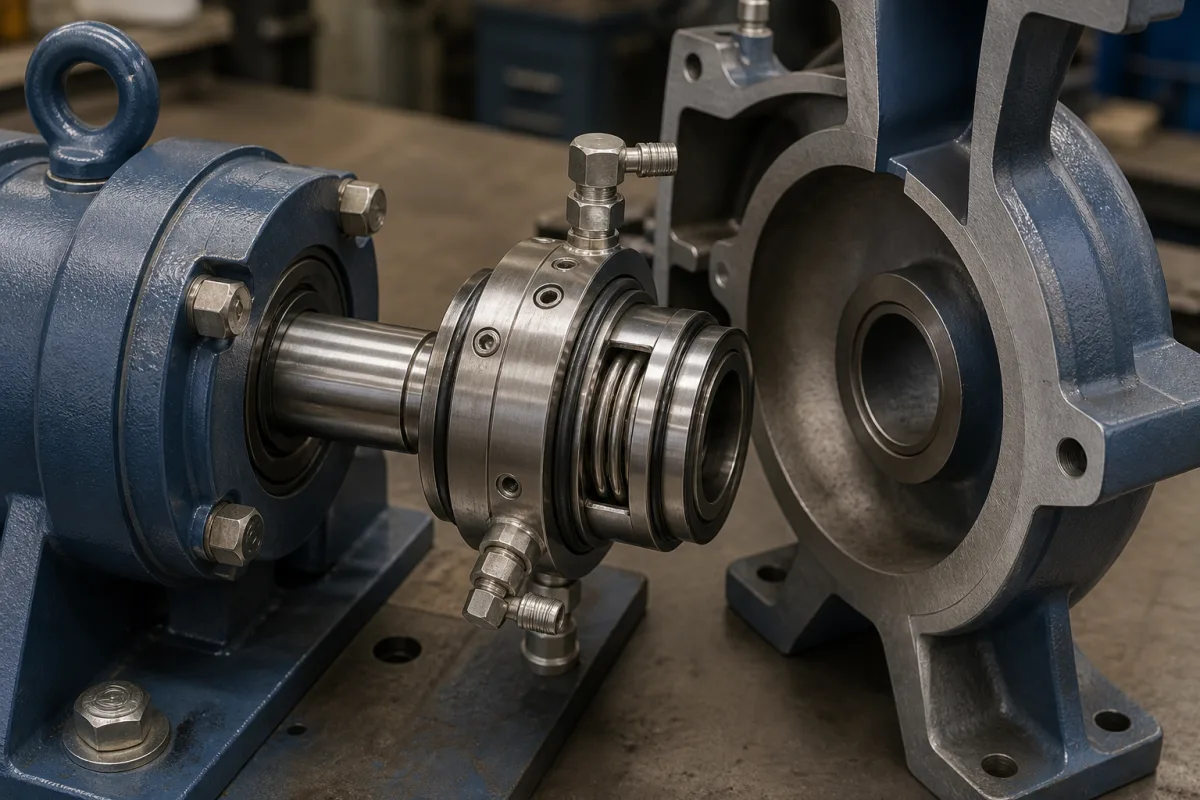
A canonical Mechanical Seal is characterized by the integration of Rotary Face and Stationary Face. In industrial production environments, manufacturers listed on CNFX commonly emphasize Carbon construction to support stable, high-cycle operation across diverse manufacturing scenarios.

A device that prevents fluid leakage between rotating and stationary parts in a pump.
Product Specifications

Technical details and manufacturing context for Mechanical Seal

Definition
A mechanical seal is a critical component in process pumps that creates a secure barrier between the rotating shaft and stationary pump housing, preventing the escape of pumped fluids while allowing shaft rotation with minimal friction.
Working Principle
Uses two precisely machined faces (one rotating with the shaft, one stationary) pressed together by spring force to create a tight seal that prevents fluid leakage while accommodating shaft rotation.
Common Materials
Carbon, Ceramic, Silicon Carbide, Tungsten Carbide, Stainless Steel
Technical Parameters
  • Shaft diameter that the seal is designed to fit (mm) Standard Spec
Components / BOM
  • Rotary Face
    Rotates with the shaft to create sealing surface
    Material: Carbon or Ceramic
  • Stationary Face
    Remains fixed to create sealing surface against rotary face
    Material: Ceramic or Tungsten Carbide
  • Spring
    Provides axial force to maintain contact between sealing faces
    Material: Stainless Steel
  • Secondary Seals
    Prevent leakage around the stationary components
    Material: Elastomer (Viton, EPDM, etc.)
Engineering Reasoning
0-200 bar differential pressure, -40°C to 400°C temperature, 0-50 m/s surface speed
Seal face contact pressure exceeds 100 MPa, temperature gradient > 150°C/mm across seal faces, PV value > 35 MPa·m/s
Design Rationale: Thermoelastic instability causing seal face coning, hydrodynamic film collapse at λ < 1.0 (film thickness ratio), carbon graphite blistering at >250°C interface temperature
Risk Mitigation (FMEA)
Trigger Hard particle ingress > 5 μm diameter between seal faces
Mode: Abrasive wear creating > 10 μm deep grooves on seal faces
Strategy: Install dual 10 μm absolute filtration in flush system with magnetic separator
Trigger Dry running condition lasting > 30 seconds
Mode: Seal face thermal cracking due to > 500°C flash temperature
Strategy: Integrate capacitive proximity sensor with 0.1 mm resolution for face contact detection

Industry Taxonomies & Aliases

Commonly used trade names and technical identifiers for Mechanical Seal.

Applied To / Applications

This component is essential for the following industrial systems and equipment:

Industrial Ecosystem & Supply Chain DNA

Complementary Systems
Downstream Applications
Specialized Tooling

Application Fit & Sizing Matrix

Operational Limits
pressure: Up to 100 bar (1500 psi)
flow rate: Dependent on pump design and seal arrangement
temperature: -40°C to 400°C
slurry concentration: Up to 40% solids by weight (varies by seal type and material)
Media Compatibility
✓ Water and aqueous solutions ✓ Hydrocarbons and oils ✓ Chemical process fluids (acids, bases)
Unsuitable: Abrasive slurries with high solids content (>40%) or large particle size (>100 microns)
Sizing Data Required
  • Shaft diameter (mm/inches)
  • Operating pressure (bar/psi)
  • Fluid temperature (°C/°F)

Reliability & Engineering Risk Analysis

Failure Mode & Root Cause
Thermal cracking
Cause: Excessive heat generation from dry running, misalignment, or insufficient cooling leads to thermal stress and fracture of seal faces.
Face wear and leakage
Cause: Abrasive particles in the fluid, improper material selection, or incorrect installation causing uneven contact and progressive material loss.
Maintenance Indicators
  • Visible fluid leakage around the seal area indicating face separation or damage
  • Abnormal noise (hissing or grinding) from the pump housing suggesting dry running or contact issues
Engineering Tips
  • Ensure proper alignment and shaft runout within manufacturer specifications to prevent uneven loading and heat generation
  • Implement clean flush systems and appropriate barrier fluids to exclude abrasives and maintain stable operating temperatures

Compliance & Manufacturing Standards

Reference Standards
ISO 21049:2004 (Pumps—Shaft sealing systems for centrifugal and rotary pumps) ANSI/API 682:2014 (Shaft Sealing Systems for Centrifugal and Rotary Pumps) DIN 24960:1992 (Mechanical seals; nominal dimensions, designations)
Manufacturing Precision
  • Shaft Bore: +/-0.02mm
  • Seal Face Flatness: 0.0006mm (0.6 microns)
Quality Inspection
  • Helium Leak Test (for high-pressure seals)
  • Surface Roughness Measurement (Ra value verification)

Factories Producing Mechanical Seal

Verified manufacturers with capability to produce this product in China

✓ 96% Supplier Capability Match Found

T Technical Director from Australia Jan 26, 2026
★★★★★
"Great transparency on the Mechanical Seal components. Essential for our Machinery and Equipment Manufacturing supply chain."
Technical Specifications Verified
P Project Engineer from Singapore Jan 23, 2026
★★★★☆
"The Mechanical Seal we sourced perfectly fits our Machinery and Equipment Manufacturing production line requirements. (Delivery took slightly longer than expected, but technical support was excellent.)"
Technical Specifications Verified
S Sourcing Manager from Germany Jan 20, 2026
★★★★★
"Found 54+ suppliers for Mechanical Seal on CNFX, but this spec remains the most cost-effective."
Technical Specifications Verified
Verification Protocol

“Feedback is collected from verified sourcing managers during RFQ (Request for Quote) and factory evaluation processes on CNFX. These reports represent historical performance data and technical audit summaries from our B2B manufacturing network.”

14 sourcing managers are analyzing this specification now. Last inquiry for Mechanical Seal from India (45m ago).

Supply Chain Compatible Machinery & Devices

Heavy-Duty CNC Plasma Cutting Machine

Industrial machine for precision metal cutting using plasma arc technology

Explore Specs →
Automated Assembly Line System

Integrated production system for sequential component assembly operations

Explore Specs →
Automated Powder Coating System

Integrated industrial system for applying dry powder coatings to metal substrates.

Explore Specs →
Centrifugal Pump Impeller

Rotating component that transfers energy to fluid in centrifugal pumps.

Explore Specs →

Frequently Asked Questions

What materials are commonly used in mechanical seals for industrial pumps?

Mechanical seals are typically constructed from durable materials including carbon, ceramic, silicon carbide, tungsten carbide, and stainless steel to withstand harsh operating conditions and prevent fluid leakage.

What are the main components of a mechanical seal assembly?

The basic bill of materials (BOM) for a mechanical seal includes the rotary face, stationary face, secondary seals (such as O-rings or gaskets), and a spring mechanism to maintain proper sealing pressure.

How does a mechanical seal prevent leakage in rotating equipment?

Mechanical seals create a tight barrier between rotating and stationary parts in pumps by using precisely machined faces that maintain contact under spring pressure, preventing fluid escape while allowing shaft rotation.

Can I contact factories directly on CNFX?

CNFX is an open directory, not a transaction platform. Each factory profile provides direct contact information and production details to help you initiate direct inquiries with Chinese suppliers.

Get Quote for Mechanical Seal

Request technical pricing, lead times, or customized specifications for Mechanical Seal directly from verified manufacturing units.

Your business information is encrypted and only shared with verified Mechanical Seal suppliers.

Thank you! Your message has been sent. We'll respond within 1–3 business days.

Need to Manufacture Mechanical Seal?

Connect with verified factories specializing in this product category

Add Your Factory Contact Us
Previous Product
Mechanical Housing & Interface
Next Product
Mechanical Seal Assembly