Editorial Technical Reference

Microcontroller/DSP

This page explains how Microcontroller/DSP is classified within Machinery and Equipment Manufacturing. Technical values and manufacturer relationships are research references; confirm the current specification and supplier evidence for each order.

Technical Definition & Core Assembly

A specialized integrated circuit that serves as the computational core of an Axis Control Module, executing control algorithms and processing sensor feedback.
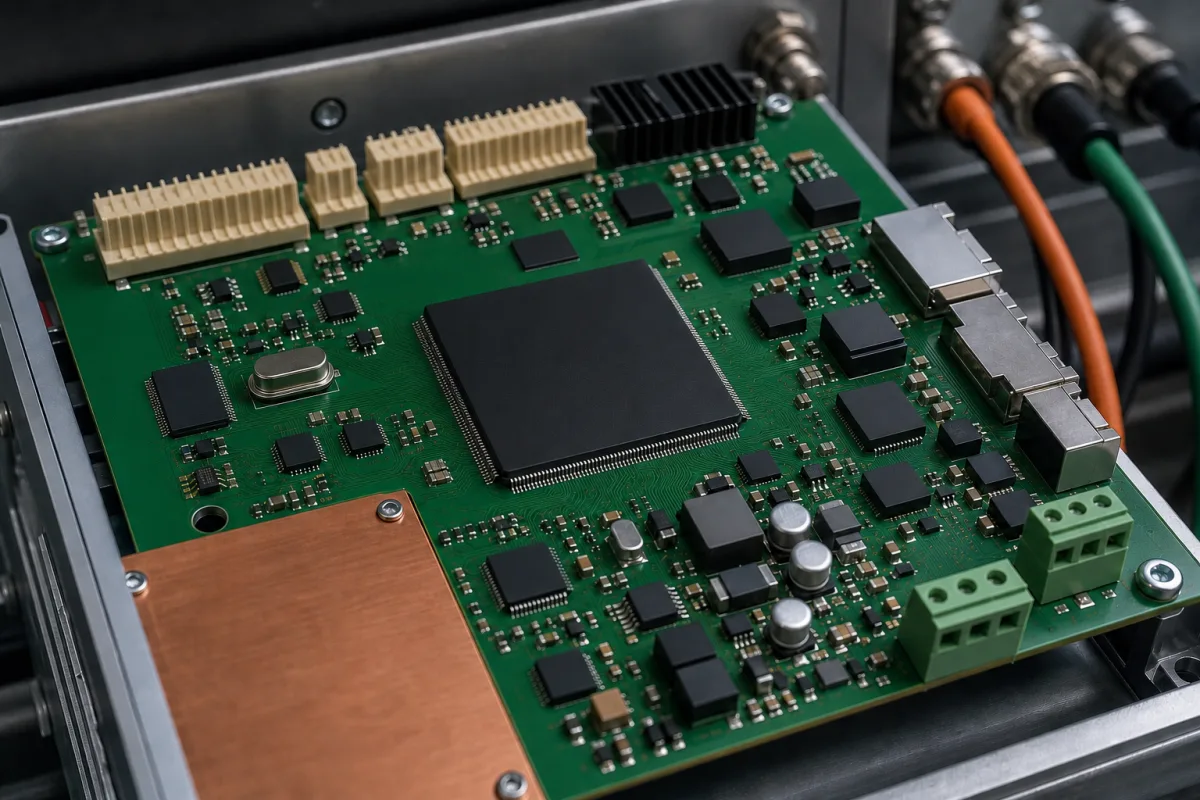
Representative product image. Confirm appearance and specifications with the manufacturer.

Product Specifications

Technical details and manufacturing context for Microcontroller/DSP

Definition
Within an Axis Control Module, the Microcontroller/DSP is the central processing unit responsible for real-time control of motor movements, position tracking, and trajectory planning. It interprets commands from higher-level controllers, processes feedback from encoders and sensors, and generates precise pulse-width modulation (PWM) signals to drive servo or stepper motors, ensuring accurate and synchronized multi-axis motion in industrial automation systems. The component is a semiconductor device typically packaged in a surface-mount package (e.g., QFP-64 to QFP-144) and operates over an industrial temperature range of -40°C to 85°C. It features a core clock speed of 100–600 MHz, flash memory of 256–2048 KB, RAM of 32–512 KB, and ADC/DAC resolutions of 12–16 bits. Operating voltage is 3.3–5 V, with 32–144 I/O pins. Power consumption ranges from 0.5–2.5 W, and weight is 1.5–5.0 g. The device is fabricated on a silicon wafer with copper interconnects and housed in ceramic or plastic packaging. It is designed for integration into industrial control systems, where it executes firmware implementing motion control algorithms such as PID control and trajectory interpolation. The microcontroller or DSP reads digital or analog inputs from position and speed sensors, performs calculations to determine error signals, and outputs control signals to motor drivers. For DSPs, specialized hardware accelerates mathematical operations for complex real-time signal processing. This component is a critical part of the Axis Control Module, enabling precise and synchronized motion in multi-axis automation. When selecting or verifying this component, it is essential to confirm model-specific values for clock speed, memory, resolution, and other parameters with the legal manufacturer or supplier, as the ranges provided are typical directory references. The listed standard (IEC 60068-2-1 for temperature testing and JEDEC MS-026 for packaging) serves as a procurement reference, not a certification guarantee. Always verify compliance and suitability for your specific application.
Working Principle
The microcontroller or DSP operates by executing firmware that implements motion control algorithms (e.g., PID control, trajectory interpolation). It reads digital or analog inputs from position/speed sensors, performs calculations to determine error signals, and outputs control signals to motor drivers. For DSPs, specialized hardware accelerates mathematical operations for complex real-time signal processing. The device continuously cycles through sensing, computing, and actuating to maintain precise motor control.
Common Materials
Silicon (semiconductor wafer), Copper (interconnects), Ceramic or plastic (packaging)
Technical Parameters
ParameterTypical rangeNotes & selection driver
Core Clock Speed100–600 MHzHigher speed enables more complex control algorithms.
Flash Memory256–2048 KBStores firmware and calibration data.
RAM32–512 KBSufficient RAM for real-time data buffering.
ADC Resolution12–16 bitHigher resolution improves sensor feedback precision.
DAC Resolution12–16 bitFor analog output to actuators.
Operating Voltage3.3–5 VTypical logic levels for industrial I/O.
I/O Count32–144 pinsNumber of digital I/O pins for interfacing.
Operating Temperature-40–85 °CIndustrial grade; extended range for harsh environments.IEC 60068-2-1
Power Consumption0.5–2.5 WAt maximum clock and all peripherals active.
Package TypeQFP-64–QFP-144Surface-mount for automated assembly.JEDEC MS-026
Weight1.5–5.0 gIncluding package and pins.

Ranges are indicative industry figures for RFQ preparation, not a supplier commitment. Confirm every value and standard with the legal manufacturer before ordering.

Components / BOM
  • Processor Core Part
    Executes control algorithms and mathematical computations
    Material: Silicon
  • Memory (Flash/RAM) Part
    Stores firmware programs and temporary data for real-time processing
    Material: Silicon with metal interconnects
  • I/O Peripherals
    Provides interfaces for communication with sensors, motor drivers, and host controllers
    Material: Silicon with copper interconnects
  • Clock Generator
    Generates timing signals for synchronous operation of all internal components
    Material: Quartz crystal or silicon oscillator

Applied To / Applications

This component is essential for the following industrial systems and equipment:

Industrial Ecosystem & Supply Chain Structure

Complementary Systems
Downstream Applications
Specialized Tooling

Application Fit & Sizing Matrix

Operational Limits
voltage: 1.8V to 3.6V operating range
clock speed: Up to 300 MHz
temperature: -40°C to +85°C
operating humidity: 0-95% non-condensing
Media Compatibility
✓ Industrial automation environments ✓ Motor control systems ✓ Precision instrumentation
Unsuitable: High-radiation environments (nuclear facilities, space applications without shielding)
Sizing Data Required
  • Required control loop frequency (Hz)
  • Number of simultaneous axes to control
  • Sensor interface types and quantity (ADC/DAC channels, communication protocols)

Reliability & Engineering Risk Analysis

Failure Mode & Root Cause
Thermal runaway
Cause: Excessive heat generation due to overclocking, poor heat dissipation, or high ambient temperatures leading to silicon degradation and eventual catastrophic failure.
Electrostatic discharge (ESD) damage
Cause: Accumulation and sudden discharge of static electricity through sensitive semiconductor components, causing immediate or latent failures in internal circuitry.
Maintenance Indicators
  • Intermittent system resets or lockups during operation
  • Abnormal heat emission from the device casing or localized hot spots
Engineering Tips
  • Implement active cooling solutions with thermal monitoring and automatic throttling to maintain junction temperatures within manufacturer specifications.
  • Establish and enforce ESD-safe handling procedures, including proper grounding, anti-static workstations, and protective packaging during installation and maintenance.

Indicative industry ranges for design and RFQ preparation. Confirm the exact figures and applicable standard with the manufacturer before specifying.

Compliance & Manufacturing Standards

Applicable Standards
IEC 60747-8:2010 - Semiconductor devices - Discrete devices - Part 8: Field-effect transistors EN 55032:2015 - Electromagnetic compatibility of multimedia equipment - Emission requirements

Quoted from the published standard.

Manufacturing Precision
  • Package dimensions: +/- 0.1mm
  • Pin coplanarity: 0.1mm maximum deviation
Quality Inspection
  • Automated Optical Inspection (AOI) for solder joints and component placement
  • Environmental Stress Screening (ESS) including temperature cycling and vibration testing

Manufacturers of Microcontroller/DSP

Manufacturer profiles associated with Microcontroller/DSP.

Sourcing Microcontroller/DSP from China?
Tell us your specification and target quantity — we will match it against manufacturer records and come back with the factories that fit.
Request manufacturers We manufacture this

Manufacturer listings support early research and capability understanding. They are not certification, ranking, or transaction guarantees.

Technical documentation
Request current drawings, revision history, and a signed specification sheet.
Manufacturing capability
Verify equipment lists, process limits, capacity, and representative production evidence.
Inspection readiness
Confirm test methods, calibrated equipment, sampling plans, and traceable reports.
Supplier transparency
Check the legal entity, factory address, ownership, certifications, and direct contacts.

CNFX does not score or rank suppliers. Buyers must verify all claims and documents with the legal manufacturer before ordering.

Supply Chain Compatible Machinery & Devices

Automated Powder Coating System

Integrated industrial system for applying dry powder coatings to metal substrates.

Explore Specs →
Centrifugal Pump Impeller

The centrifugal pump impeller is a critical rotating component that converts mechanical energy from the motor into kinetic energy in fluid systems.

Explore Specs →
High-Precision CNC Laser Cutting Machine

Computer-controlled industrial machine using focused laser beams to cut sheet metal with micron-level accuracy.

Explore Specs →
Industrial-Grade Hydraulic Cylinder Piston Rod

This industrial-grade piston rod is a precision-ground cylindrical component designed for use in hydraulic cylinders.

Explore Specs →

Frequently Asked Questions

What is the role of the Microcontroller/DSP in an Axis Control Module?

It serves as the central processing unit, executing control algorithms, processing sensor feedback, and generating PWM signals to drive motors for precise motion control.

What are the typical specifications for this component?

Typical ranges include core clock speed 100–600 MHz, flash memory 256–2048 KB, RAM 32–512 KB, ADC/DAC resolution 12–16 bits, operating voltage 3.3–5 V, I/O count 32–144 pins, operating temperature -40°C to 85°C, power consumption 0.5–2.5 W, and package types QFP-64 to QFP-144. These are directory references; verify with the manufacturer.

How does the Microcontroller/DSP work?

It runs firmware that implements motion control algorithms. It reads sensor inputs, computes error signals, and outputs control signals to motor drivers. DSPs use specialized hardware for fast math operations.

What standards are associated with this component?

The operating temperature range references IEC 60068-2-1, and the package type references JEDEC MS-026. These are verification references, not proof of certification. Always confirm compliance with the supplier.

Data Basis

Editorial classification, named public sources where available, and source-reviewed manufacturer records.

Preliminary Technical Classification
This page supports structured research, RFQ preparation, and supplier evaluation. It does not replace buyer-led supplier qualification, standards review, or technical approval.
Buyer enquiry

Request manufacturing insight for Microcontroller/DSP

Ask for use case, specification boundaries, supplier type, and RFQ preparation information for this product.

Where it goes
Straight to the CNFX editorial desk, and to the manufacturer if this product is linked to a claimed profile. Nothing is broadcast to a supplier list.
Your details stay here
We do not sell or rent enquiry data, and we do not add you to a mailing list. Used only to answer this request.
No commission, no middleman
CNFX is a directory. We take no cut of any order and never negotiate on a supplier's behalf.
What we don't claim
A listing is not an endorsement. Qualify every supplier and verify every figure yourself before ordering.

Your business information is used only to process this request.

Thank you! Your message has been sent. We'll respond within 1–3 business days.
Sorry, we couldn't send your message. Please try again, or email us at contact@cnfx.com.

Need to Manufacture Microcontroller/DSP?

Compare manufacturer profiles with relevant product and process capability.

Previous Product
Z-axis Ram/Spindle
Last Product
Get QuotesChat