Editorial Technical Reference

Moving Coil Assembly

This page explains how Moving Coil Assembly is classified within Machinery and Equipment Manufacturing. Technical values and manufacturer relationships are research references; confirm the current specification and supplier evidence for each order.

Technical Definition & Core Assembly

Core electromagnetic actuator component that generates controlled vibration forces in electromagnetic vibration testing systems.
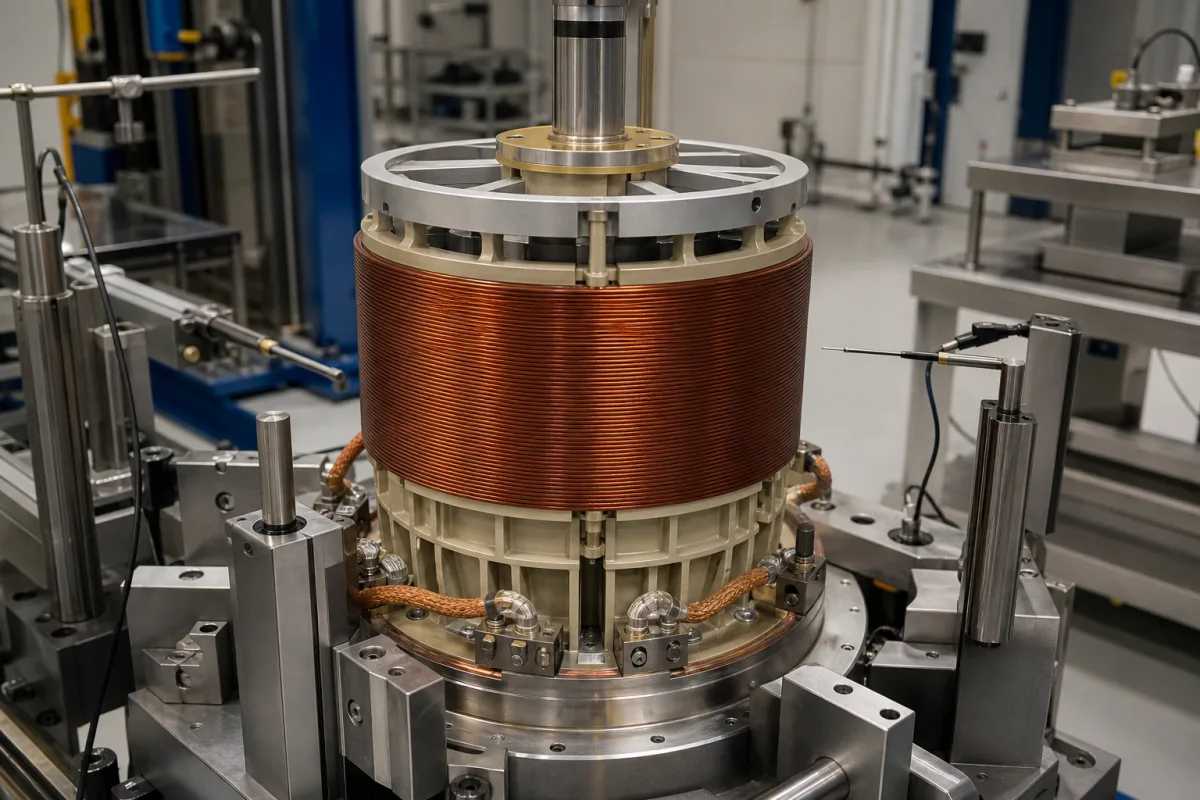
Moving Coil Assembly in a manufacturing environment
Representative product image. Confirm appearance and specifications with the manufacturer.

Product Specifications

Technical details and manufacturing context for Moving Coil Assembly

Definition
The moving coil assembly is the central electromechanical component within an industrial electromagnetic vibration testing system. It converts electrical signals into precise mechanical vibrations. The assembly consists of a coil wound on a former that moves within a magnetic field generated by permanent magnets or electromagnets. When an alternating current passes through the coil, it interacts with the static magnetic field, generating Lorentz forces that cause the coil and attached test fixture to oscillate. The amplitude and frequency of vibration are precisely controlled by the input electrical signal, allowing simulation of various vibration profiles for product testing and reliability assessment.

Typical specifications for such assemblies include a rated force of 50–500 N at rated current, a stroke length of 10–50 mm, and a frequency range of 5–3000 Hz. Coil resistance is typically 2–8 Ω at 20°C, and rated current is 5–20 A. Maximum input power is 100–1000 W. Operating temperature ranges from -20°C to 70°C. Insulation class is F–H per IEC 60085. Coil material is oxygen-free copper (Cu-ETP) per EN 13601. Magnet material is NdFeB-N42. Weight depends on force rating, typically 2–15 kg. Protection rating is IP54–IP65 per IEC 60529.

Materials commonly used include copper wire, aluminum former, epoxy resin, and high-strength steel components. These assemblies are used in vibration testing systems for simulating real-world conditions. When selecting or verifying a moving coil assembly, confirm model-specific values for force, stroke, frequency range, resistance, current, power, temperature limits, insulation class, materials, weight, and protection rating with the legal manufacturer or supplier. Standards listed are procurement references and do not imply certification or compliance of any specific product.
Working Principle
When alternating current passes through the coil, it interacts with the static magnetic field, generating Lorentz forces that cause the coil and attached test fixture to oscillate. The amplitude and frequency of vibration are precisely controlled by the input electrical signal, allowing simulation of various vibration profiles for testing purposes.
Common Materials
Copper wire, Aluminum former, Epoxy resin, High-strength steel components
Technical Parameters
ParameterTypical rangeNotes & selection driver
Rated Force50–500 NPeak force at rated current
Stroke Length10–50 mmMaximum linear displacement
Frequency Range5–3000 HzUsable bandwidth for vibration testing
Coil Resistance2–8 ΩAt 20°C; affects power amplifier matching
Rated Current5–20 AContinuous current for rated force
Max Input Power100–1000 WContinuous power rating
Operating Temperature-20–70 °CAmbient temperature range
Insulation ClassF–HThermal endurance of coil insulationIEC 60085
Coil MaterialCu-ETPOxygen-free copper for conductivityEN 13601
Magnet MaterialNdFeB-N42High energy product for compact design
Weight2–15 kgDepends on force rating
Protection RatingIP54–IP65Dust and water resistanceIEC 60529

Ranges are indicative industry figures for RFQ preparation, not a supplier commitment. Confirm every value and standard with the legal manufacturer before ordering.

Components / BOM
  • Coil Winding Part
    Conducts electrical current to generate electromagnetic forces
    Material: Copper wire with insulation
  • Coil Former Part
    Provides structural support for the coil winding
    Material: Aluminum or composite material
  • Suspension System
    Allows controlled linear motion while maintaining alignment
    Material: Spring steel or flexure bearings
  • Connector Terminals Part
    Electrical interface for power and signal connections
    Material: Brass or copper alloy

Application & selection

Application Fit & Sizing Matrix

Operational Limits
pressure: Atmospheric to 2 bar
other spec: Max Force: 5000 N, Frequency Range: 5-3000 Hz, Stroke: ±25 mm
temperature: -20°C to +70°C
Media Compatibility
✓ Clean Dry Air ✓ Inert Gas (Nitrogen/Argon) ✓ Vacuum Environment
Unsuitable: Corrosive or Conductive Fluids (e.g., saltwater, acids)
Sizing Data Required
  • Required Force Output (N)
  • Operating Frequency Range (Hz)
  • Stroke Length Requirement (mm)

Risk, maintenance & compliance

Reliability & Engineering Risk Analysis

Failure Mode & Root Cause
Coil winding insulation breakdown
Cause: Thermal degradation from excessive current or poor cooling, leading to short circuits or open circuits
Mechanical binding or sticking
Cause: Contamination ingress (dust, debris) or misalignment causing increased friction and restricted movement
Maintenance Indicators
  • Audible humming, buzzing, or scraping noises during operation
  • Visible overheating (discoloration, smoke) or erratic movement/positioning
Engineering Tips
  • Implement regular cleaning and inspection schedules to prevent contamination buildup and ensure proper alignment
  • Monitor operating temperatures and electrical parameters (current, voltage) to detect early signs of insulation stress or overheating

Indicative industry ranges for design and RFQ preparation. Confirm the exact figures and applicable standard with the manufacturer before specifying.

Compliance & Manufacturing Standards

Applicable Standards
IEC 60034-1 - Rotating Electrical Machines ASTM E1251 - Standard Test Method for Analysis of Aluminum and Aluminum Alloys by Spark Atomic Emission Spectrometry

Quoted from the published standard.

Manufacturing Precision
  • Coil Winding Pitch: +/-0.05mm
  • Magnetic Gap Alignment: +/-0.1mm
Quality Inspection
  • Electrical Resistance and Continuity Test
  • Vibration and Resonance Frequency Analysis
Technical documentation
Request current drawings, revision history, and a signed specification sheet.
Manufacturing capability
Verify equipment lists, process limits, capacity, and representative production evidence.
Inspection readiness
Confirm test methods, calibrated equipment, sampling plans, and traceable reports.
Supplier transparency
Check the legal entity, factory address, ownership, certifications, and direct contacts.

Compare the published product scope and source details, then include your specifications and quantity in an enquiry.

Manufacturers of Moving Coil Assembly

Manufacturer profiles associated with Moving Coil Assembly.

Sourcing Moving Coil Assembly from China?
Tell us your specification and target quantity — we will match it against manufacturer records and come back with the factories that fit.
Request manufacturers We manufacture this

Explore company information and manufacturing capabilities, then discuss the scope of your project with a relevant supplier.

Buyer enquiry

Request manufacturing insight for Moving Coil Assembly

Ask for use case, specification boundaries, supplier type, and RFQ preparation information for this product.

Where it goes
Straight to the CNFX editorial desk, and to the manufacturer if this product is linked to a claimed profile. Nothing is broadcast to a supplier list.
Your details stay here
We do not sell or rent enquiry data, and we do not add you to a mailing list. Used only to answer this request.
No commission, no middleman
CNFX is a directory. We take no cut of any order and never negotiate on a supplier's behalf.
What to include
Share your product specifications, quantity, destination and target delivery date.

Your business information is used only to process this request.

Thank you! Your message has been sent. We'll respond within 1–3 business days.
Sorry, we couldn't send your message. Please try again, or email us at [email protected].

Frequently Asked Questions

What is the typical rated force range for a moving coil assembly?

According to directory reference data, the rated force at rated current is typically in the range of 50–500 N. However, the exact value depends on the specific model and application. Always confirm the rated force with the legal manufacturer or supplier for your intended use.

What frequency range can a moving coil assembly operate over?

The usable bandwidth for vibration testing is typically 5–3000 Hz. This range allows simulation of various vibration profiles. Verify the frequency range for the specific assembly model, as it may vary based on design and application.

What materials are commonly used in a moving coil assembly?

Common materials include copper wire for the coil, aluminum former, epoxy resin for insulation and bonding, and high-strength steel components for structural parts. The coil material is often oxygen-free copper (Cu-ETP) per EN 13601, and the magnet material is typically NdFeB-N42. Confirm material specifications with the manufacturer.

What protection rating does a moving coil assembly typically have?

The protection rating is typically IP54–IP65 per IEC 60529, indicating dust and water resistance. The actual rating depends on the enclosure and design. Check the specific product datasheet or consult the supplier to confirm the protection rating for your environment.

Related equipment

Data Basis

Editorial classification, named public sources where available, and source-reviewed manufacturer records.

Preliminary Technical Classification
This page supports structured research, RFQ preparation, and supplier evaluation. It does not replace buyer-led supplier qualification, standards review, or technical approval.

Need to Manufacture Moving Coil Assembly?

Compare manufacturer profiles with relevant product and process capability.

Previous Product
Z-axis Ram/Spindle
Last Product
Get QuotesChat