Industry-Verified Manufacturing Data (2026)

Mud Drum

Based on aggregated insights from multiple verified factory profiles within the CNFX directory, the standard Mud Drum used in the Machinery and Equipment Manufacturing sector typically supports operational capacities ranging from standard industrial configurations to heavy-duty production requirements.

Technical Definition & Core Assembly

A canonical Mud Drum is characterized by the integration of Shell and Heads. In industrial production environments, manufacturers listed on CNFX commonly emphasize Carbon Steel construction to support stable, high-cycle operation across diverse manufacturing scenarios.

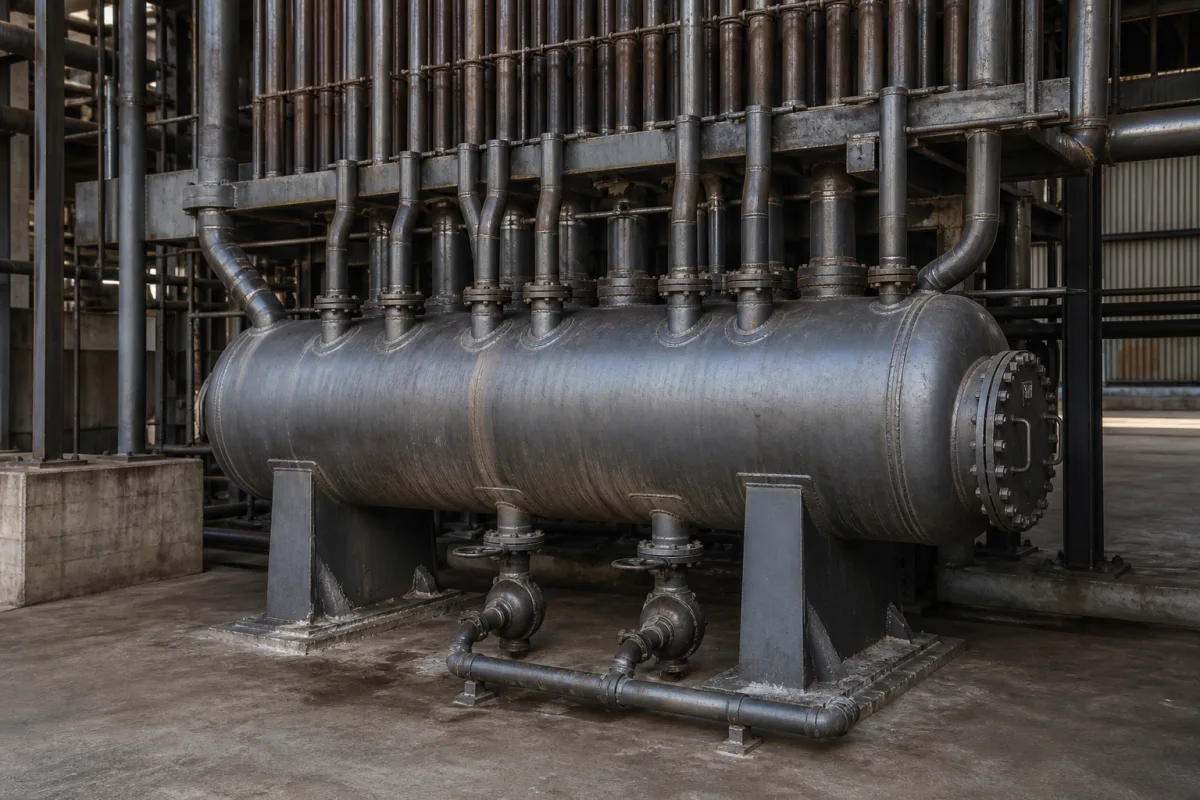
A pressure vessel in waste heat boilers that collects and removes solid impurities (mud) from boiler water.
Product Specifications

Technical details and manufacturing context for Mud Drum

Definition
The mud drum is a critical component of waste heat boiler systems, typically located at the lowest point of the boiler. It serves as a collection chamber for solid impurities, scale, and sediment (collectively called 'mud') that settle out of the boiler water during operation. This component ensures water quality by allowing periodic blowdown to remove accumulated solids, preventing scaling and corrosion in heat transfer surfaces.
Working Principle
As boiler water circulates through the waste heat recovery system, gravity causes heavier solid particles to settle downward. The mud drum's strategic low-point location collects these solids. During operation, operators periodically open blowdown valves to discharge the accumulated mud, maintaining water chemistry and preventing damage to boiler tubes and other components.
Common Materials
Carbon Steel, Low Alloy Steel
Technical Parameters
  • Diameter and length dimensions based on boiler capacity and water treatment requirements (mm) Customizable
Components / BOM
  • Shell
    Main pressure-containing cylindrical body
    Material: Carbon Steel
  • Heads
    End closures for the cylindrical shell
    Material: Carbon Steel
  • Blowdown Nozzle
    Connection point for removing accumulated solids
    Material: Carbon Steel
  • Inspection Opening
    Access for internal inspection and maintenance
    Material: Carbon Steel
  • Support Brackets
    Structural supports for mounting the drum
    Material: Carbon Steel
Engineering Reasoning
0.5-3.0 MPa (5-30 bar) at 150-250°C
Yield strength of SA-516 Grade 70 carbon steel (260 MPa) at design temperature, or corrosion allowance reduction below 1.5 mm
Design Rationale: Stress corrosion cracking from chloride ion concentration exceeding 25 ppm in boiler water at temperatures above 60°C, combined with cyclic thermal stresses from 50-200°C temperature differentials during blowdown cycles
Risk Mitigation (FMEA)
Trigger Inadequate blowdown frequency causing mud accumulation exceeding 15% of drum volume
Mode: Localized overheating and thermal stress cracking in tube-to-drum welds
Strategy: Install automatic blowdown control system with conductivity sensors maintaining total dissolved solids below 3500 ppm
Trigger Oxygen pitting corrosion from dissolved oxygen concentration above 7 ppb
Mode: Progressive wall thinning leading to pressure boundary failure at stress concentrations
Strategy: Integrate deaerator system maintaining oxygen levels below 5 ppb with sodium sulfite injection at 20-40 ppm residual

Industry Taxonomies & Aliases

Commonly used trade names and technical identifiers for Mud Drum.

Applied To / Applications

This component is essential for the following industrial systems and equipment:

Industrial Ecosystem & Supply Chain DNA

Complementary Systems
Downstream Applications
Specialized Tooling

Application Fit & Sizing Matrix

Operational Limits
pressure: Up to 150 bar (design pressure for industrial waste heat boilers)
flow rate: 10-500 m³/h (based on boiler capacity)
temperature: 150-350°C (typical boiler water operating range)
slurry concentration: Up to 15% solids by weight (typical mud removal limit)
Media Compatibility
✓ Boiler feedwater with suspended solids ✓ Industrial process water with mineral impurities ✓ Steam condensate with particulate contamination
Unsuitable: Highly corrosive chemical solutions (e.g., strong acids, chlorides)
Sizing Data Required
  • Boiler water flow rate (m³/h)
  • Expected solids loading (kg/h)
  • Required blowdown frequency (times/day)

Reliability & Engineering Risk Analysis

Failure Mode & Root Cause
Corrosion-induced thinning
Cause: Exposure to oxygenated water and dissolved solids in boiler feedwater, leading to pitting and general metal loss, especially in areas of stagnant flow or under deposits.
Thermal fatigue cracking
Cause: Repeated thermal cycling (startup/shutdown) and uneven heating/cooling, causing stress concentrations at welded joints, nozzles, or support attachments.
Maintenance Indicators
  • Visible external bulging, distortion, or blistering of the drum shell, indicating potential overheating or internal pressure issues.
  • Audible water hammer or irregular knocking sounds during operation, suggesting improper water level control or steam/water mixing problems.
Engineering Tips
  • Implement strict water chemistry control (e.g., maintaining proper pH, oxygen scavenging, and blowdown schedules) to minimize corrosion and scale formation.
  • Follow controlled startup and shutdown procedures to reduce thermal stress, and conduct regular internal inspections (e.g., during outages) to check for cracks, corrosion, or deposit buildup.

Compliance & Manufacturing Standards

Reference Standards
ISO 9001:2015 - Quality Management Systems ASME Boiler and Pressure Vessel Code Section VIII EN 13445 - Unfired Pressure Vessels
Manufacturing Precision
  • Wall Thickness: +/- 5% of nominal thickness
  • Circumferential Weld Alignment: +/- 1.5mm
Quality Inspection
  • Radiographic Testing (RT) of Welds
  • Hydrostatic Pressure Test

Factories Producing Mud Drum

Verified manufacturers with capability to produce this product in China

✓ 93% Supplier Capability Match Found

T Technical Director from Germany Jan 06, 2026
★★★★★
"As a professional in the Machinery and Equipment Manufacturing sector, I confirm this Mud Drum meets all ISO standards."
Technical Specifications Verified
P Project Engineer from Brazil Jan 03, 2026
★★★★☆
"Standard OEM quality for Machinery and Equipment Manufacturing applications. The Mud Drum arrived with full certification. (Delivery took slightly longer than expected, but technical support was excellent.)"
Technical Specifications Verified
S Sourcing Manager from Canada Dec 31, 2025
★★★★★
"Great transparency on the Mud Drum components. Essential for our Machinery and Equipment Manufacturing supply chain."
Technical Specifications Verified
Verification Protocol

“Feedback is collected from verified sourcing managers during RFQ (Request for Quote) and factory evaluation processes on CNFX. These reports represent historical performance data and technical audit summaries from our B2B manufacturing network.”

5 sourcing managers are analyzing this specification now. Last inquiry for Mud Drum from India (32m ago).

Supply Chain Compatible Machinery & Devices

Hydraulic Press

Industrial machine using hydraulic pressure to compress, form, or assemble materials

Explore Specs →
Heavy-Duty CNC Plasma Cutting Machine

Industrial machine for precision metal cutting using plasma arc technology

Explore Specs →
Automated Assembly Line System

Integrated production system for sequential component assembly operations

Explore Specs →
Automated Powder Coating System

Integrated industrial system for applying dry powder coatings to metal substrates.

Explore Specs →

Frequently Asked Questions

What is the primary function of a mud drum in waste heat boilers?

The mud drum serves as a pressure vessel that collects and removes solid impurities (mud) from boiler water, preventing scale buildup and maintaining boiler efficiency in waste heat recovery systems.

What materials are commonly used for mud drum construction?

Mud drums are typically constructed from carbon steel or low alloy steel, chosen for their durability, pressure resistance, and corrosion tolerance in high-temperature industrial environments.

What are the key components of a standard mud drum assembly?

A standard mud drum includes the shell, heads, blowdown nozzle for sediment removal, inspection opening for maintenance access, and support brackets for secure installation in machinery systems.

Can I contact factories directly on CNFX?

CNFX is an open directory, not a transaction platform. Each factory profile provides direct contact information and production details to help you initiate direct inquiries with Chinese suppliers.

Get Quote for Mud Drum

Request technical pricing, lead times, or customized specifications for Mud Drum directly from verified manufacturing units.

Your business information is encrypted and only shared with verified Mud Drum suppliers.

Thank you! Your message has been sent. We'll respond within 1–3 business days.

Need to Manufacture Mud Drum?

Connect with verified factories specializing in this product category

Add Your Factory Contact Us
Previous Product
Mud Circulation System
Next Product
Mud Mixing and Pumping System