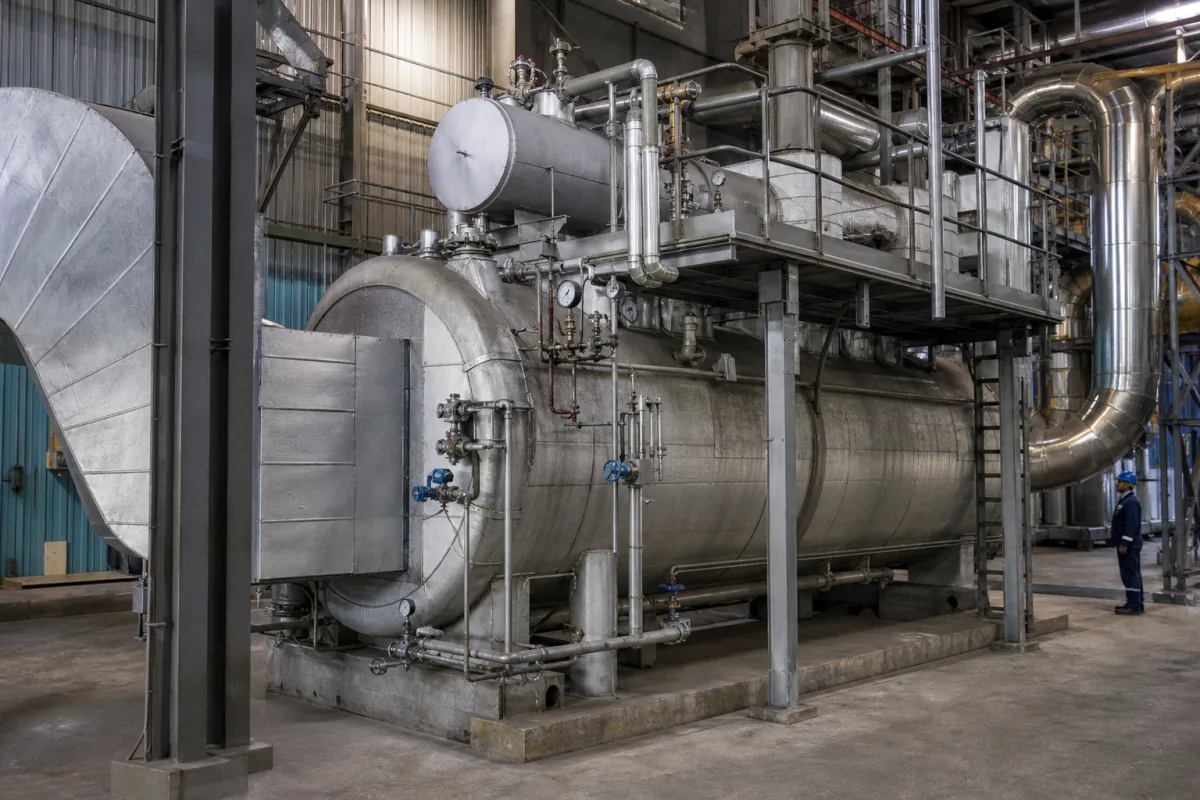
Heat recovery steam generation · gas flow and temperature, minimum outlet temperature against dew-point corrosion, heat recovered and steam produced
A waste heat boiler raises steam or hot water from the exhaust gas of a furnace, kiln, incinerator, engine or chemical process instead of from its own burner, sometimes with an auxiliary burner when the waste heat is not enough. Ask three things first: what gas flow, temperature, composition and dust load it must take, how low the gas can safely be cooled before condensation corrodes the surfaces, and what steam pressure, temperature and quantity that leaves you.
Boilers and steam generators that recover heat from process or exhaust gases, including fire-tube and water-tube designs, with economisers and superheaters supplied as part of the unit. Fired boilers without heat recovery, thermal oil heaters and stand-alone gas-to-gas heat exchangers are outside this page.
CNFX editorial research · Sources checked October 12, 2026 · 4 sources
Characterise the gas and its lowest safe outlet temperature
The US Department of Energy's waste heat recovery report (2008) states that the heat in a waste stream depends on its mass flow rate and specific enthalpy, and classes waste heat by temperature: high at 649 °C (1,200 °F) and above, medium from 232 to 650 °C, and low at 232 °C (450 °F) and below. Because heat transfer follows Q = UAΔT, a small temperature difference between gas and water needs a larger heat exchanger. [1]
The same report explains that flue gases cooled below their dew point condense and deposit corrosive substances, so exchangers are designed to keep gas above the condensation point: gas from natural gas might be cooled to about 120 °C (250 °F), while gas from coal or high-sulphur fuel oil may be limited to about 150–175 °C (300–350 °F), and sulphates in glass-furnace exhaust deposit below about 270 °C. It calls 300 °F (150 °C) "a common design point used to avoid condensation with many waste gas streams" and notes that fouling remains an unresolved problem. [1]
DOE's steam tip sheet on economisers gives the same fuel-based limits for boiler flue gas: 250 °F (about 120 °C) for natural gas, 300 °F (about 150 °C) for coal and low-sulphur fuel oils, and 350 °F (about 175 °C) for high-sulphur fuel oils, set to prevent condensation and possible stack corrosion. [2]
Give the supplier the gas source, flow (mass or normal volume), inlet temperature range, composition including H₂O, SO₂/SO₃ and HCl, dust load and stickiness, allowable gas-side pressure drop, required outlet temperature, steam pressure and temperature or hot-water conditions, feedwater temperature and quality, auxiliary firing, space, and design code.
02
Estimate the heat recovered and the steam it makes
DOE describes waste heat boilers as water-tube boilers that use medium- to high-temperature exhaust gases to generate steam, available for gas intakes from 1,000 to 1 million ft³/min; auxiliary burners or an afterburner can be added where waste heat is insufficient, and superheated steam needs an external superheater. [1]
In DOE's economiser example, 45,000 lb/h of 150 psig saturated steam (enthalpy 1,195.5 Btu/lb) made from 117 °F feedwater (84.97 Btu/lb) is a boiler output of 50 million Btu/h, and DOE states that "generally, boiler efficiency can be increased by 1% for every 40°F reduction in flue gas temperature". [2]
Thermax (TBWES) lists waste heat recovery boilers for incinerators that cool flue gas from burning waste gases, liquids and solids and raise steam for power or process, at capacities up to 15 TPH and pressures up to 25 kg/cm² (g), to ASME, IBR, TR CU or PED. Its options include water-tube or fire-tube construction, bare or extended heat-transfer surface, natural circulation, single- or multi-pass gas paths, membrane-wall or refractory-lined construction and an application-specific cleaning mechanism. [3]
Editorial calculation: 25 kg/cm² (g) is about 24.5 bar(g) or 2.45 MPa(g) (25 × 0.981). [3]
Editorial calculation: 20,000 kg/h of exhaust gas cooled from 500 °C to 180 °C, with an assumed mean specific heat of 1.1 kJ/kg·K, gives up 20,000 / 3,600 × 1.1 × 320 ≈ 1,956 kW. Using DOE's enthalpy rise of 1,195.5 − 84.97 = 1,110.5 Btu/lb (≈ 2,583 kJ/kg) for 150 psig saturated steam from 117 °F feedwater, that heat would make about 1,956 / 2,583 ≈ 0.76 kg/s, or about 2.7 t/h of steam, before heat losses and blowdown. Gas flow, temperatures and specific heat are assumptions; use measured values and your own steam conditions. [2]
03
Chinese boiler makers listing waste heat units beside fired boilers
Six companies are shown below; Zhengzhou Boiler is the only one whose card gives a range, 10–75 t/h up to 2.5 MPa, and the others list waste heat boilers next to coal, biomass, CFB or oil-gas boilers.
Listings include waste heat boilers alongside fired, biomass and fluidised-bed boilers, with published capacity and pressure ranges from some makers, and waste heat and incineration boilers with pressure parts. Ask each for heat-balance calculations on your gas, not catalogue ratings.
04
Match the boiler type to gas flow, gas pressure and solids load
Rentech Boiler Systems lists watertube and firetube waste heat boilers for flue gas capacities from 50,000 to 1,000,000+ lb/h (22,000 to 450,000+ kg/h), steam capacities from 10,000 to 400,000+ lb/h (4,500 to 182,000+ kg/h), saturated or superheated steam, and pressures from 200 to 1,500 psi (14 to 105+ bar). It names high flue gas pressure, high solids content and corrosive gases as design conditions, and says its refractory linings can comply with API 936. [4]
For dusty gas it offers an open bottom for removing ash and solids, or ash hoppers attached under the boiler that connect to a solids-removal system supplied by the customer. Its single-drum firetube boilers suit flue gas at relatively high pressure, in one-, two- or three-pass vertical or horizontal arrangements; elevated-steam-drum firetube boilers with natural circulation serve higher steam output and pressure; and process gas firetube boilers can have an internal bypass to hold the required gas exit temperature. [4]
Editorial calculation: Rentech's upper figure of 105+ bar is about four times the 25 kg/cm² (g), about 24.5 bar(g), listed for Thermax's incinerator units (105 ÷ 24.5 ≈ 4.3). [4][3] Give each supplier your gas pressure, solids load and corrosive constituents as well as the steam pressure.
05
Evaporator, drums, economiser, superheater, auxiliary burner and level control
The superheater and auxiliary burner are options that DOE describes for gas that is too cool or too little.
Part
Role
Fix in the order
Evaporator tube bundle
Transfers gas heat to boiling water; bare or finned. [1][3]
Steam capacity, pressure, gas temperatures and materials for the quotation
Gas flow, composition and steam conditions come from your process. DOE and Thermax figures appear in the middle column as limits and examples, not as a rating for the unit offered.
Field
What it means and published values
Ask the supplier for
Rated Steam Capacity (t/h)
From gas heat and steam conditions; e.g. up to 15 t/h for incinerator units. [2][3]
Heat balance at your gas cases.
Operating Pressure (MPa)
e.g. up to 25 kg/cm² (g) for incinerator units. [3]
6 companies list this product among what they make. Company figures are quoted from each
company's own website; every card states where the relationship came from.
Zhengzhou Boiler Co., Ltd.
Manufacturing site to be confirmed for the order
Lists waste heat boilers of 10–75 t/h up to 2.5 MPa alongside fired and CFB boilers.
Explore company information and manufacturing capabilities, then discuss the scope of your project with a relevant supplier.
Share this page
Compiled and source-reviewed by the CNFX editorial team.
Each manufacturer above links to the page on that company's own website where the product is listed, with the date we checked it. How we source and review
· Page last updated 13 October 2026
Buyer questions
How low can a waste heat boiler cool the gas?
DOE gives about 120 °C for natural-gas flue gas and about 150–175 °C for coal or high-sulphur fuel oil, to avoid condensation and corrosion. [1][2]
What counts as high-temperature waste heat?
DOE classes 649 °C (1,200 °F) and above as high, 232–650 °C as medium and below 232 °C as low. [1]
Can a waste heat boiler make superheated steam?
DOE notes superheated steam needs an external superheater, and auxiliary burners can add heat when waste heat is short. [1]
What pressure do incinerator waste heat boilers reach?
Thermax lists its incinerator WHRBs at up to 15 TPH and up to 25 kg/cm² (g), in water-tube or fire-tube construction. [3]
What steam output and pressure do industrial waste heat boilers cover?
Rentech lists its waste heat boilers from 10,000 to 400,000+ lb/h of steam (4,500 to 182,000+ kg/h) at 200 to 1,500 psi (14 to 105+ bar), for flue gas flows of 50,000 to 1,000,000+ lb/h. [4]
Sources and what still needs a direct check
Sources checked 2026-10-12. Both sources are from the US Department of Energy: a 2008 industry-wide waste heat recovery assessment and a steam system tip sheet. Neither is a design code; pressure parts follow the code you specify.