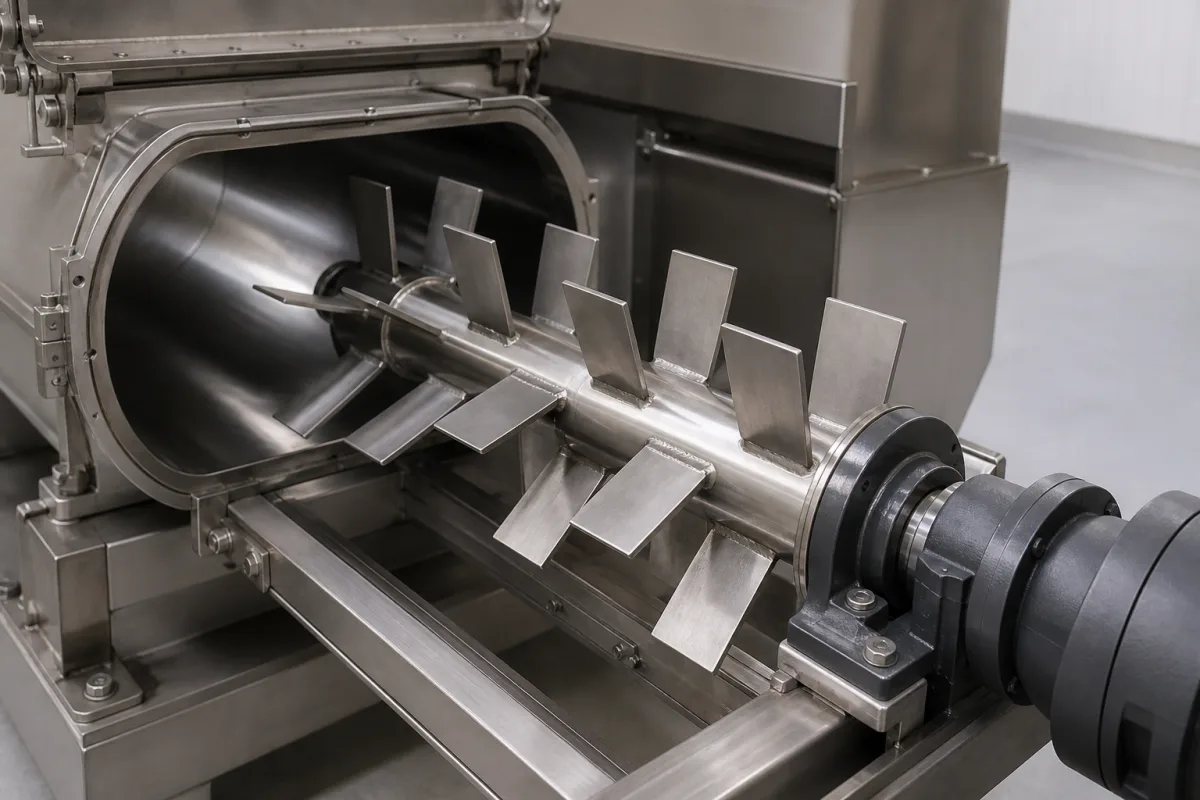
The paddle shaft of a powder mixer, and how it comes out for cleaning
The illustrated paddle shaft has been drawn out of its stainless trough: angled flat paddles welded to a tube, a bearing housing and drive at one end only. In a powder line this is the mixing element. Its speed is not chosen by feel; it is set so the paddles throw material up into a fluidised zone without grinding it, and that point is defined by the Froude number. The single-ended bearing is what lets the whole shaft come out for cleaning.
Covers paddle shafts (paddle wheels) in batch powder mixers: the Froude number and the speed it sets, the fluidised mixing zone of double-shaft paddle mixers, fill level, mixing time and liquid addition, access options including extractable cantilevered shafts, and discharge valves. Loss-in-weight powder feeders are on Powder Feeder (1418); ingredient and bag-tip hoppers on 825 and 966; batching and blending systems on 403. Paddle-wheel aerators for ponds and paddle-wheel flowmeters share the name but are outside this page.
CNFX editorial research · Sources checked October 13, 2026 · 4 sources
The Froude number sets the speed: just above 1 for a paddle mixer
PowderProcess.net defines the Froude number in powder mixing as the ratio of the forces other than gravity, centrifugal force above all, to gravity, calculated from the mixing tool's radius and angular speed, and uses it to sort dry mixers by how particles move.
PowderProcess.net's paddle-mixer page sets the speed of a double-shaft paddle mixer to reach Fr 1–1.1, where the paddles lift the solids into a fluidised zone, and says that running above Fr 1–1.1 shortens the mixing time little while the extra energy degrades the solids by breaking particles, and gives the speed by setting Fr = 1.1 for the tool radius. With Fr = Rω²/g, a paddle radius of 0.3 m needs ω = √(1.1 × 9.81 ÷ 0.3) ≈ 6.0 rad/s, about 57 rpm and 1.8 m/s tip speed; a 0.5 m radius needs about 44 rpm and 2.3 m/s (Editorial calculation).
Larger mixers therefore turn slower for the same fluidisation, while their paddle tips move faster.
Froude number
Particle behaviour (PowderProcess.net)
Fr < 1
Gravity exceeds inertia; dense-phase mixing, particles rolling over each other
Fr ≈ 1
Tipping point; particles can be put in suspension and fluidisation occurs
Fr above about 6–7
Powder centrifuged into a ring on the wall
The Fr = Rω²/g form is the standard definition; PowderProcess.net's own equation images were not reproduced here.
02
Batch size, mixing time, minor ingredients and liquids
PowderProcess.net lists the operating parameters that set how fast a double-shaft paddle mixer reaches the required homogeneity.
Profiled paddles set at an angle promote both radial and axial movement, which PowderProcess.net links to the total mixing time. The angled paddles on the illustrated shaft are that feature.
Gericke states that its double-rotor Multiflux GMS mixes multiple powders and liquids into a homogeneous mixture even with quantities below 0.01 percent.
Parameter
PowderProcess.net
Batch size
Minimum 30–40% and maximum 70–80% of total mixer volume
Speed
Calculated and set to Fr 1–1.1
Minor ingredients
Added after the main ingredients or sandwiched, preferably into the central area
Mixing time
30 s to 2–3 min for a dry mix; longer points to a setting problem
Liquid addition
A few percent of batch weight for light agglomeration; more needs deagglomerators (high-speed choppers)
Homogeneity
Set by the user and tested at qualification by sampling and analysis
PowderProcess.net's mixing-time range is stated for double-shaft paddle mixers with a fluidised zone; single-shaft paddle mixers work on a different principle.
03
Getting the paddles out: extractable and cantilevered shafts
Paddle mixers differ in how the chamber is opened for cleaning; the illustrated shaft shows the extractable option, first in PowderProcess.net's list ordered by ease of access.
Kemutec's point is the hygienic one: every bearing and seal inside or at the wall of the product zone is a place for residue, and a cantilevered shaft removes a set of them at the non-drive end. The trade-off is a shaft supported from one side only (editorial reading).
Option
Source
Access options by ease: extractable shafts, front door, side doors, opening top cover
PowderProcess.net
Cantilevered shafts (bearings on one side) as an option on some makes, letting the shaft be extracted and the chamber left empty for cleaning
PowderProcess.net
Gericke ECD: drive shaft and mixing rotors on rails, extracted at the press of a button for 360° access; FDA and GMP-oriented stainless construction, continuously welded seams; six models from 36 to 1,320 gal
Gericke via Powder & Bulk Solids
Kemutec Gardner: cantilever agitator removes one set of bearings and seals at the non-drive end; full-diameter hinged, interlocked door; plough, paddle or interrupted spiral agitators
Kemutec via Powder & Bulk Solids
Discharge: rectangular flap valves; hygienic round valves with smaller gaps but slower discharge; bomb doors opening the whole bottom, discharge under 30 s and little residue
PowderProcess.net
Gericke and Kemutec descriptions are from product announcements published in Powder & Bulk Solids.
04
What to give a paddle mixer supplier
Paste it into your enquiry below or into an email to a maker, then replace every bracket.
Give the powders, bulk densities and particle sizes, batch volume and minor-ingredient fractions, any liquid addition, required homogeneity and test method, cleaning regime (dry, wet, full washdown) and hygiene standard, and discharge requirements. Ask for paddle radius, speed and resulting Froude number, fill range, mixing time trials, access option (extractable or cantilevered shaft, doors), seal type at the shaft, discharge valve type and residue.
Explore company information and manufacturing capabilities, then discuss the scope of your project with a relevant supplier.
Share this page
Compiled and source-reviewed by the CNFX editorial team.
Each manufacturer above links to the page on that company's own website where the product is listed, with the date we checked it. How we source and review
· Page last updated 13 October 2026
Buyer questions
What Froude number does a paddle mixer run at?
PowderProcess.net's paddle-mixer page sets the speed to reach Fr 1 to 1.1 for double-shaft paddle mixers with a fluidised zone, and warns that higher values shorten mixing little while breaking particles. [1][2]
How fast should a 0.3 m radius paddle turn?
At Fr = 1.1, about 57 rpm with a tip speed of about 1.8 m/s (Editorial calculation from Fr = Rω²/g). [2]
How full should a paddle mixer be?
PowderProcess.net gives a batch of at least 30–40% and at most 70–80% of total mixer volume. [2]
Why use a cantilevered paddle shaft?
Kemutec states that it removes one set of bearings and seals at the non-drive end, improving access for cleaning; Gericke's extractable design slides the whole rotor unit out on rails. [4][3]
Sources and what still needs a direct check
Sources checked 2026-10-13. Two pages from a powder-processing engineering reference site, and two mixer announcements from Gericke and Kemutec published in Powder & Bulk Solids.