Industry-Verified Manufacturing Data (2026)

Volume Adjustment Mechanism

Based on aggregated insights from multiple verified factory profiles within the CNFX directory, the standard Volume Adjustment Mechanism used in the Machinery and Equipment Manufacturing sector typically supports operational capacities ranging from standard industrial configurations to heavy-duty production requirements.

Technical Definition & Core Assembly

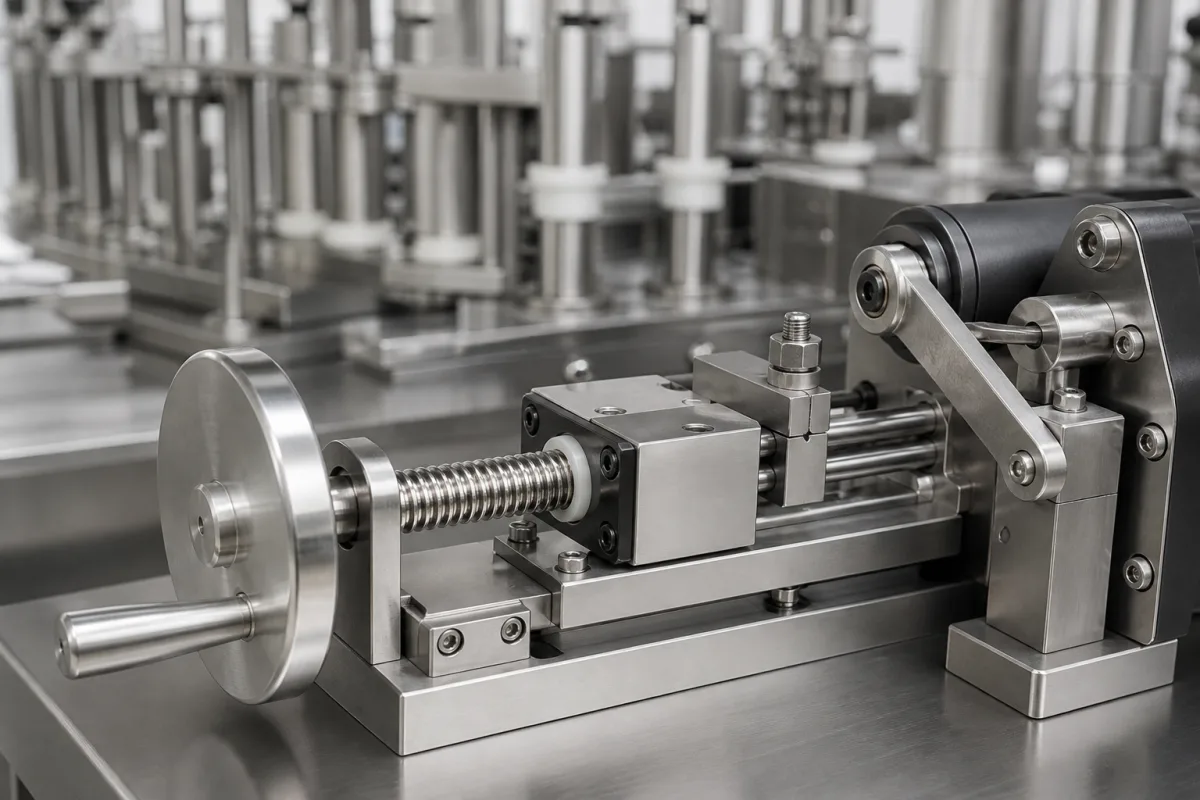
A canonical Volume Adjustment Mechanism is characterized by the integration of Adjustment Screw / Lead Screw and Calibration Dial / Encoder. In industrial production environments, manufacturers listed on CNFX commonly emphasize Stainless Steel (AISI 304/316) construction to support stable, high-cycle operation across diverse manufacturing scenarios.

A mechanical or electromechanical component within a peristaltic or piston filling pump that precisely controls and adjusts the volume of fluid dispensed per cycle.
Product Specifications

Technical details and manufacturing context for Volume Adjustment Mechanism

Definition
The Volume Adjustment Mechanism is a critical subassembly in peristaltic or piston filling pumps responsible for fine-tuning the volumetric output. It interfaces directly with the pump's displacement element (e.g., the piston, diaphragm, or the section of tubing compressed by the peristaltic rotor) to alter its effective stroke length or compression geometry. This adjustment allows operators to set and maintain precise fill volumes, ensuring dosing accuracy and consistency across production batches. Its role is central to the pump's metering function.
Working Principle
The mechanism typically works by altering the physical limits of the pump's displacement action. In a piston pump, this often involves a mechanical linkage, lead screw, or cam system that changes the piston's end-stop position, thereby modifying its stroke length. In a peristaltic pump, adjustment may involve changing the occlusion point of the rollers on the tubing or adjusting the effective length of the compressed tubing segment. Manual versions use calibrated dials or screws, while automated versions employ servo motors or stepper motors controlled by a system PLC to achieve precise, repeatable volume settings.
Common Materials
Stainless Steel (AISI 304/316), Anodized Aluminum, Engineering Plastics (e.g., POM, PTFE)
Technical Parameters
  • Adjustment range, defining the minimum and maximum stroke length or positional change achievable, directly correlating to the pump's volumetric output range. (mm) Standard Spec
Components / BOM
  • Adjustment Screw / Lead Screw
    Converts rotational input from a dial or motor into precise linear motion to set the stroke limit.
    Material: Stainless Steel
  • Calibration Dial / Encoder
    Provides a visual scale or digital feedback for setting and reading the adjusted volume.
    Material: Anodized Aluminum / Plastic
  • Locking Nut / Clamp
    Secures the adjustment setting in place to prevent drift during operation.
    Material: Stainless Steel
  • Actuator (Motorized versions)
    An electric motor (servo or stepper) that automates the adjustment process based on external control signals.
    Material: Various (Housing: Aluminum, Internal: Copper, Steel)
Engineering Reasoning
0.1-1000 μL per cycle with ±0.5% accuracy at 20°C
Mechanical failure at 150% rated torque (2.5 N·m) or electrical failure at 125% rated voltage (15V DC)
Design Rationale: Lead screw deformation exceeding 0.01 mm elastic limit under 2.5 N·m torque, causing positional accuracy loss beyond ±5 μm
Risk Mitigation (FMEA)
Trigger Backlash accumulation in 0.5 mm pitch lead screw exceeding 15 μm tolerance
Mode: Volume deviation exceeding ±2% specification at 100 μL setting
Strategy: Preloaded anti-backlash nut with 10 N preload force and 0.2 μm positional feedback
Trigger Stepper motor microstepping resolution loss at 0.9° step angle with 5% current ripple
Mode: Discrete volume steps instead of continuous adjustment at <10 μL settings
Strategy: Closed-loop servo with 5000 ppr encoder and PID control at 1 kHz update rate

Industry Taxonomies & Aliases

Commonly used trade names and technical identifiers for Volume Adjustment Mechanism.

Applied To / Applications

This component is essential for the following industrial systems and equipment:

Industrial Ecosystem & Supply Chain DNA

Complementary Systems
Downstream Applications
Specialized Tooling

Application Fit & Sizing Matrix

Operational Limits
pressure: 0 to 10 bar
flow rate: 0.1 to 1000 mL/min
temperature: -10°C to 80°C
slurry concentration: Up to 40% solids by weight
Media Compatibility
✓ Water-based solutions ✓ Low-viscosity oils ✓ Food-grade syrups
Unsuitable: Highly abrasive slurries with >40% solids
Sizing Data Required
  • Required dispense volume per cycle (mL)
  • Fluid viscosity (cP)
  • Required accuracy tolerance (±%)

Reliability & Engineering Risk Analysis

Failure Mode & Root Cause
Wear and binding of adjustment threads
Cause: Inadequate lubrication leading to metal-on-metal contact and particulate contamination
Seal degradation and fluid leakage
Cause: Chemical incompatibility with process fluids, thermal cycling, or excessive mechanical stress on sealing surfaces
Maintenance Indicators
  • Audible grinding or sticking sounds during adjustment cycles
  • Visible fluid seepage or drips around adjustment interfaces and seals
Engineering Tips
  • Implement a preventive lubrication schedule using manufacturer-recommended high-temperature, anti-wear lubricants
  • Install inline filtration and conduct regular fluid analysis to monitor contamination levels and chemical compatibility

Compliance & Manufacturing Standards

Reference Standards
ISO 9001:2015 - Quality Management Systems ANSI/ASME B46.1-2019 - Surface Texture DIN EN 1090-1:2018 - Execution of steel structures and aluminium structures
Manufacturing Precision
  • Shaft Diameter: +/-0.01mm
  • Thread Pitch: +/-0.05mm per 25mm
Quality Inspection
  • Dimensional Verification with CMM
  • Torque Testing for Adjustment Mechanism

Factories Producing Volume Adjustment Mechanism

Verified manufacturers with capability to produce this product in China

✓ 96% Supplier Capability Match Found

P Procurement Specialist from Australia Feb 04, 2026
★★★★★
"Great transparency on the Volume Adjustment Mechanism components. Essential for our Machinery and Equipment Manufacturing supply chain."
Technical Specifications Verified
T Technical Director from Singapore Feb 01, 2026
★★★★★
"The Volume Adjustment Mechanism we sourced perfectly fits our Machinery and Equipment Manufacturing production line requirements."
Technical Specifications Verified
P Project Engineer from Germany Jan 29, 2026
★★★★★
"Found 25+ suppliers for Volume Adjustment Mechanism on CNFX, but this spec remains the most cost-effective."
Technical Specifications Verified
Verification Protocol

“Feedback is collected from verified sourcing managers during RFQ (Request for Quote) and factory evaluation processes on CNFX. These reports represent historical performance data and technical audit summaries from our B2B manufacturing network.”

8 sourcing managers are analyzing this specification now. Last inquiry for Volume Adjustment Mechanism from Brazil (52m ago).

Supply Chain Compatible Machinery & Devices

Heavy-Duty CNC Plasma Cutting Machine

Industrial machine for precision metal cutting using plasma arc technology

Explore Specs →
Automated Assembly Line System

Integrated production system for sequential component assembly operations

Explore Specs →
Automated Powder Coating System

Integrated industrial system for applying dry powder coatings to metal substrates.

Explore Specs →
Centrifugal Pump Impeller

Rotating component that transfers energy to fluid in centrifugal pumps.

Explore Specs →

Frequently Asked Questions

What materials are used in your volume adjustment mechanisms?

Our mechanisms are constructed from durable materials including Stainless Steel (AISI 304/316), Anodized Aluminum, and Engineering Plastics such as POM and PTFE for corrosion resistance and longevity in industrial environments.

How does the volume adjustment mechanism work in filling pumps?

The mechanism precisely controls fluid volume per cycle through components like adjustment screws, calibration dials, and actuators. It allows operators to fine-tune dispense volumes with accuracy, ensuring consistent product filling in manufacturing processes.

What are the key components in your volume adjustment mechanism BOM?

Key components include Adjustment Screw/Lead Screw for fine-tuning, Calibration Dial/Encoder for precise measurement, Locking Nut/Clamp for secure settings, and optional Motorized Actuators for automated adjustment in advanced systems.

Can I contact factories directly on CNFX?

CNFX is an open directory, not a transaction platform. Each factory profile provides direct contact information and production details to help you initiate direct inquiries with Chinese suppliers.

Get Quote for Volume Adjustment Mechanism

Request technical pricing, lead times, or customized specifications for Volume Adjustment Mechanism directly from verified manufacturing units.

Your business information is encrypted and only shared with verified Volume Adjustment Mechanism suppliers.

Thank you! Your message has been sent. We'll respond within 1–3 business days.

Need to Manufacture Volume Adjustment Mechanism?

Connect with verified factories specializing in this product category

Add Your Factory Contact Us
Previous Product
Vision/Positioning System
Next Product
Volute Casing