Industry-Verified Manufacturing Data (2026)

Pivot Bearing Assembly

Based on aggregated insights from multiple verified factory profiles within the CNFX directory, the standard Pivot Bearing Assembly used in the Machinery and Equipment Manufacturing sector typically supports operational capacities ranging from standard industrial configurations to heavy-duty production requirements.

Technical Definition & Core Assembly

A canonical Pivot Bearing Assembly is characterized by the integration of Outer Race and Inner Race. In industrial production environments, manufacturers listed on CNFX commonly emphasize Bearing steel construction to support stable, high-cycle operation across diverse manufacturing scenarios.

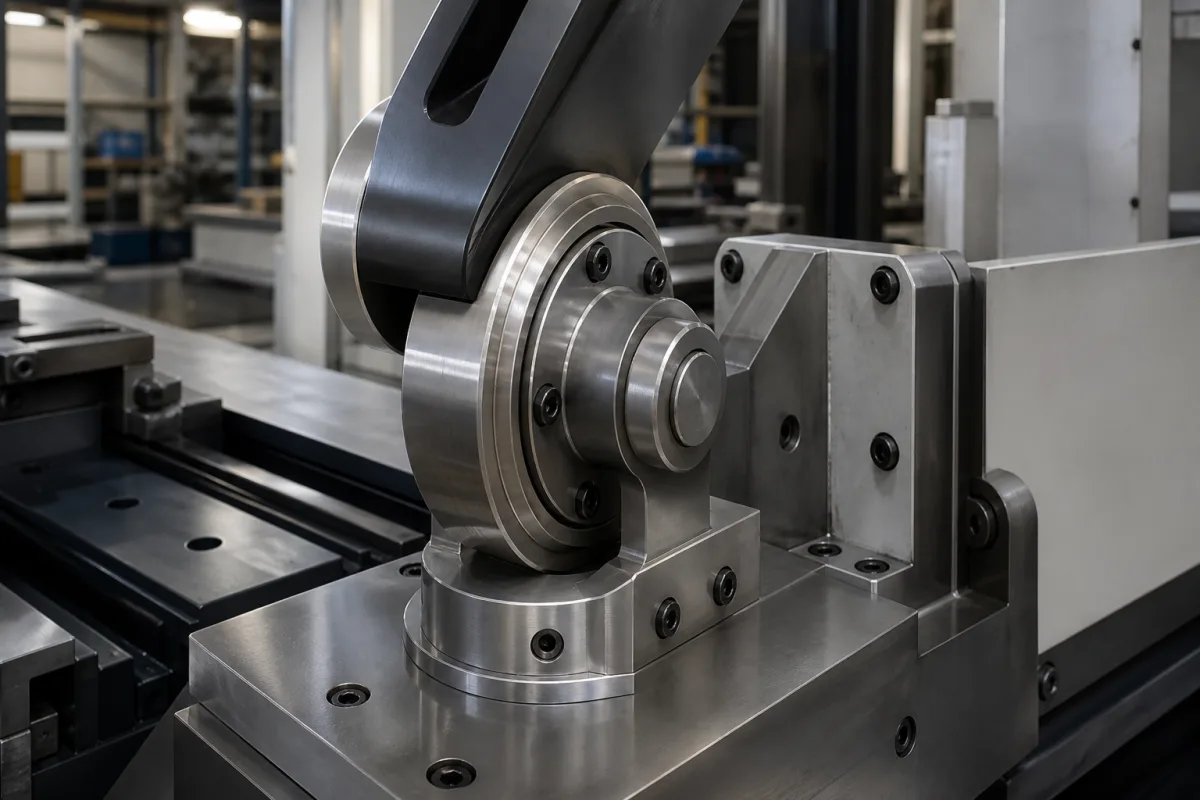
A mechanical assembly that provides rotational support and reduces friction at the pivot point of a bending arm.
Product Specifications

Technical details and manufacturing context for Pivot Bearing Assembly

Definition
The Pivot Bearing Assembly is a critical component within the Bending Arm Assembly, responsible for enabling smooth rotational movement at the arm's primary pivot joint. It consists of bearing elements housed within a structural casing, designed to withstand radial and axial loads while minimizing friction and wear during bending operations.
Working Principle
The assembly utilizes rolling-element bearings (such as ball or roller bearings) or plain bearings to separate moving surfaces. When the bending arm rotates around its pivot point, the bearing elements facilitate this motion by reducing direct metal-to-metal contact, thereby decreasing friction, heat generation, and mechanical wear.
Common Materials
Bearing steel, Hardened alloy steel, Lubricant
Technical Parameters
  • Bore diameter of the bearing assembly, determining the shaft size it fits onto. (mm) Customizable
Components / BOM
  • Outer Race
    Forms the stationary outer housing of the bearing, providing a mounting surface and load path to the bending arm structure.
    Material: Hardened alloy steel
  • Inner Race
    Forms the rotating inner ring that is press-fitted onto the pivot shaft, transmitting torque and load.
    Material: Hardened alloy steel
  • Rolling Elements
    Balls or rollers that separate the inner and outer races, enabling smooth rotation by rolling contact.
    Material: Bearing steel
  • Cage/Retainer
    Spaces and retains the rolling elements, preventing them from contacting each other and ensuring even distribution.
    Material: Steel or polymer
  • Seals/Shields
    Protect the bearing interior from contaminants and retain lubricant.
    Material: Rubber or metal
Engineering Reasoning
0-1500 N·m torque, -40°C to 120°C temperature, 0-100 RPM rotational speed
Brinell hardness drop below 200 HB at bearing surface, radial clearance exceeding 0.15 mm, surface roughness exceeding Ra 0.8 μm
Design Rationale: Adhesive wear (galling) due to boundary lubrication breakdown at Stribeck curve transition, causing asperity contact and material transfer between bearing surfaces
Risk Mitigation (FMEA)
Trigger Contaminant ingress (ISO 4406 Class 18/16/13 particles >4 μm)
Mode: Three-body abrasive wear causing 0.05 mm/hour material removal rate
Strategy: Integral labyrinth seal with 0.02 mm radial clearance and positive pressure purge at 0.1 bar above ambient
Trigger Misalignment exceeding 0.05° angular deviation from shaft centerline
Mode: Edge loading with Hertzian contact stress exceeding 1500 MPa at bearing race
Strategy: Self-aligning spherical bearing design with ±2° angular compliance and integrated laser alignment targets

Industry Taxonomies & Aliases

Commonly used trade names and technical identifiers for Pivot Bearing Assembly.

Applied To / Applications

This component is essential for the following industrial systems and equipment:

Industrial Ecosystem & Supply Chain DNA

Complementary Systems
Downstream Applications
Specialized Tooling

Application Fit & Sizing Matrix

Operational Limits
pressure: Max 50 MPa static, 25 MPa dynamic
other spec: Max rotational speed: 500 RPM, Max axial load: 15 kN, Max radial load: 30 kN
temperature: -40°C to 120°C
Media Compatibility
✓ Hydraulic oil systems ✓ Industrial water-based lubricants ✓ Dry inert gas environments
Unsuitable: High-concentration abrasive slurry with particles >50 microns
Sizing Data Required
  • Bending arm moment load (Nm)
  • Required angular deflection range (degrees)
  • Pivot shaft diameter (mm)

Reliability & Engineering Risk Analysis

Failure Mode & Root Cause
Fatigue spalling
Cause: Cyclic loading beyond design limits leading to subsurface crack initiation and propagation, often from improper preload, misalignment, or contamination-induced stress concentrations.
Lubrication failure
Cause: Inadequate or degraded lubricant due to incorrect viscosity, contamination (water, particles), thermal degradation, or insufficient lubrication intervals causing adhesive wear and overheating.
Maintenance Indicators
  • Abnormal audible grinding or clicking noises during rotation indicating bearing surface damage or contamination
  • Excessive heat generation detected via thermal imaging or touch, suggesting lubrication failure or overload
Engineering Tips
  • Implement precision alignment during installation using laser alignment tools and maintain proper preload specifications to minimize uneven load distribution
  • Establish a condition-based lubrication program with filtered lubricants, regular oil analysis, and contamination control seals to prevent lubricant degradation

Compliance & Manufacturing Standards

Reference Standards
ISO 1132-1:2000 (Rolling bearings - Tolerances - Part 1: Terms and definitions) ANSI/ABMA 20:1996 (Radial Bearings of Ball, Cylindrical Roller, and Spherical Roller Types - Boundary Dimensions and Tolerances) DIN 5412-1:2016 (Rolling bearings - Tolerances - Part 1: General principles and definitions)
Manufacturing Precision
  • Bore diameter: +/-0.01mm
  • Radial runout: 0.02mm max
Quality Inspection
  • Dimensional verification with coordinate measuring machine (CMM)
  • Ultrasonic testing for internal defects

Factories Producing Pivot Bearing Assembly

Verified manufacturers with capability to produce this product in China

✓ 97% Supplier Capability Match Found

P Procurement Specialist from Canada Feb 08, 2026
★★★★★
"As a professional in the Machinery and Equipment Manufacturing sector, I confirm this Pivot Bearing Assembly meets all ISO standards."
Technical Specifications Verified
T Technical Director from United States Feb 05, 2026
★★★★★
"Standard OEM quality for Machinery and Equipment Manufacturing applications. The Pivot Bearing Assembly arrived with full certification."
Technical Specifications Verified
P Project Engineer from United Arab Emirates Feb 02, 2026
★★★★★
"Great transparency on the Pivot Bearing Assembly components. Essential for our Machinery and Equipment Manufacturing supply chain."
Technical Specifications Verified
Verification Protocol

“Feedback is collected from verified sourcing managers during RFQ (Request for Quote) and factory evaluation processes on CNFX. These reports represent historical performance data and technical audit summaries from our B2B manufacturing network.”

14 sourcing managers are analyzing this specification now. Last inquiry for Pivot Bearing Assembly from USA (1h ago).

Supply Chain Compatible Machinery & Devices

Hydraulic Press

Industrial machine using hydraulic pressure to compress, form, or assemble materials

Explore Specs →
Heavy-Duty CNC Plasma Cutting Machine

Industrial machine for precision metal cutting using plasma arc technology

Explore Specs →
Automated Assembly Line System

Integrated production system for sequential component assembly operations

Explore Specs →
Automated Powder Coating System

Integrated industrial system for applying dry powder coatings to metal substrates.

Explore Specs →

Frequently Asked Questions

What materials are used in this pivot bearing assembly?

This assembly uses bearing steel for the races, hardened alloy steel for structural components, and specialized lubricants to ensure smooth operation and longevity.

How does this pivot bearing assembly reduce friction in machinery?

The assembly uses precision rolling elements between hardened inner and outer races, combined with proper lubrication, to minimize friction at the pivot point of bending arms.

What maintenance is required for this bearing assembly?

Regular lubrication checks and seal inspections are recommended. The sealed design helps retain lubricant and prevent contamination in industrial environments.

Can I contact factories directly on CNFX?

CNFX is an open directory, not a transaction platform. Each factory profile provides direct contact information and production details to help you initiate direct inquiries with Chinese suppliers.

Get Quote for Pivot Bearing Assembly

Request technical pricing, lead times, or customized specifications for Pivot Bearing Assembly directly from verified manufacturing units.

Your business information is encrypted and only shared with verified Pivot Bearing Assembly suppliers.

Thank you! Your message has been sent. We'll respond within 1–3 business days.

Need to Manufacture Pivot Bearing Assembly?

Connect with verified factories specializing in this product category

Add Your Factory Contact Us
Previous Product
Pivot Bearing
Next Product
Pivot Bearing Housing