XY Gantry System
View system integration details
This page explains how Position Feedback Encoders is classified within Machinery and Equipment Manufacturing. Technical values and manufacturer relationships are research references; confirm the current specification and supplier evidence for each order.
Precision sensors that provide real-time position feedback for motion control systems.
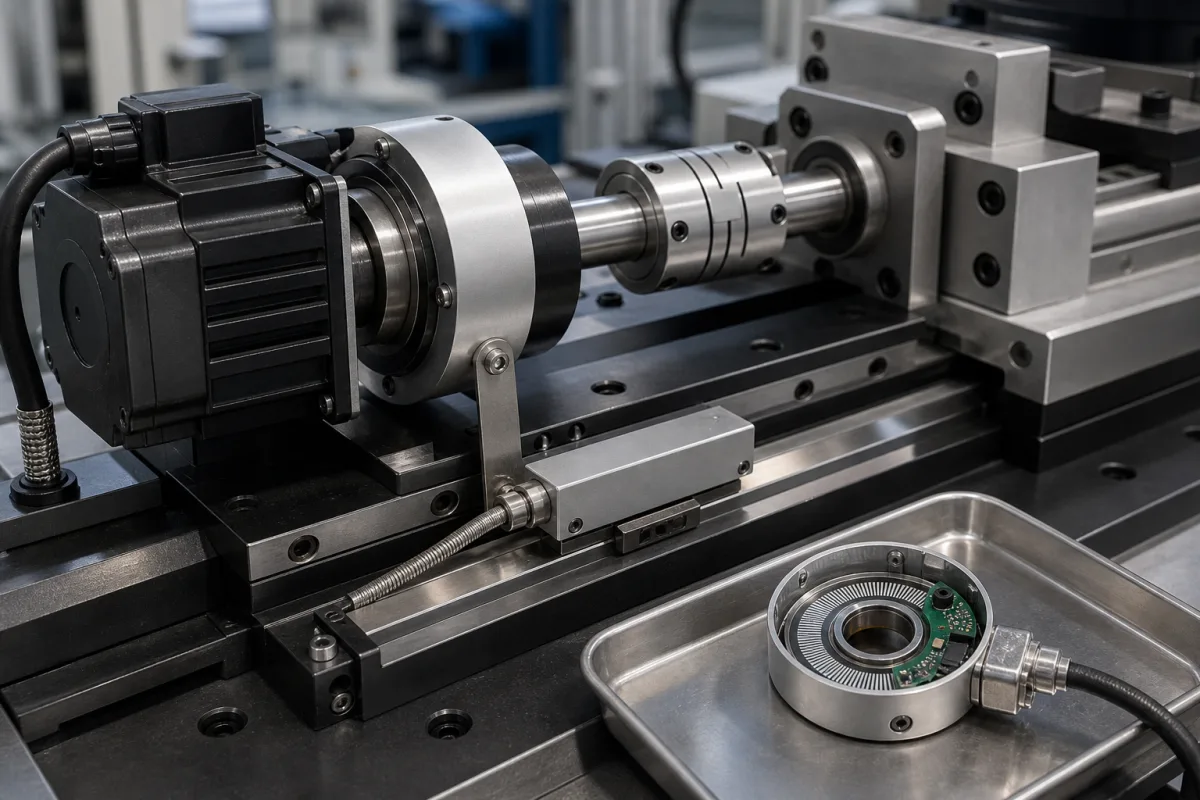
Technical details and manufacturing context for Position Feedback Encoders
What to specify in your RFQ
These are the quantities to specify to the manufacturer when sizing or requesting a quote. The manufacturer's own documentation governs the exact figures and applicable standard.
This component is essential for the following industrial systems and equipment:
| pressure: | 0.8 to 1.1 atm (standard), IP67/IP69K rating for environmental protection |
| other spec: | Vibration resistance: 20g (10-2000 Hz), Shock resistance: 100g (6ms), Resolution: up to 32-bit, Accuracy: ±1 arc-second |
| temperature: | -40°C to +85°C (operating), -55°C to +100°C (storage) |
Indicative industry ranges for design and RFQ preparation. Confirm the exact figures and applicable standard with the manufacturer before specifying.
Quoted from the published standard.
Manufacturer profiles associated with Position Feedback Encoders.
Manufacturer listings support early research and capability understanding. They are not certification, ranking, or transaction guarantees.
A practical evidence checklist for RFQ preparation and supplier evaluation.
CNFX does not score or rank suppliers. Buyers must verify all claims and documents with the legal manufacturer before ordering.
The primary function is to measure the actual position of a moving component and send that information to the control system, enabling closed-loop control for precise positioning.
They use optical, magnetic, or inductive sensing technologies to convert mechanical motion into electrical signals.
Common materials include an aluminum housing, stainless steel shaft, glass or metal code disc, optical or magnetic sensors, and a PCB with electronics.
Accuracy and repeatability specifications are provided in millimeters (mm) and must be confirmed with the legal manufacturer or supplier for the specific model and application.
Editorial classification, named public sources where available, and source-reviewed manufacturer records.
Ask for use case, specification boundaries, supplier type, and RFQ preparation information for this product.
Compare manufacturer profiles with relevant product and process capability.