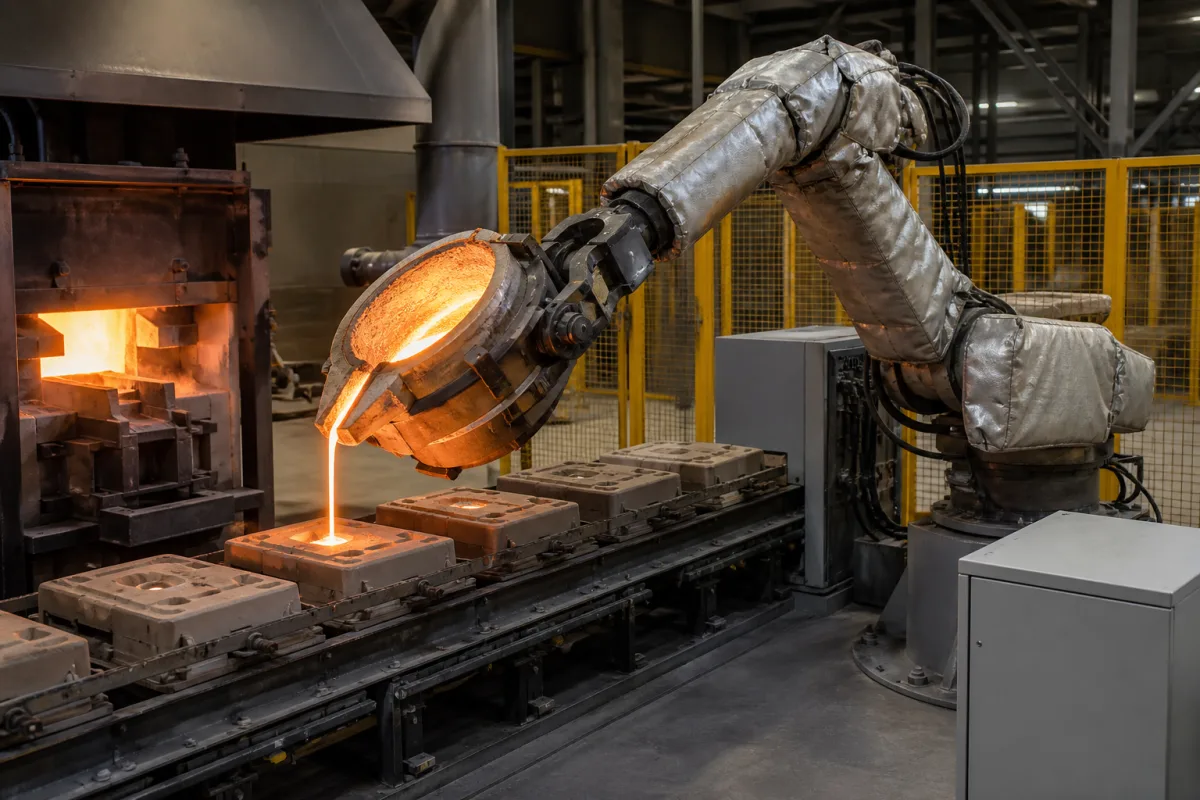
Robotic pouring and ladling systems for aluminium foundries — gravity die-casting cells and die-casting machine ladlers · dose per pour, servo-controlled ladle angle and speed, cycle time per robot, multi-machine cells, heat protection, cell-control integration, changeover
A robotic pouring system takes molten metal from a holding furnace in a ladle and pours it into moulds or a die-casting machine's shot sleeve automatically, reducing human work in high-risk areas and making each pour repeatable. Ask three things first: the metal, dose weight and moulds or machines to serve; the cycle time and how many machines one robot or ladler must cover; and how the system's ladle motion, heat protection and controls integrate with your furnace and casting cell.
Automatic pouring and ladling systems for foundries — robot-held ladles for gravity die casting, dedicated ladling devices for high-pressure die-casting machines, and tilting-ladle pouring units — with ladles, heat protection and controls. Holding and melting furnaces, die-casting machines (see high-pressure die casting machine), sand-mould pouring lines without automation and general handling robots are outside this page except where compared.
CNFX editorial research · Sources checked October 11, 2026 · 4 sources
Bühler's BuhlLadle ladling device doses up to 60 kg of liquid aluminium on Bühler's Evolution and Carat die-casting machines. Its servo technology lets speed and ladle angle be programmed to an accuracy of ±1.5%, it comes in three sizes with large horizontal paths, height adjustment and optional tilt, and it is integrated into and displayed on the machine's cell control unit, with setup, basic settings and diagnostics from the machine display. Bühler states that faster, controlled movements cut cycle times even with larger doses, and that precise dosing reduces waste. [1]
Editorial note: ±1.5% describes the programmed ladle motion; ask suppliers separately for the measured pour-weight repeatability at your dose and metal temperature, and how it is verified in production.
Give the supplier the metal and alloy, pouring temperature, dose weight range per pour, moulds or machines to serve (gravity die casting, high-pressure die casting, low-pressure), layout from furnace to machines, cycle time target, ladle type and size, robot or dedicated ladler, heat and splash protection, safety fencing, integration with cell and furnace controls, changeover needs, and quantity.
02
Size the cycle time and the casting cell
Comau describes robotic pouring cells for aluminium gravity die casting in which its six-axis NJ-series robots, with payload, reach and thermal protection for metal pouring, pour into metal moulds using optimised trajectories and pouring angles for consistency, safety and repeatability, reducing human intervention in high-risk areas while keeping casting temperature and cycle time stable. One robot can complete a casting every 45 seconds; cells can be programmed for sequential or parallel operation with multiple casting machines; layouts are tailor-made with modular robot configurations; and with SMED analysis a production changeover takes about two hours. [2]
Editorial calculation: a casting every 45 seconds is 80 castings per hour per robot, or 640 in an eight-hour shift at full utilisation; if one robot serves two gravity machines whose own cycles are longer than 90 seconds, the machines rather than the robot set the output. [2]
03
Size the robot's payload for ladle plus metal
A pouring robot carries the ladle, the metal in it and any tooling, so the payload class is set by the full dose. KUKA's foundry robot page shows how payload bands map to robot families: it lists more than 275 models from 3 to 1,300 kg for the foundry market, with a foundry wrist in corrosion-resistant V2A materials certified to IP67. KUKA notes that its KR 1000 titan was the first robot used to cast molten iron, at Georg Fischer Mettmann. [4]
Editorial calculation: with Bühler's 60 kg maximum aluminium dose in the ladle, a robot from KUKA's 16–120 kg band leaves at most 120 − 60 = 60 kg for the ladle, its lining and the gripper; a heavier ladle moves the cell into the 120–270 kg band. Weigh the empty, lined ladle and add the maximum dose before choosing the payload class, and check the payload at the wrist offset the ladle creates. [4][1]
For die-casting machines, KUKA lists shelf-mounted robots designed to sit on the machine, with payloads from 16 to 270 kg and reaches up to 3,900 mm, and says its KR C4 controller protects electronics from dust and dirt with overpressure in the housing. [4]
The manufacturer cards below state what each reviewed source shows.
When requesting quotations, ask each supplier for dose range, pour-weight repeatability, cycle time with your moulds, heat-protection design, integration with your furnaces and machines, and references in similar foundries.
05
Specify the robot's foundry protection, not just its payload
A pouring robot works among metal spits, coolants and lubricants, so the protection package belongs in the specification. ABB's Foundry Plus 2 brochure lists ladling and die casting among its main applications and describes an optional package that makes the entire robot IP67 compliant from base to wrist, so electrical compartments are sealed against liquid and solid contaminants. ABB adds that IP67 alone is not enough for long service life: the package also uses a corrosion-resistant coating under two-component epoxy paint, rust preventives, extra protection of cabling and electronics, a nickel-coated tool flange and a design that withstands high-pressure steam washing. [3]
For aluminium pouring, ABB offers a leather guard for the cabling as an option where aluminium and other aggressive spits occur. The brochure's own example of an unprotected robot is a motor failure at the base, which it says can add 12–24 hours of unplanned downtime on top of repair costs. It also shows that the package is model-specific: of the robot models it lists, the IRB 2400 and IRB 4400 come without the nickel-coated tool flange. Ask each supplier which protection class and options apply to the exact robot model quoted. [3]
06
Trace the pouring cell
This is a functional reference built from the sources cited; it is not one maker's design.
Fill the specification fields with values for your project
A robotic pouring system quotation needs values for your project. The table explains each field, gives published values where a reviewed source states them, and says what to obtain from the supplier.
The manufacturers below list automatic pouring and ladling equipment on their own websites; each card links to the page reviewed. Confirm ratings, materials and approvals for your order.
Yizumi Holdings Co., Ltd.
Manufacturing site to be confirmed for the order
Lists die-casting intelligent units with ladling, spraying and extracting devices for high-pressure die-casting cells.
Explore company information and manufacturing capabilities, then discuss the scope of your project with a relevant supplier.
Share this page
Compiled and source-reviewed by the CNFX editorial team.
Published product pages show what a company offers, not tested performance. Confirm the legal seller, factory and scope for your order. How we source and review
· Page last updated 13 October 2026
Buyer questions
How much aluminium can a ladling device dose?
Bühler's BuhlLadle doses up to 60 kg of liquid aluminium. [1]
How fast is a robotic pouring cell?
Comau says one robot can complete a casting every 45 seconds in its gravity casting cells. [2]
How precise is the ladle motion?
Bühler's servo drive programs speed and ladle angle to ±1.5%. [1]
What protection does a robot need for ladling molten aluminium?
ABB's Foundry Plus 2 brochure describes an IP67-compliant robot from base to wrist with corrosion-resistant coating under epoxy paint, protected cabling, a nickel-coated tool flange and an optional leather cable guard against aluminium spits. [3]
What payload does a pouring robot need?
Ladle plus lining plus maximum dose; KUKA's foundry range runs from 3 to 1,300 kg, with its KR 30/60 F series at 16–120 kg and the KR 1000 titan F, used to pour molten iron, at up to 1,300 kg. [4]
Sources and what still needs a direct check
Sources checked 2026-10-11. Bühler, Comau, ABB and KUKA describe their own ladling, robotic pouring and foundry robot products.