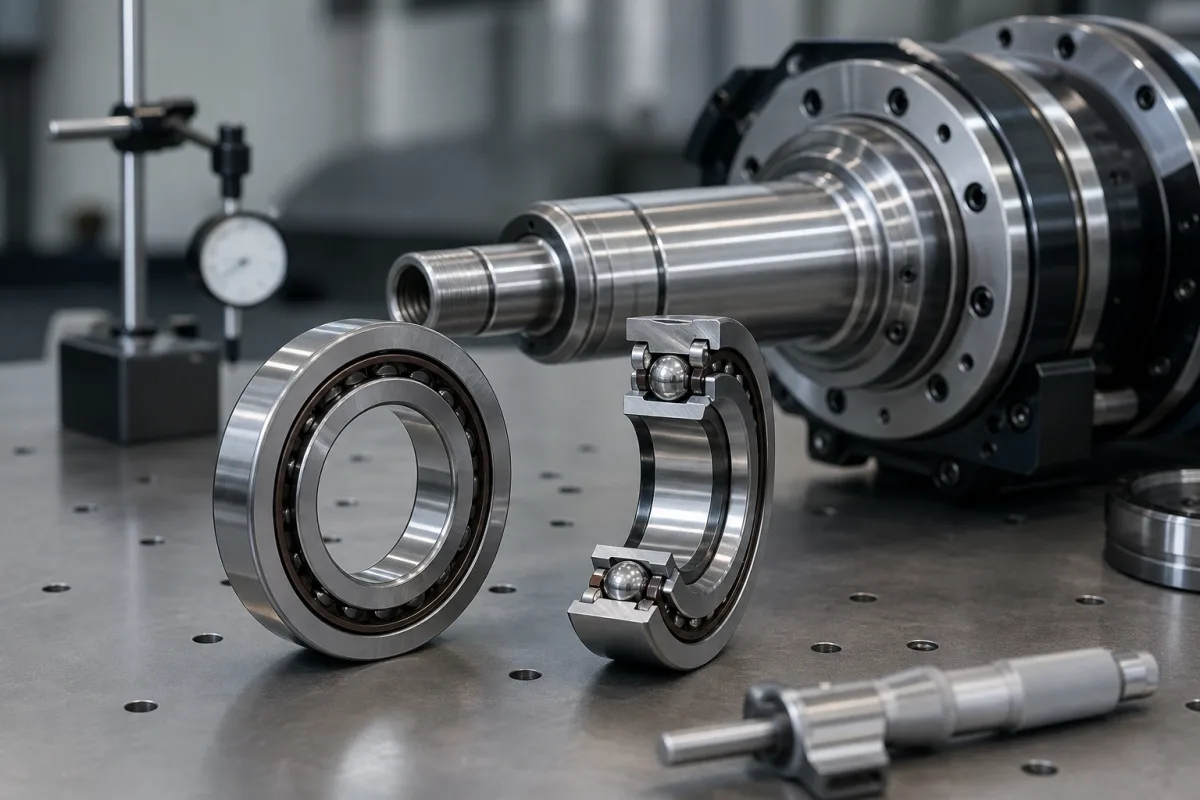
Super precision angular contact ball bearings · 15°, 25° and 30° contact angles, P4 and P2 accuracy, light to heavy preload, steel or ceramic balls, for machine tool spindles running to about 3 million dmN
Precision bearings are rolling bearings made to tight running-accuracy classes for spindles and shafts where run-out, stiffness and speed matter — on this page, super precision angular contact ball bearings mounted in preloaded sets in machine tool spindles. Ask three things first: what speed, load and stiffness the spindle needs, which contact angle, preload and arrangement deliver them, and what accuracy class, ball material and lubrication the duty requires.
Super precision angular contact ball bearings and matched sets for machine tool spindles and similar high-accuracy, high-speed shafts, with notes on precision thrust bearings for machine tools. General-purpose deep groove and angular contact bearings, spherical roller bearings (see spherical roller bearings), thrust bearings for general machinery (see thrust bearing), slewing rings, flexible bearings for strain wave gears (see flexible bearing), air bearings and ceramic balls sold alone (see ceramic bearing ball) are outside this page.
CNFX editorial research · Sources checked October 12, 2026 · 4 sources
NSK describes its super precision angular contact ball bearings for equipment needing high running accuracy or high rotational speed, such as the main spindles of machine tools, in ISO-conforming standard series and series specialised for machine tools. Its high-precision NSKHPS range offers 15°, 25° and 30° contact angles, ceramic balls for lower heat generation and non-contact seals; its precision thrust bearings for machine tools come in 30° and 40° types and in a 60° type for combined axial and radial loads. [1]
A reseller listing for the SKF 7005 CEGB/P4A describes a 25 × 47 × 12 mm extra-light-series bearing with a 15° contact angle in the high-speed E design, supplied as a single universally matchable bearing with a medium preload and P4 precision, open, with a plastic cage. [2]
Give the supplier the spindle drawing and arrangement, speed range, radial and axial loads, required stiffness and run-out, bearing series and size, contact angle, preload and matching, accuracy class, ball material, lubrication (grease or oil-air) and sealing, and the operating temperature.
02
Set accuracy, ball material, lubrication and speed
The SKF 7005 CEGB/P4A listing gives a basic dynamic load rating of 8.32 kN, static 4.15 kN, fatigue load limit 0.173 kN, and limiting speeds of 46,000 r/min with grease and 70,000 r/min with oil. [2] NSK lists ultra-high-speed types for oil-air lubrication with ceramic balls running at about 2.7 million dmN (Spinshot II) and P2–P4 accuracy (ROBUSTSHOT), and ROBUSTDYNA bearings handling about 3 million dmN with P2–P4Y precision. [1]
Editorial calculation: taking dm as the mean of bore and outside diameter, (25 + 47) / 2 = 36 mm, the 7005 CEGB/P4A runs to about 36 × 46,000 ≈ 1.66 million dmN on grease and 36 × 70,000 ≈ 2.52 million dmN on oil. [2]
03
Ask for preload as a force, not just a class letter
JTEKT's Koyo bearing-knowledge page on amount of preload tabulates standard preload in newtons for matched pairs of angular contact ball bearings of JIS class 5 or higher used for machine tool spindles, in four classes: slight (S), light (L), medium (M) and heavy (H). JTEKT states: "Generally, light or medium preload is recommended for grinder spindles, and medium or heavy preload for spindles of lathes and milling machines." [4]
The page says preload should be set to avoid adverse effects on bearing life, temperature rise and friction torque, and that loss of preload from wear-in, shaft and housing accuracy, mounting conditions and lubrication must also be considered. [4]
Editorial note: bore number 05 is the size code of the 7005 bearing above, which the reseller listing gives as 25 mm bore with medium preload [2]. JTEKT's medium value at that size ranges from 100 N to 390 N across its series, so a class letter alone does not fix the force; ask each maker for the preload in newtons for your series and size. [4]
JTEKT series, bore number 05
Standard preload S / L / M / H (N)
L → M (Editorial calculation)
7900 C
15 / 50 / 100 / —
× 2.0
7000 C
20 / 60 / 145 / 295
× 2.4
7200 C
35 / 100 / 245 / 490
× 2.45
7000
— / 100 / 245 / 490
× 2.45
7200
— / 145 / 390 / 785
× 2.7
Give the supplier the spindle type (grinder, lathe, milling) and ask for the preload force, not only the class, for the matched set offered.
04
Use DN to compare speed limits and lubrication method
NASA TM X-71678 (Zaretsky, Signer and Bamberger, 1975) defines DN as bearing bore in millimetres multiplied by shaft speed in rpm, and reports tests of 120 mm bore angular-contact ball bearings of vacuum-melted AISI M-50 steel. Jet-lubricated bearings were limited to speeds below 2.5 million DN, inner-race land-riding cages ran cooler than outer-race land-riding cages, dual-orifice jets ran cooler than single-orifice jets at the same oil flow, and under-race lubrication ran cooler in every condition with no apparent speed limit. [3]
The paper states that oil-gas mist systems avoid pumps and scavenge lines and reduce torque but cannot remove as much heat as recirculating oil, so mist-lubricated bearings run hotter; under-race lubrication feeds oil through radial passages in the inner ring directly to the balls and cage lands. Spindle bearings for machine tools face the same trade-off between grease, oil-air and jet lubrication. [3][1]
Editorial calculation: the SKF 7005 CEGB/P4A above (25 mm bore) at its 70,000 r/min oil limiting speed runs at 25 × 70,000 = 1.75 million DN, and at its 46,000 r/min grease limit at 1.15 million DN. [2]
Finding cited in NASA TM X-71678
Value
Jet-lubricated 120 mm bearings, speed limit
Below 2.5 million DN
30 mm bearings with jets, earlier work: limit with inner- / outer-race riding cage
1.5 / 2.4 million DN
75 mm bearing at 20,000 rpm (1.5 million DN): outer-race temperature, oil jet vs oil-air mist
394 K vs 447 K
Same bearing: torque, oil jet vs oil-air mist
1.3 N·m vs 0.4 N·m
Test jets
Two per bearing, 180° apart; 3.2 mm single or 1.6 mm double orifice, 3.1 mm from the outer-race face
State bore, maximum speed (and so DN), the lubrication method available (grease, oil-air, jet or under-race) and cooling, and ask the supplier for limiting speed by lubrication method and cage guidance type.
05
Find precision bearing manufacturers
The manufacturer card below states what the reviewed source shows.
Ask any supplier for series and dimensions, contact angle, accuracy class to ISO 492 or equivalent, preload class and values, matching (universal or set), ball material, cage, load ratings, limiting speeds for grease and oil, sealing, inspection records, and proof of origin for branded bearings.
06
Trace what each part does
This is a functional reference built from the sources cited; it is not one maker's specification.
Fill the specification fields with values for your order
A precision bearing quotation needs values for your spindle. The table explains each field, gives published values where a reviewed source states them, and says what to obtain from the supplier.
The manufacturer below lists super precision angular contact ball bearings on its own website; each card links to the page reviewed. Confirm ratings, materials and approvals for your order.
Luoyang Zhongyue Precision Bearing Co., Ltd.
Manufacturing site to be confirmed for the order
Lists high-precision and high-precision ultra-high-speed angular contact ball bearings and high-speed thrust angular contact ball bearings.
Explore company information and manufacturing capabilities, then discuss the scope of your project with a relevant supplier.
Share this page
Compiled and source-reviewed by the CNFX editorial team.
Published product pages show what a company offers, not tested performance. Confirm the legal seller, factory and scope for your order. How we source and review
· Page last updated 13 October 2026
Buyer questions
Which contact angle should a spindle bearing have?
NSK offers 15°, 25° and 30° angles in its high-precision range; confirm with the bearing maker which suits your speed and loads. [1]
Why use ceramic balls?
NSK lists ceramic balls for lower heat generation in high-speed spindles. [1]
How fast can a small spindle bearing run?
One 25 mm bore 15° bearing lists 46,000 r/min with grease and 70,000 r/min with oil. [2]
What does DN mean for a bearing?
DN is bore in millimetres times shaft speed in rpm; NASA tests found jet-lubricated 120 mm bore ball bearings limited below 2.5 million DN. [3]
How much force is a medium preload on a spindle bearing pair?
It depends on series and size: JTEKT's standard table gives 145 N medium preload for a bore-number-05 pair in its 7000 C series, against 60 N light and 295 N heavy. [4]
Sources and what still needs a direct check
Sources checked 2026-10-12. NSK makes super precision bearings; the SKF bearing data comes from a reseller listing.