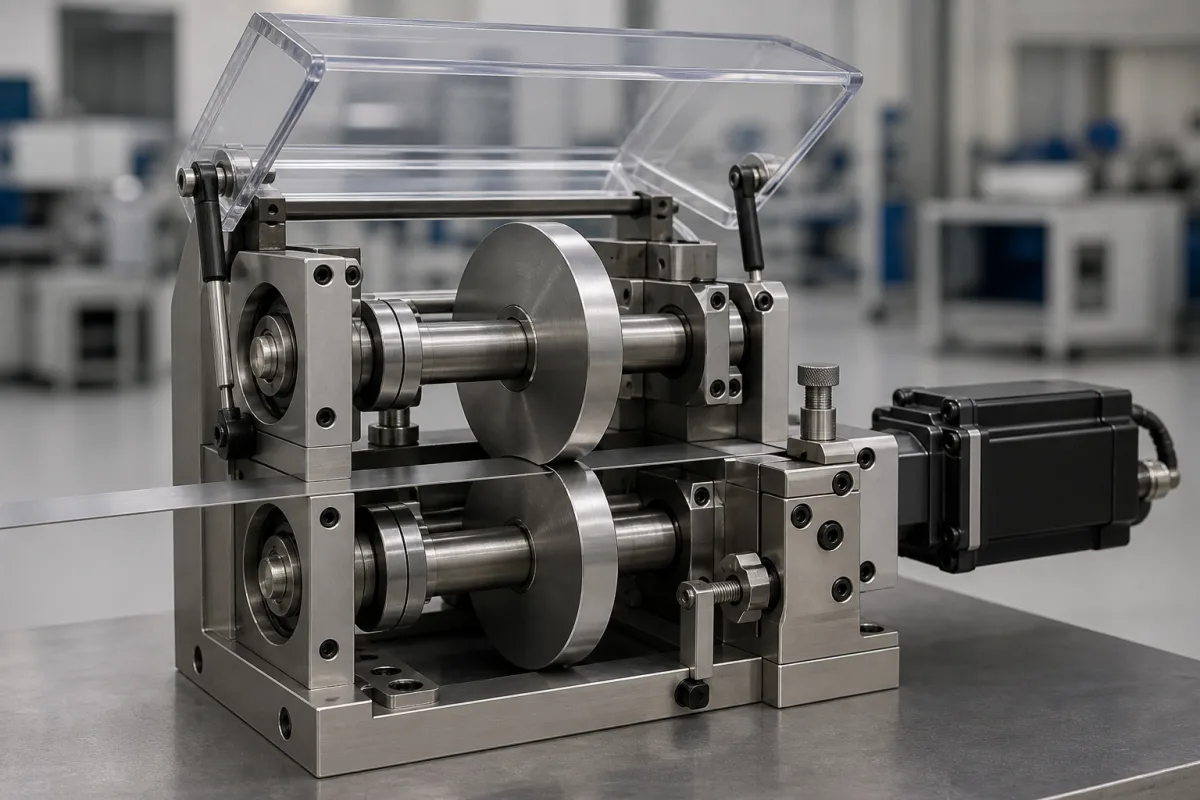
Precision cutting blade assembly for strip slitting: paired circular knives on two arbors, set by horizontal clearance and overlap
Rotary shear slitting heads · paired circular knives on two parallel arbors, horizontal clearance as a fraction of strip thickness, vertical overlap, shimless spacers, strippers and holding the knives' axial setting against arbor drift
In the picture a strip runs between two circular knives, one on an upper arbor and one on a lower, with a servo motor driving the head and a clear guard over the top. Each pair of knives cuts by shear: the knives overlap slightly, sit a small gap apart sideways, and the strip breaks between them. Two settings decide the slit edge — that sideways gap and the overlap — and both have to survive a production run.
Rotary shear slitting heads and their knife sets for metal strip and similar webs: male-and-female circular knife pairs on parallel arbors, spacers and shims, strippers, horizontal clearance and vertical overlap settings, and arbor adjustment that keeps the knives in register. Blade units of automatic fish, poultry and meat portion cutters are covered on the Cutting assembly for fish and meat portion cutters page, and whole-fish filleting machines on the Industrial fish filleting machine page; band saw blade tensioners for meat and fish on the Band saw blade tensioning mechanism page. Complete battery electrode slitters are covered on the Battery electrode slitting machine page, guillotine shear blades on the Upper blade for a guillotine shear page, granulator knives on the Knife assembly (granulator rotor and bed knives) page, and oscillating knife tools on the Oscillating blade assembly page.
CNFX editorial research · Sources checked October 13, 2026 · 3 sources
Horizontal clearance between the knives: set from strip thickness and tensile strength
US patent 4,667,550 (Precision Strip Technology, 1987) states that slit-edge quality is controlled to a great extent by the axial relationship of mating knives, and for steel sheet puts the clearance at about 10 % of the material thickness, more or less for special applications, for example 0.0015 in on a 0.015 in web. [1]
The same patent describes both failure directions: too tight, and mating knives can touch, wearing the cutting edges hard and shortening knife life; too wide, and the slit edges carry burrs or roughness from tearing. [1] US patent 5,574,890 (Asko, 1996) adds that the proper clearance depends primarily on thickness and tensile strength, increasing as either increases, and also on arbor parallelism, the arbor bearings, arbor deflection, the condition of knives, spacers and shims, and the cleanliness of the setup. [2]
Asko's patent describes the edge to aim for: a shiny penetration zone (the nick), a smooth matte grey separation zone (the break), and a fairly straight line between them; the knives penetrate until shear forces exceed the strip's ultimate tensile strength. [2] Editorial calculation: the example set-up screen in that patent pairs 0.032 in material at 150 ksi tensile strength with a 0.003 in horizontal clearance, which is 0.003 / 0.032 ≈ 9.4 % of thickness. [2]
Give the strip material, thickness range and tensile strength for each order, and ask the knife supplier which horizontal clearance it sets for each, and how that is built into the spacer stack.
02
Vertical overlap, the knife and spacer stack, and strippers
Asko's patent gives a rule for the vertical setting: bring the arbors together until a cut is produced, then close them slightly more to allow for variation in strip thickness, bearing condition, arbor positioning tolerance, arbor deflection and knife wear. [2]
TKM, a maker of slitting knives, recommends 1 mm of overlap for rotary slitter knives running against a counter-knife or anvil: too much, and the cutting point and knife speed change because the knife is driven by friction with the anvil, raising dust and wear and risking a web break; too little, and the knife can break or ride up over the anvil. [3]
In the male-and-female knife arrangement the patent describes, knives on the upper and lower arbors alternate, and spacers between them set each slit width and, with the knife width added, the horizontal clearance. The patent explains that compressible plastic shims of uncertain thickness gave way to metal-to-metal, shimless tooling: supply tolerances moved from 0.0001 in to ten-millionths of an inch, and its computer-assisted shimless system uses tooling made to within 1 µm. Strippers between the knives push the slit strands off, hold the strip flat during slitting and, on some machines, act as pinch rolls. [2]
List the knife diameter and thickness, the spacer set and its tolerance, whether shims are used, and the stripper material for the arbor size of the slitting head.
03
Keeping the setting during a run: arbor drift, thermal growth and backlash
Patent 4,667,550 notes that arbors shift axially in service, from thermal expansion as the bearings heat up, from end play, and from distortion of the base as the slitting head is moved in and out of the line, so a clearance set at the start drifts and burrs appear on the slit coils. [1]
Its answer mounts one arbor end in a sleeve that a cam can move axially in both directions, compares the measured arbor position with a set null point within a selectable tolerance, and drives the sleeve to restore the knives' axial relationship; a spring-loaded tailstock keeps the arbors in compression to remove axial backlash. [1] Asko's design tool records slit width and clearance results so the set-up can be corrected from measured data. [2]
04
Data for a rotary slitting knife assembly
Paste it into your enquiry below or into an email to a maker, then replace every bracket.
Material: [grade; thickness range; tensile strength; coating]
Slitting: [number of strands; narrowest and widest slit; width tolerance]
Arbors: [diameter; length; drive; servo or mechanical]
Knives: [diameter; thickness; material; regrind allowance]
Set-up: [horizontal clearance per material; overlap; shimmed or shimless]
Strippers and guards: [stripper material; guard]
Run: [line speed; arbor position control]
Explore company information and manufacturing capabilities, then discuss the scope of your project with a relevant supplier.
Share this page
Compiled and source-reviewed by the CNFX editorial team.
Each manufacturer above links to the page on that company's own website where the product is listed, with the date we checked it. How we source and review
· Page last updated 13 October 2026
Buyer questions
How much horizontal clearance should slitter knives have?
US 4,667,550 gives about 10 % of thickness for steel sheet, more or less for special applications; US 5,574,890 says it increases with thickness and tensile strength. [1][2]
What happens if the knife clearance is wrong?
Too tight and mating knives can touch and wear rapidly; too wide and the slit edges carry burrs from tearing. [1]
How is knife overlap set?
Asko's patent closes the arbors until a cut is made, then slightly more to cover thickness variation, bearings and wear; TKM recommends 1 mm for slitter knives cutting against an anvil. [2][3]
Why do slit edges develop burrs during a run?
US 4,667,550 attributes it to axial arbor shift from bearing heat, end play and base distortion, which changes the knife clearance. [1]
Sources and what still needs a direct check
Sources checked 2026-10-13. US patents 4,667,550 (Precision Strip Technology) on holding the axial setting of slitter knives and 5,574,890 (Asko) on rotary slitting set-up, and TKM's guidance on slitter knife overlap.