Editorial Technical Reference

Pressure Spring/Pneumatic Actuator

This page explains how Pressure Spring/Pneumatic Actuator is classified within Machinery and Equipment Manufacturing. Technical values and manufacturer relationships are research references; confirm the current specification and supplier evidence for each order.

Technical Definition & Core Assembly

A component within a polishing head assembly that provides controlled pressure application through spring force or pneumatic actuation.
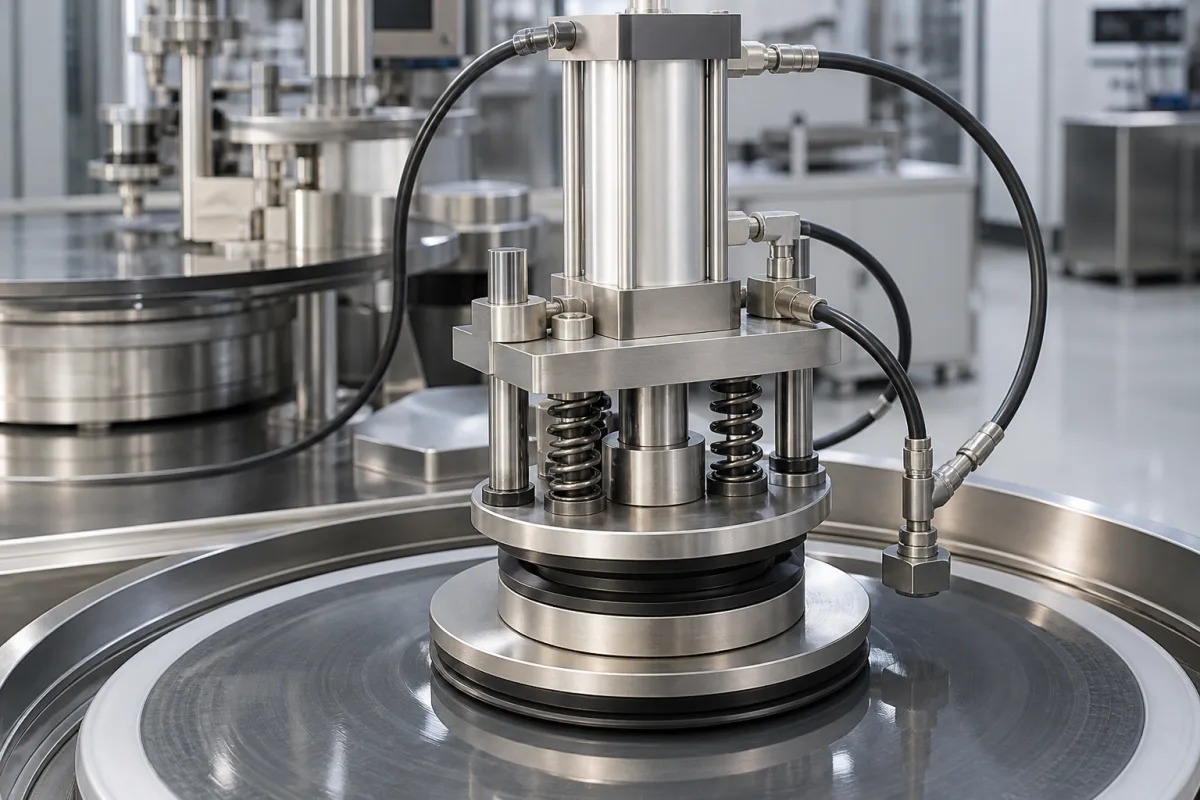
Pressure Spring/Pneumatic Actuator in a manufacturing environment
Representative product image. Confirm appearance and specifications with the manufacturer.

Product Specifications

Technical details and manufacturing context for Pressure Spring/Pneumatic Actuator

Definition
The pressure spring/pneumatic actuator is a critical component of the polishing head assembly responsible for generating and maintaining consistent pressure between the polishing tool and workpiece surface. It ensures uniform material removal and surface finish quality by compensating for surface irregularities and maintaining optimal contact force throughout the polishing operation. This actuator is available in two primary configurations: spring-based and pneumatic. Spring-based actuators rely on elastic deformation of a coil spring to produce a predetermined force, while pneumatic actuators use compressed air to generate adjustable force. Both types are designed to operate within specified parameters, including operating pressure of 1.0–1.6 MPa, stroke length of 10–50 mm, spring rate of 5–20 N/mm, force range of 50–500 N, and operating temperature of -20 to 80°C. For pneumatic versions, air supply pressure should be 0.4–0.8 MPa (ISO 8573-1), with air consumption of 0.1–0.5 L/min at 0.6 MPa supply. The actuator offers a response time of 0.1–0.5 seconds from signal to full stroke, repeatability of ±0.05 mm, and ingress protection rating of IP54–IP65 (IEC 60529). Materials used include stainless steel (grades 304/316 per ASTM A240), spring steel, aluminum alloy, and synthetic rubber seals. The weight ranges from 1.5 to 3.5 kg depending on size and configuration. These values are directory reference ranges and must be verified with the legal manufacturer for specific models and applications. The actuator is suitable for polishing operations where consistent pressure is essential for achieving desired surface finish and material removal rates.
Working Principle
The actuator operates by converting stored energy into linear mechanical force. In spring-based systems, elastic deformation of the spring stores potential energy, which is released as force when the spring is compressed or extended. In pneumatic systems, compressed air is supplied to a cylinder, and the pressure differential across the piston generates force. This force is transmitted to the polishing head, allowing it to maintain consistent pressure against the workpiece surface. The actuator compensates for minor variations in surface geometry or tool wear by adjusting the force output, either through spring preload adjustment or by regulating air pressure. This ensures uniform contact force throughout the polishing cycle, contributing to consistent material removal and surface finish quality.
Common Materials
Stainless steel, Spring steel, Aluminum alloy, Synthetic rubber seals
Technical Parameters
ParameterTypical rangeNotes & selection driver
Stroke Length10–50 mmCustomizable per application
Spring Rate5–20 N/mmDetermines force per mm deflection
Force Range50–500 NAdjustable via pressure or spring preload
Operating Temperature-20–80 °CSeals degrade above 80°C
Air Supply Pressure0.4–0.8 MPaFor pneumatic actuationISO 8573-1
Air Consumption0.1–0.5 L/minAt 0.6 MPa supply
Response Time0.1–0.5 sFrom signal to full stroke
Repeatability±0.05 mmPositioning accuracy
Ingress ProtectionIP54–IP65Dust and water resistanceIEC 60529
Material304/316 SSCorrosion resistantASTM A240
Weight1.5–3.5 kgDepends on size and configuration

Ranges are indicative industry figures for RFQ preparation, not a supplier commitment. Confirm every value and standard with the legal manufacturer before ordering.

Components / BOM
  • Piston/rod assembly
    Transmits force from actuator to polishing head
    Material: Hardened steel
  • Pressure chamber/spring housing
    Contains pneumatic pressure or spring mechanism
    Material: Aluminum alloy
  • Seals/gaskets Part
    Prevents pressure leakage and contamination
    Material: Synthetic rubber
  • Mounting bracket Part
    Secures actuator to polishing head assembly
    Material: Steel
  • Pressure Spring
    Stores and releases the force that keeps the polishing head pressed on the work.

Applied To / Applications

This component is essential for the following industrial systems and equipment:

Industrial Ecosystem & Supply Chain Structure

Complementary Systems
Downstream Applications
Specialized Tooling

Application Fit & Sizing Matrix

Operational Limits
pressure: 0 to 150 psi (spring) / 0 to 100 psi (pneumatic)
other spec: Slurry concentration: ≤30% solids by weight, Flow rate: 5-50 L/min
temperature: -20°C to 120°C
Media Compatibility
✓ CMP slurries (silica, alumina) ✓ DI water rinse solutions ✓ Chemical cleaning agents (pH 4-10)
Unsuitable: High-viscosity abrasive slurries (>500 cP)
Sizing Data Required
  • Required polishing pressure (psi)
  • Actuation stroke length (mm)
  • Available pneumatic supply pressure (psi) or spring constant (N/mm)

Reliability & Engineering Risk Analysis

Failure Mode & Root Cause
Spring Fatigue Failure
Cause: Cyclic loading beyond material endurance limit due to pressure fluctuations, improper sizing, or excessive operating cycles leading to crack initiation and propagation.
Pneumatic Seal Degradation
Cause: Contamination ingress (dust, moisture, oil), incompatible media, or excessive temperatures causing O-ring/diaphragm hardening, cracking, or extrusion leading to air leaks.
Maintenance Indicators
  • Irregular or jerky actuator movement accompanied by hissing air leaks
  • Visible spring corrosion or deformation with reduced return force
Engineering Tips
  • Implement filtered, dry compressed air supply with proper lubrication control to prevent seal and internal component contamination
  • Install pressure regulators with surge protection and conduct periodic spring inspection/testing to verify elastic limits and preload integrity

Indicative industry ranges for design and RFQ preparation. Confirm the exact figures and applicable standard with the manufacturer before specifying.

Compliance & Manufacturing Standards

Applicable Standards
ISO 6431: Pneumatic cylinders - Bore and rod diameters and mounting dimensions ANSI/B93.5M: Hydraulic fluid power - Cylinders - Bore and rod area dimensions DIN ISO 15552: Pneumatic fluid power - Standard cylinders - Mounting dimensions

Quoted from the published standard.

Manufacturing Precision
  • Bore diameter: +/-0.02mm
  • Stroke length: +/-0.5mm
Quality Inspection
  • Pressure test: Leakage and burst pressure verification
  • Dimensional inspection: Critical feature measurement with CMM

Manufacturers of Pressure Spring/Pneumatic Actuator

Manufacturer profiles associated with Pressure Spring/Pneumatic Actuator.

Sourcing Pressure Spring/Pneumatic Actuator from China?
Tell us your specification and target quantity — we will match it against manufacturer records and come back with the factories that fit.
Request manufacturers We manufacture this

Manufacturer listings support early research and capability understanding. They are not certification, ranking, or transaction guarantees.

Share this page
Technical documentation
Request current drawings, revision history, and a signed specification sheet.
Manufacturing capability
Verify equipment lists, process limits, capacity, and representative production evidence.
Inspection readiness
Confirm test methods, calibrated equipment, sampling plans, and traceable reports.
Supplier transparency
Check the legal entity, factory address, ownership, certifications, and direct contacts.

CNFX does not score or rank suppliers. Buyers must verify all claims and documents with the legal manufacturer before ordering.

Supply Chain Compatible Machinery & Devices

Heavy-Duty CNC Plasma Cutting Machine

The Heavy-Duty CNC Plasma Cutting Machine is a standalone industrial device designed for cutting conductive metals such as steel, stainless steel, aluminum, and copper alloys.

Explore Specs →
Automated Powder Coating System

Integrated industrial system for applying dry powder coatings to metal substrates.

Explore Specs →
Centrifugal Pump Impeller

The centrifugal pump impeller is a critical rotating component that converts mechanical energy from the motor into kinetic energy in fluid systems.

Explore Specs →
High-Precision CNC Laser Cutting Machine

Computer-controlled industrial machine using focused laser beams to cut sheet metal with micron-level accuracy.

Explore Specs →

Frequently Asked Questions

What is the operating pressure range for this actuator?

According to the directory reference, the operating pressure range is 1.0–1.6 MPa. However, this is a reference range; you must verify the exact value for your specific model with the legal manufacturer.

What materials are used in the construction?

The materials on file include stainless steel (grades 304/316 per ASTM A240), spring steel, aluminum alloy, and synthetic rubber seals. Confirm material suitability for your application with the supplier.

What is the response time of the actuator?

The response time from signal to full stroke is 0.1–0.5 seconds, as listed in the directory. This is a reference value; actual response may vary based on model and operating conditions.

What is the ingress protection rating?

The ingress protection rating is IP54–IP65 per IEC 60529, indicating dust and water resistance. Verify the specific rating for your model with the manufacturer.

Data Basis

Editorial classification, named public sources where available, and source-reviewed manufacturer records.

Preliminary Technical Classification
This page supports structured research, RFQ preparation, and supplier evaluation. It does not replace buyer-led supplier qualification, standards review, or technical approval.
Buyer enquiry

Request manufacturing insight for Pressure Spring/Pneumatic Actuator

Ask for use case, specification boundaries, supplier type, and RFQ preparation information for this product.

Where it goes
Straight to the CNFX editorial desk, and to the manufacturer if this product is linked to a claimed profile. Nothing is broadcast to a supplier list.
Your details stay here
We do not sell or rent enquiry data, and we do not add you to a mailing list. Used only to answer this request.
No commission, no middleman
CNFX is a directory. We take no cut of any order and never negotiate on a supplier's behalf.
What we don't claim
A listing is not an endorsement. Qualify every supplier and verify every figure yourself before ordering.

Your business information is used only to process this request.

Thank you! Your message has been sent. We'll respond within 1–3 business days.
Sorry, we couldn't send your message. Please try again, or email us at [email protected].

Need to Manufacture Pressure Spring/Pneumatic Actuator?

Compare manufacturer profiles with relevant product and process capability.

Previous Product
Z-axis Ram/Spindle
Last Product
Get QuotesChat