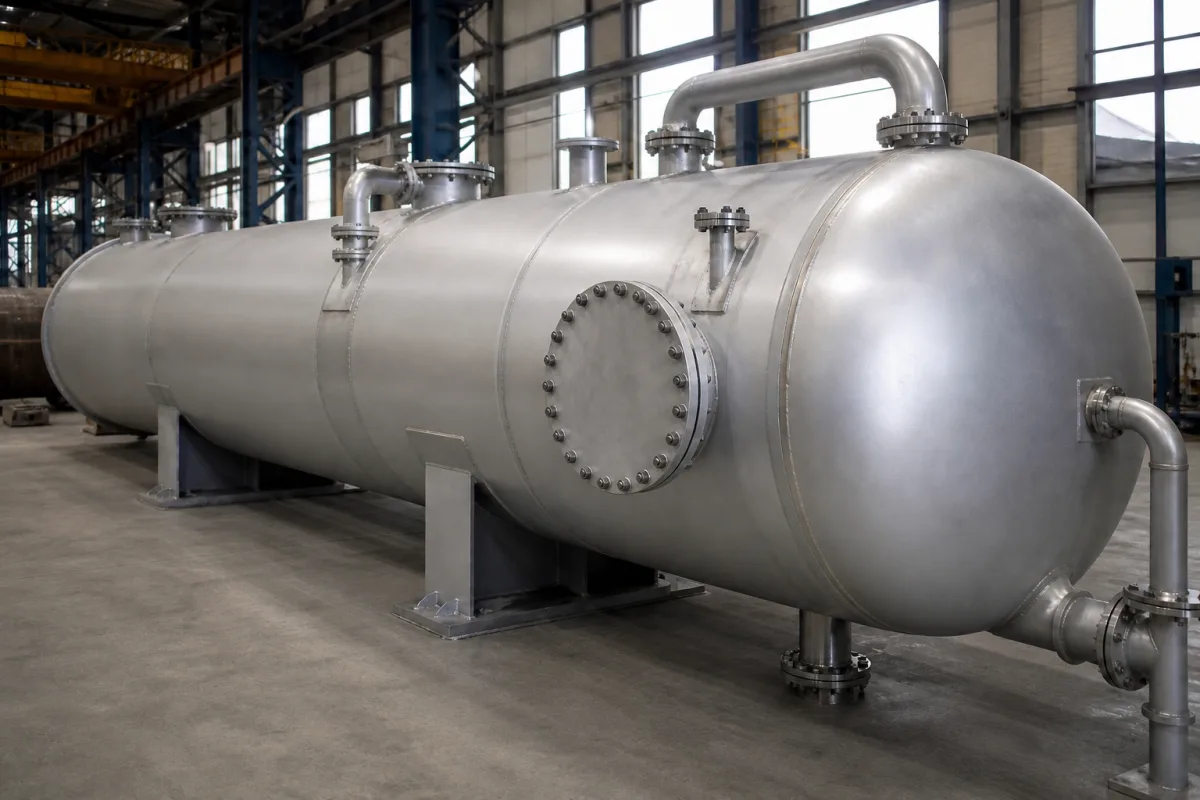
Process equipment · Code, test pressure and in-service cracking
A pressure vessel is bought once and inspected for decades. Settle the code it is built to and the rules of the market where it will be installed, define the maximum allowable pressure and temperature, and specify the tests and documents up front. Then plan inspection around the welds and service conditions that are known to crack.
Welded and forged vessels for gases, vapours and liquids under internal pressure: receivers, separators, reactors, filter housings, heat-exchanger shells and storage vessels. Boilers, piping and transportable gas cylinders are outside this page.
CNFX editorial research · Sources checked October 12, 2026 · 6 sources
In the EU, Directive 2014/68/EU applies essential safety requirements to vessels by fluid group, volume V and maximum allowable pressure PS: for example, vessels for Group 1 (hazardous) gases above 1 L with PS·V above 25 bar·L or PS above 200 bar, and for Group 2 gases above 1 L with PS·V above 50 bar·L or PS above 1,000 bar. Liquids whose vapour pressure is not more than 0.5 bar above atmospheric have higher limits. [1]
Equipment at or below those limits must be designed and made to the sound engineering practice of a Member State, with adequate instructions, and must not bear the CE marking. Above them, equipment is classified into categories of ascending hazard under Annex II. [1]
As an editorial calculation example only: a 500 L compressed-air receiver with PS 10 bar has PS·V of 5,000 bar·L, far above the 50 bar·L limit for Group 2 gases, so it falls within the Directive and its category must be read from Annex II.
OSHA notes that "most of the pressure or storage vessels in service in the United States will have been designed and constructed" to Section VIII of the ASME Boiler and Pressure Vessel Code, or to API Standard 620 for lower-pressure vessels outside the ASME Code, and that vessel certification is done by inspectors qualified for each code. [2]
State the country of installation, the code and edition required, and who will inspect or certify. A vessel built to one code is not automatically accepted under another.
02
Define maximum allowable pressure, temperature and protection
Under the Directive, PS is the maximum pressure the equipment is designed for, specified by the manufacturer at a stated location. Pressure-limiting devices must keep pressure from permanently exceeding PS; for pressure vessels, a momentary surge is limited to 10% of PS. [1]
OSHA warns that no valves or T-fittings should be present between the vessel and its safety relief valve. [2]
Give the supplier the fluid and its group, maximum and minimum allowable pressure and temperature, vacuum or external pressure, cyclic loading, corrosion allowance and any external loads such as wind, seismic or piping loads.
03
Set the hydrostatic test pressure and final inspection
The Directive requires a final inspection, internally and externally where appropriate, and a test of pressure containment, which it says "will normally take the form of a hydrostatic pressure test". For pressure vessels the hydrostatic test pressure must be at least the greater of 1.25 times the maximum loading in service (taking account of PS and maximum allowable temperature) and 1.43 times PS. [1]
As an editorial calculation example only: for PS 10 bar, the 1.43 × PS criterion gives at least 14.3 bar; if the service loading corrected for temperature is higher, the 1.25 criterion governs.
The Directive's dataplate must show, among other items, the year of manufacture, identification and serial number and essential maximum and minimum allowable limits, and where applicable the volume, test pressure and date, safety device set pressure and fluid group. [1]
04
Plan inspection around the welds that crack in service
OSHA reports that inspection programmes have found cracking in a considerable number of vessels, linked to the service environment: water hammer in deaerators, amine units, wet hydrogen sulfide, ammonia storage and kraft digesters. Cracking was concentrated in welds that had not been postweld heat treated, and OSHA advises inspection emphasis on non-PWHT and repaired vessels. [2]
OSHA says five NDE methods "are widely used for the examination of pressure vessels and tanks by certified pressure vessel inspectors": visual (VT), liquid penetrant (PT), magnetic particle (MT), radiography (RT) and ultrasonic (UT). VT, PT and MT find surface or near-surface defects; RT and UT find internal ones. PT works on austenitic stainless steel where MT does not, and UT can also measure wall thickness lost to corrosion. [2]
OSHA reminds that safety assessment depends on the largest flaw that may be missed, not the smallest that can be found. Ask the supplier which welds receive which examination, and to what extent, in the inspection and test plan. [2]
05
Compare what suppliers build
Suppliers linked to this page list receivers and storage vessels, separators, reactors, filter housings, vulcanizing tanks and high-pressure gas and cryogenic vessels. [3][4][5]
DFC, for example, lists ammonia separators built to GB 150 with design pressures such as 2.5 MPa, and an ASME three-phase separator in SA516-70; it reports passing an ASME renewal joint inspection. AIX lists electrically heated vulcanizing tanks for rubber processing. Treat code and stamp claims as items to verify against certificates. [3][6]
06
Trace the vessel components
This is a functional reference built from the sources cited; it is not one maker's parts list. Materials and thicknesses come from the design calculation of the vessel you order.
Part
Role
Fix in the order
Shell
Main pressure boundary; welds are the main inspection focus. [2]
Material grade, thickness, corrosion allowance and weld examination.
Heads or end closures
Close the shell.
Head type, material and forming method.
Nozzles and manways
Connect piping and give access for internal inspection. [2]
Sizes, ratings, flange standard and reinforcement.
Supports
Saddles, legs or skirts carry the vessel and its loads.
Support type and design loads.
Relief valve or bursting disc
Keep pressure from permanently exceeding PS. [1][2]
Set pressure, capacity and no valves between vessel and device.
Dataplate
Carries limits, test pressure and identification. [1]
Required marking under the applicable code.
07
Fill the specification fields with values for your vessel
A vessel quotation needs service-specific values. The table explains each field, gives published values where a reviewed source states them, and says what to obtain from the supplier.
Field
What it means and published values
Ask the supplier for
Design pressure (MPa)
Under PED, PS is the maximum pressure the equipment is designed for. [1]
Explore company information and manufacturing capabilities, then discuss the scope of your project with a relevant supplier.
Share this page
Compiled and source-reviewed by the CNFX editorial team.
Published product pages show what a company offers, not tested performance. Confirm the legal seller, factory, code certification and scope for your order. How we source and review
· Page last updated 13 October 2026
Buyer questions
Does the EU Pressure Equipment Directive apply to my vessel?
It depends on fluid group, volume and PS. For Group 2 gases, vessels above 1 L with PS·V above 50 bar·L or PS above 1,000 bar fall within it; smaller ones follow sound engineering practice and carry no CE marking. [1]
What hydrostatic test pressure is required?
Under the Directive, at least the greater of 1.25 times the maximum service loading (accounting for temperature) and 1.43 times PS. [1]
Where does OSHA report pressure vessel cracking?
OSHA reports cracking concentrated in welds without postweld heat treatment, driven by service environments such as wet hydrogen sulfide, amine, ammonia and caustic, and by water hammer in deaerators. [2]
Sources and what still needs a direct check
Sources checked 2026-10-12. The EU Directive and the OSHA Technical Manual are government sources; the Directive applies to the EU market only. Supplier pages describe their own offers. The ASME Boiler and Pressure Vessel Code, API 620 and GB 150 were not read for this page.