Industry-Verified Manufacturing Data (2026)

Primary (Roughing) Pump

Based on aggregated insights from multiple verified factory profiles within the CNFX directory, the standard Primary (Roughing) Pump used in the Machinery and Equipment Manufacturing sector typically supports operational capacities ranging from standard industrial configurations to heavy-duty production requirements.

Technical Definition & Core Assembly

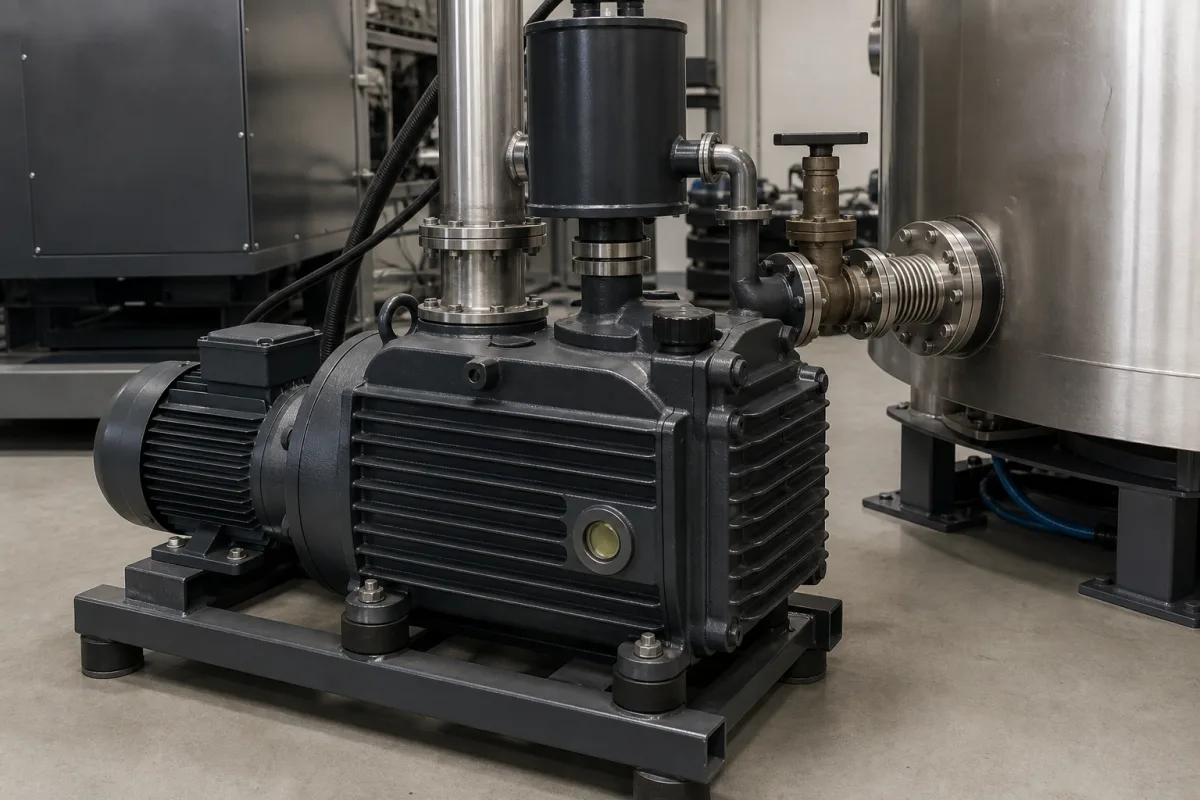
A canonical Primary (Roughing) Pump is characterized by the integration of Rotor and Vanes. In industrial production environments, manufacturers listed on CNFX commonly emphasize Cast Iron construction to support stable, high-cycle operation across diverse manufacturing scenarios.

A vacuum pump used to initially evacuate a system from atmospheric pressure to an intermediate vacuum level.
Product Specifications

Technical details and manufacturing context for Primary (Roughing) Pump

Definition
The primary (roughing) pump is a critical component within a vacuum pumping system responsible for the initial evacuation phase. It removes the bulk of gases from atmospheric pressure down to an intermediate vacuum range (typically 10^-3 to 10^-1 mbar), creating the necessary precondition for high-vacuum pumps to operate effectively. It serves as the first stage in multi-stage vacuum systems.
Working Principle
Operates by mechanically capturing and expelling gas molecules from the vacuum chamber. Common types include rotary vane pumps (using rotating vanes to create compression chambers) and diaphragm pumps (using a flexing diaphragm to create pressure differentials), which physically displace gas from the inlet to the exhaust port.
Common Materials
Cast Iron, Stainless Steel, Synthetic Elastomers (for seals)
Technical Parameters
  • Pumping speed at the inlet, measured in cubic meters per hour, indicating the volume flow rate of gas the pump can remove. (m³/h) Customizable
Components / BOM
  • Rotor
    The rotating element that creates the compression chambers for gas displacement.
    Material: Steel or Cast Iron
  • Vanes
    Sliding blades that seal against the stator wall, creating isolated compression chambers.
    Material: Carbon Composite or Reinforced Polymer
  • Stator Housing
    The main pump body that contains the rotor and vanes, forming the compression chamber.
    Material: Cast Iron or Aluminum
  • Inlet/Exhaust Valves
    Check valves that allow gas flow into the compression chamber and prevent backflow from the exhaust.
    Material: Stainless Steel
  • Oil Reservoir
    Contains lubricating and sealing oil for lubrication, cooling, and sealing internal clearances (for oil-sealed pumps).
    Material: Steel
Engineering Reasoning
1.01325 bar to 1.0e-3 bar (atmospheric to 1 mbar)
1.0e-2 bar (10 mbar) - oil backstreaming threshold for rotary vane pumps
Design Rationale: Oil vapor backstreaming occurs when inlet pressure exceeds 10 mbar, causing oil migration into vacuum chamber and contamination
Risk Mitigation (FMEA)
Trigger Inadequate gas ballast flow below 5% of pump displacement volume
Mode: Condensable vapor accumulation in pump oil
Strategy: Integrate automatic gas ballast valve with 10-15% displacement capacity and moisture sensor feedback
Trigger Continuous operation at 1.0e-1 bar (100 mbar) inlet pressure
Mode: Thermal overload from high compression ratio (1000:1)
Strategy: Install pressure-regulated bypass valve opening at 5.0e-2 bar with thermal cutout at 120°C bearing temperature

Industry Taxonomies & Aliases

Commonly used trade names and technical identifiers for Primary (Roughing) Pump.

Applied To / Applications

This component is essential for the following industrial systems and equipment:

Industrial Ecosystem & Supply Chain DNA

Complementary Systems
Downstream Applications
Specialized Tooling

Application Fit & Sizing Matrix

Operational Limits
pressure: Atmospheric to 10^-2 mbar
other spec: Flow Rate: 10-1000 m³/h, Slurry Concentration: Not applicable (dry operation)
temperature: -20°C to 120°C
Media Compatibility
✓ Dry air/gases ✓ Non-condensable vapors ✓ Clean process gases
Unsuitable: Corrosive or abrasive particulate-laden environments
Sizing Data Required
  • Required ultimate vacuum level (mbar)
  • Required pumping speed (m³/h)
  • System volume and desired evacuation time

Reliability & Engineering Risk Analysis

Failure Mode & Root Cause
Cavitation
Cause: Insufficient net positive suction head (NPSH) due to low inlet pressure, high fluid temperature, or excessive pump speed causing vapor bubble formation and implosion on impeller surfaces.
Bearing failure
Cause: Inadequate lubrication, contamination from process fluids or particulates, misalignment, or excessive radial/axial loads leading to overheating, wear, and eventual seizure.
Maintenance Indicators
  • Excessive vibration or audible knocking/rumbling from the pump casing
  • Sudden drop in discharge pressure accompanied by increased noise (indicative of cavitation or internal wear)
Engineering Tips
  • Maintain NPSH margin above manufacturer specifications by ensuring proper suction piping design, avoiding air ingress, and monitoring fluid temperature/pressure.
  • Implement precision alignment during installation/rebuilds and use condition monitoring (vibration analysis, oil analysis) to detect early bearing degradation.

Compliance & Manufacturing Standards

Reference Standards
ISO 5199:2015 - Technical specifications for centrifugal pumps ANSI/HI 1.1-1.6 - American National Standard for Rotodynamic Centrifugal Pumps DIN EN 22858 - Horizontal end suction centrifugal pumps
Manufacturing Precision
  • Impeller diameter: +/-0.5mm
  • Shaft runout: 0.05mm maximum
Quality Inspection
  • Hydrostatic pressure test
  • Vibration analysis test

Factories Producing Primary (Roughing) Pump

Verified manufacturers with capability to produce this product in China

✓ 93% Supplier Capability Match Found

S Sourcing Manager from Germany Jan 12, 2026
★★★★★
"As a professional in the Machinery and Equipment Manufacturing sector, I confirm this Primary (Roughing) Pump meets all ISO standards."
Technical Specifications Verified
P Procurement Specialist from Brazil Jan 09, 2026
★★★★☆
"Standard OEM quality for Machinery and Equipment Manufacturing applications. The Primary (Roughing) Pump arrived with full certification. (Delivery took slightly longer than expected, but technical support was excellent.)"
Technical Specifications Verified
T Technical Director from Canada Jan 06, 2026
★★★★★
"Great transparency on the Primary (Roughing) Pump components. Essential for our Machinery and Equipment Manufacturing supply chain."
Technical Specifications Verified
Verification Protocol

“Feedback is collected from verified sourcing managers during RFQ (Request for Quote) and factory evaluation processes on CNFX. These reports represent historical performance data and technical audit summaries from our B2B manufacturing network.”

11 sourcing managers are analyzing this specification now. Last inquiry for Primary (Roughing) Pump from Mexico (1h ago).

Supply Chain Compatible Machinery & Devices

Hydraulic Press

Industrial machine using hydraulic pressure to compress, form, or assemble materials

Explore Specs →
Heavy-Duty CNC Plasma Cutting Machine

Industrial machine for precision metal cutting using plasma arc technology

Explore Specs →
Automated Assembly Line System

Integrated production system for sequential component assembly operations

Explore Specs →
Automated Powder Coating System

Integrated industrial system for applying dry powder coatings to metal substrates.

Explore Specs →

Frequently Asked Questions

What is the typical pressure range for a primary roughing pump?

Primary roughing pumps typically evacuate systems from atmospheric pressure (760 Torr) down to intermediate vacuum levels around 1-10 Torr, preparing systems for high-vacuum pumps.

Why are cast iron and stainless steel used in roughing pump construction?

Cast iron provides durability and vibration damping for the housing, while stainless steel offers corrosion resistance for components exposed to process gases, ensuring long service life in industrial environments.

How often should oil be changed in an oil-sealed roughing pump?

Oil changes depend on operating conditions, but typically every 3-6 months of continuous use or 2,000-3,000 operating hours. Regular oil maintenance prevents contamination and maintains optimal vacuum performance.

Can I contact factories directly on CNFX?

CNFX is an open directory, not a transaction platform. Each factory profile provides direct contact information and production details to help you initiate direct inquiries with Chinese suppliers.

Get Quote for Primary (Roughing) Pump

Request technical pricing, lead times, or customized specifications for Primary (Roughing) Pump directly from verified manufacturing units.

Your business information is encrypted and only shared with verified Primary (Roughing) Pump suppliers.

Thank you! Your message has been sent. We'll respond within 1–3 business days.

Need to Manufacture Primary (Roughing) Pump?

Connect with verified factories specializing in this product category

Add Your Factory Contact Us
Previous Product
Pressure/Vacuum System
Next Product
Prime Mover (Engine/Generator)