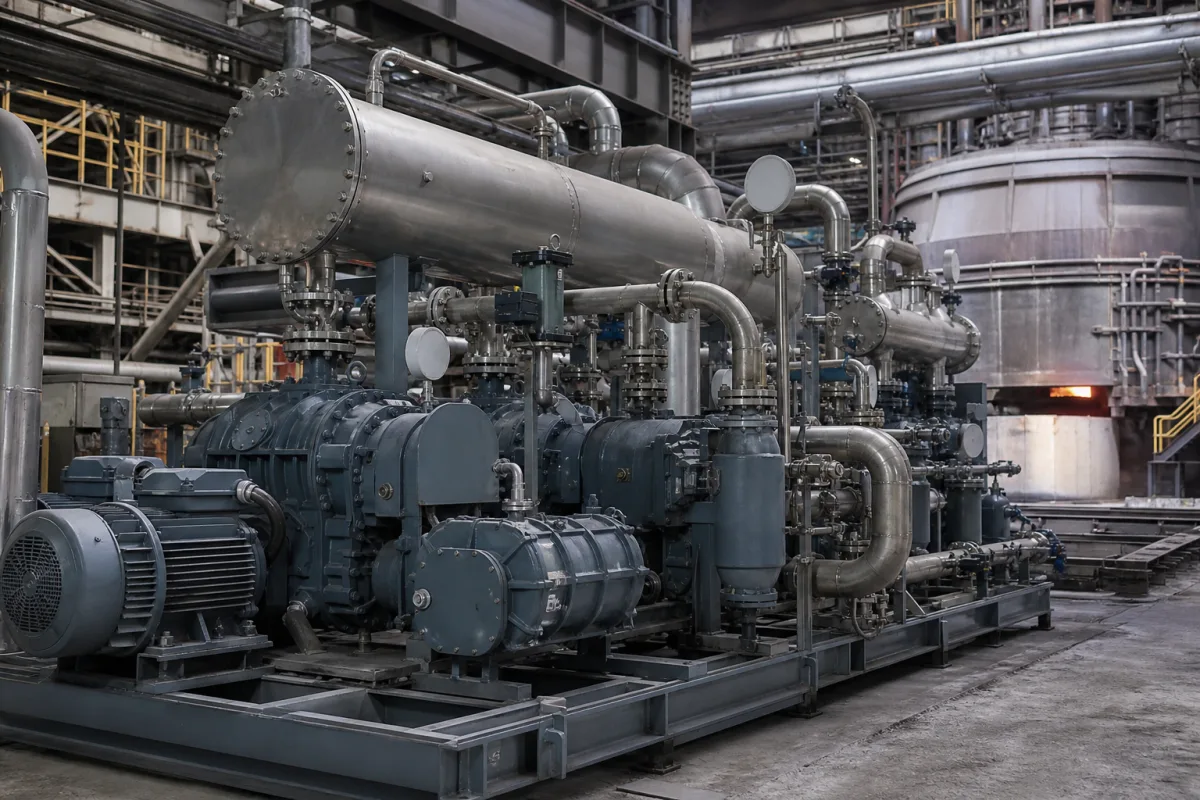
Vacuum pumping system for steel degassing: dry Roots and screw pump stages that pull a hot, dusty ladle tank below 1 hPa in minutes
Vacuum pumping systems for steel degassers · Below 1 hPa in VD for 10–20 minutes, 200–50 hPa while blowing oxygen in VOD, 3–7 minute pump-downs, 30,000 to over 1,000,000 m³/h at 0.67 hPa, fine metal dust, and dry Roots-and-screw skids that replace steam ejectors
This page covers the vacuum pumping systems of secondary steelmaking degassers: the multi-stage pump sets, gas coolers, dust filters and valves that evacuate VD and VOD tank degassers and RH vessels. Ask three things first: what pressures, hold times and pump-down time each process needs at your ladle size, how the dust and hot gas are cooled and filtered before the pumps, and whether the system is steam ejector or dry mechanical, with its energy and water consequences.
Vacuum pumping systems for VD, VOD and RH steel degassers, including steam ejector and dry mechanical (Roots and screw) systems, gas coolers and dust filters. Vacuum tank degasser stations, with their metallurgy, argon stirring and freeboard, are covered on the Degassing chamber for liquid steel page, which also compares ejectors and dry pumps in brief; this page covers the pumping train itself. Vacuum induction degassing furnaces are covered on the Vacuum induction degassing unit page, general packaged pump skids on the Packaged vacuum pump system page, inert gas metering on the Gas control system for molten metal treatment page, and single vacuum pumps on their own pages. Vacuum systems for transformer oil treatment and aluminium degassing rotors are outside this page.
CNFX editorial research · Sources checked October 12, 2026 · 4 sources
What the pumps face: below 1 hPa in minutes, huge volumes and fine metal dust
Zöllig of Oerlikon Leybold describes VD and VOD as tank degassing of ladles holding around 20–200 t: in VD the tank is pumped below 1 hPa after sealing and held there for 10–20 minutes; in VOD the pressure is first brought to 200–50 hPa while oxygen is blown onto the steel for about 10–40 minutes to burn off carbon or phosphorus, followed by a VD stage below 1 hPa; RH draws the steel up through two snorkels into a vacuum chamber dipped into the ladle. Because the melt keeps cooling, evacuation must be fast, with evacuation times of only about 3–7 minutes, and at a design pressure of 0.67 hPa the required exhaust rate runs from around 30,000 m³/h for a small VD to over 1,000,000 m³/h for a large RH. Metal evaporating from melt above 1,500 °C and oxides from oxygen blowing condense into large amounts of very fine dust that the vacuum system has to handle. [1]
Editorial calculation: going from 1,013 hPa to 0.67 hPa is a pressure ratio of about 1,500:1, more than one pump type covers efficiently, which is why the suppliers below build three or four stages.
Give the supplier the degasser type (VD, VOD, VLD, RH), ladle size and heats per day, the vessel and duct volume, target pressures and hold times, required pump-down time, oxygen blowing rates, expected dust load, available power and cooling water, and any explosion-protection requirement.
02
Dry Roots-and-screw skids with gas coolers and dust filters, against steam ejectors
Zöllig lists the drawbacks of the established steam ejector systems, which in practice are paired with liquid ring pumps in a good share of plants: very high energy use and a negative CO2 balance, steam generation and start-up of at least 1–2 hours so they run continuously on standby, poor pressure regulation, dust layers needing regular mechanical cleaning, and wet dust separation in condensers and liquid ring pumps that produces waste water. [1] Pfeiffer adds that ejectors are cheap to buy but costly to run because dust contaminates the cooling water, and offers mechanical systems of three or more stages of gas-circulation-cooled Roots pumps (OktaLine G), Roots pumps (OktaLine) and screw pumps (HeptaDry), with a dust filter; its SKID module puts an Okta 25000, an Okta 4000 G with integrated gas cooler and a Hepta 600 on one frame, and a VD/VOD station for 45 t of steel needed only eleven pumps: five OktaLine, three OktaLine G and three HeptaDry. [3]
Leybold's revamping package for VD, VOD and RH degassers replaces steam ejectors, which need steam at 200 °C, with gas coolers, dust filters and separation, three- or four-stage skids of DRYVAC screw and RUVAC Roots pumps, police filters on the exhaust, flare stack and gas analysis, and controls linked to the plant PLC. [2] At Rubiera Special Steel in Italy, two vacuum lid degasser (VLD) stations, whose cover sits directly on the ladle to minimise volume, had their steam ejectors replaced by dry mechanical pumps with a dust separator, a textile filter and radar-based foaming slag control, aiming to run VD/VOD without the steam supply and to improve pump-down time and final pressure. [4]
03
Send the degasser, cycle and utilities together
Paste it into your enquiry below or into an email to a maker, then replace every bracket.
Explore company information and manufacturing capabilities, then discuss the scope of your project with a relevant supplier.
Share this page
Compiled and source-reviewed by the CNFX editorial team.
Each manufacturer above links to the page on that company's own website where the product is listed, with the date we checked it. How we source and review
· Page last updated 13 October 2026
Buyer questions
How fast must a steel degasser be evacuated?
Zöllig of Oerlikon Leybold gives pump-down times of about 3–7 minutes because the melt keeps cooling, with VD held below 1 hPa for 10–20 minutes. [1]
How large is a steel degassing vacuum system?
At 0.67 hPa the required exhaust rate runs from around 30,000 m³/h for a small VD to over 1,000,000 m³/h for a large RH unit. [1]
Why replace steam ejectors with dry pumps on a degasser?
Steam ejectors use large amounts of energy, need 1–2 hours of steam start-up, regulate pressure poorly and separate dust wet into waste water; dry Roots-and-screw systems with dust filters avoid these. [1][3]
Sources and what still needs a direct check
Sources checked 2026-10-12. An Oerlikon Leybold paper in TU Dortmund conference proceedings explains degasser duty; Leybold and Pfeiffer describe their systems; a trade release covers a plant retrofit.