Editorial Technical Reference

Radiation Shielding Structure

This page explains how Radiation Shielding Structure is classified within Machinery and Equipment Manufacturing. Technical values and manufacturer relationships are research references; confirm the current specification and supplier evidence for each order.

Technical Definition & Core Assembly

A protective enclosure designed to contain and attenuate gamma radiation within an automated sterilization system.
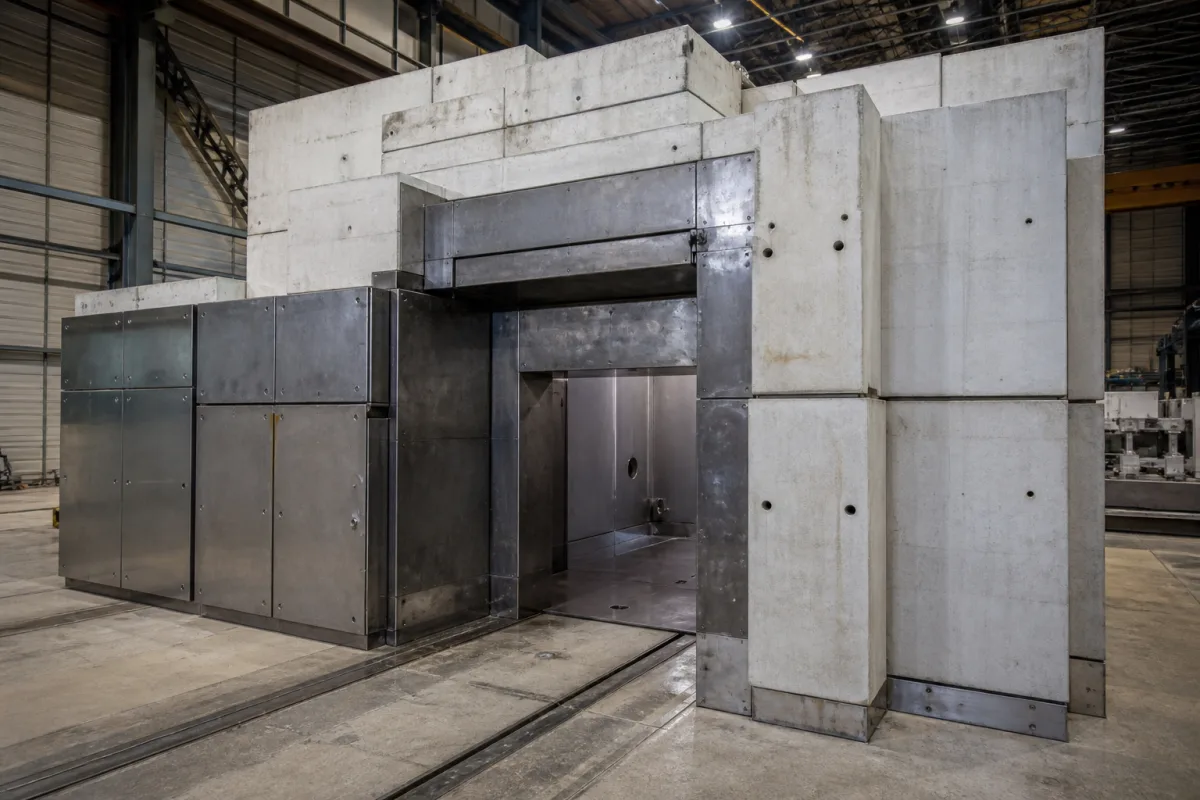
Radiation Shielding Structure in a manufacturing environment
Representative product image. Confirm appearance and specifications with the manufacturer.

Product Specifications

Technical details and manufacturing context for Radiation Shielding Structure

Definition
The Radiation Shielding Structure is a critical safety component of the Automated Gamma Sterilization Processing Line. Its primary function is to physically contain the radiation source and prevent gamma ray leakage, ensuring operator safety and regulatory compliance. The structure surrounds the irradiation chamber and conveyor system, forming a barrier that attenuates radiation to safe levels outside the enclosure. Constructed from high-density materials such as lead, high-density concrete, or steel, the shielding absorbs and scatters gamma radiation through photoelectric absorption, Compton scattering, and pair production. The design incorporates a lead equivalent thickness ranging from 10 to 50 mm, achieving a gamma attenuation efficiency of 99.5% to 99.9% for Co-60 sources, as verified by dosimetry. The structure operates within a temperature range of -40°C to 85°C and a pressure range of 1.0 to 1.6 MPa, with a sealing class of IP54 to IP65 to protect against dust and water jets. The surface finish is specified as Ra 0.8 to 1.6 μm for easy decontamination, and dimensional tolerances are ±0.5 mm to ensure proper fit with the sterilization system. The weight ranges from 500 to 2000 kg, and the footprint is customizable, with a typical size of 2000×1500×1800 mm. The radiation leakage rate at the surface is less than 0.5 mSv/h, complying with IAEA safety standards. Shielding material options include lead (Pb) or tungsten (W), with lead being cost-effective and tungsten offering higher density and reduced thickness. Material grade for lead alloy is ASTM B749-14 with purity ≥99.9%. All parameters are reference ranges that must be verified for the specific model and application. Buyers should confirm compliance with relevant standards such as ASTM B749, ISO 4037, IEC 60068-2-14, IEC 60529, ISO 1302, and ISO 2768-m with the legal manufacturer or supplier.
Working Principle
The shielding structure uses high-density materials like lead, concrete, or steel to attenuate gamma radiation. When gamma photons interact with the material, they undergo photoelectric absorption, Compton scattering, and pair production, which reduce the energy and intensity of the radiation. The lead equivalent thickness determines the attenuation level, with higher thickness providing greater shielding for higher gamma energies. The structure is designed to reduce radiation levels outside to safe limits, as verified by dosimetry.
Common Materials
Lead, High-density concrete, Steel
Technical Parameters
ParameterTypical rangeNotes & selection driver
Shielding MaterialLead (Pb) or Tungsten (W)Lead for cost-effectiveness; tungsten for higher density and reduced thickness.ASTM B749
Lead Equivalent Thickness10–50 mmDetermines attenuation level; higher for higher gamma energies.ISO 4037
Gamma Attenuation Efficiency99.5–99.9 %For Co-60 sources; verify with dosimetry.ISO 4037
Operating Temperature Range-40–85 °COutside range may affect material integrity.IEC 60068-2-14
Sealing ClassIP54–IP65Protects against dust and water jets.IEC 60529
Surface FinishRa 0.8–1.6 μmSmooth finish for easy decontamination.ISO 1302
Dimensional Tolerance±0.5 mmEnsures proper fit with sterilization system.ISO 2768-m
Weight500–2000 kgDepends on size and material; affects installation.
Footprint (L×W×H)2000×1500×1800 mmCustomizable; verify with system layout.
Radiation Leakage Rate<0.5 mSv/hAt surface; must comply with local regulations.IAEA Safety Standards
Material GradeASTM B749-14Lead alloy; purity ≥99.9%.ASTM B749

Ranges are indicative industry figures for RFQ preparation, not a supplier commitment. Confirm every value and standard with the legal manufacturer before ordering.

Components / BOM
  • Primary Shield Wall Part
    Main radiation attenuation barrier surrounding irradiation chamber
    Material: Lead-concrete composite
  • Access Door Shield
    Radiation-protected entry point with interlock safety system
    Material: Lead-steel laminate
  • Viewing Window Part
    Lead-glass panel for visual monitoring of sterilization process
    Material: Lead-glass composite
  • Conveyor Port Shield
    Radiation maze or labyrinth for product entry/exit while maintaining shielding integrity
    Material: Steel with lead lining

Industrial Ecosystem & Supply Chain Structure

Complementary Systems
Downstream Applications
Specialized Tooling

Application Fit & Sizing Matrix

Operational Limits
humidity: 20% to 80% RH (non-condensing)
pressure: Atmospheric to 1.5 bar (gauge)
temperature: 10°C to 40°C (operating), -20°C to 60°C (storage)
radiation dose rate: Up to 10 kGy/h (external attenuation to <0.5 µSv/h)
Media Compatibility
✓ Gamma radiation from Co-60 or Cs-137 sources ✓ Medical devices/implants for sterilization ✓ Pharmaceutical packaging materials
Unsuitable: High-pressure steam (autoclave) or chemical sterilization environments
Sizing Data Required
  • Maximum product dimensions/volume to be sterilized
  • Required radiation dose (kGy) and source strength (Ci)
  • Required shielding attenuation factor (e.g., 1/1000 reduction)

Reliability & Engineering Risk Analysis

Failure Mode & Root Cause
Radiation Leakage
Cause: Material degradation due to prolonged neutron bombardment causing embrittlement and micro-cracking in shielding materials like lead or concrete
Structural Integrity Compromise
Cause: Thermal cycling-induced stress fractures from repeated heating/cooling cycles during radiation exposure and maintenance shutdowns
Maintenance Indicators
  • Visible surface discoloration or blistering indicating material breakdown
  • Audible cracking sounds during thermal expansion/contraction cycles
Engineering Tips
  • Implement regular neutron flux monitoring and material thickness testing to detect degradation before critical levels
  • Use thermal expansion joints and graded material transitions to minimize stress concentrations during temperature fluctuations

Indicative industry ranges for design and RFQ preparation. Confirm the exact figures and applicable standard with the manufacturer before specifying.

Compliance & Manufacturing Standards

Applicable Standards
ISO 4037-1:2019 (X and gamma reference radiation for calibrating dosemeters and doserate meters) ANSI/HPS N43.2-2021 (Radiation Safety for X-Ray Diffraction and Fluorescence Analysis Equipment) DIN 25413-1:2013 (Shielding against ionizing radiation - Part 1: Calculation principles)

Quoted from the published standard.

Manufacturing Precision
  • Shielding thickness: +/-1.5% of nominal value
  • Joint gap uniformity: ≤0.5mm across all mating surfaces
Quality Inspection
  • Leakage radiation test (per IEC 60601-1-3)
  • Ultrasonic testing for material homogeneity and bonding integrity

Manufacturers of Radiation Shielding Structure

Manufacturer profiles associated with Radiation Shielding Structure.

Sourcing Radiation Shielding Structure from China?
Tell us your specification and target quantity — we will match it against manufacturer records and come back with the factories that fit.
Request manufacturers We manufacture this

Manufacturer listings support early research and capability understanding. They are not certification, ranking, or transaction guarantees.

Share this page
Technical documentation
Request current drawings, revision history, and a signed specification sheet.
Manufacturing capability
Verify equipment lists, process limits, capacity, and representative production evidence.
Inspection readiness
Confirm test methods, calibrated equipment, sampling plans, and traceable reports.
Supplier transparency
Check the legal entity, factory address, ownership, certifications, and direct contacts.

CNFX does not score or rank suppliers. Buyers must verify all claims and documents with the legal manufacturer before ordering.

Supply Chain Compatible Machinery & Devices

Hydraulic Press

Industrial machine using hydraulic pressure to compress, form, or assemble materials

Explore Specs →
Heavy-Duty CNC Plasma Cutting Machine

The Heavy-Duty CNC Plasma Cutting Machine is a standalone industrial device designed for cutting conductive metals such as steel, stainless steel, aluminum, and copper alloys.

Explore Specs →
Automated Powder Coating System

Integrated industrial system for applying dry powder coatings to metal substrates.

Explore Specs →
Centrifugal Pump Impeller

The centrifugal pump impeller is a critical rotating component that converts mechanical energy from the motor into kinetic energy in fluid systems.

Explore Specs →

Frequently Asked Questions

What materials are used in the radiation shielding structure?

The structure can be made of lead, high-density concrete, or steel. Lead is cost-effective, while tungsten offers higher density and reduced thickness. The material grade for lead alloy is ASTM B749-14 with purity ≥99.9%.

What is the typical lead equivalent thickness?

The lead equivalent thickness ranges from 10 to 50 mm, depending on the gamma energy and required attenuation. This value must be verified for the specific application.

What is the radiation leakage rate?

The radiation leakage rate at the surface is less than 0.5 mSv/h, complying with IAEA safety standards. Actual leakage should be verified with dosimetry.

What standards apply to this component?

Relevant standards include ASTM B749 for material, ISO 4037 for attenuation, IEC 60068-2-14 for temperature, IEC 60529 for sealing, ISO 1302 for surface finish, and ISO 2768-m for dimensional tolerance. Compliance must be confirmed with the manufacturer.

Data Basis

Editorial classification, named public sources where available, and source-reviewed manufacturer records.

Preliminary Technical Classification
This page supports structured research, RFQ preparation, and supplier evaluation. It does not replace buyer-led supplier qualification, standards review, or technical approval.
Buyer enquiry

Request manufacturing insight for Radiation Shielding Structure

Ask for use case, specification boundaries, supplier type, and RFQ preparation information for this product.

Where it goes
Straight to the CNFX editorial desk, and to the manufacturer if this product is linked to a claimed profile. Nothing is broadcast to a supplier list.
Your details stay here
We do not sell or rent enquiry data, and we do not add you to a mailing list. Used only to answer this request.
No commission, no middleman
CNFX is a directory. We take no cut of any order and never negotiate on a supplier's behalf.
What we don't claim
A listing is not an endorsement. Qualify every supplier and verify every figure yourself before ordering.

Your business information is used only to process this request.

Thank you! Your message has been sent. We'll respond within 1–3 business days.
Sorry, we couldn't send your message. Please try again, or email us at [email protected].

Need to Manufacture Radiation Shielding Structure?

Compare manufacturer profiles with relevant product and process capability.

Previous Product
Z-axis Ram/Spindle
Last Product
Get QuotesChat