Industry-Verified Manufacturing Data (2026)

Relief Valve (Optional)

Based on aggregated insights from multiple verified factory profiles within the CNFX directory, the standard Relief Valve (Optional) used in the Machinery and Equipment Manufacturing sector typically supports operational capacities ranging from standard industrial configurations to heavy-duty production requirements.

Technical Definition & Core Assembly

A canonical Relief Valve (Optional) is characterized by the integration of Valve Body and Spring. In industrial production environments, manufacturers listed on CNFX commonly emphasize Stainless Steel (Body/Spring) construction to support stable, high-cycle operation across diverse manufacturing scenarios.

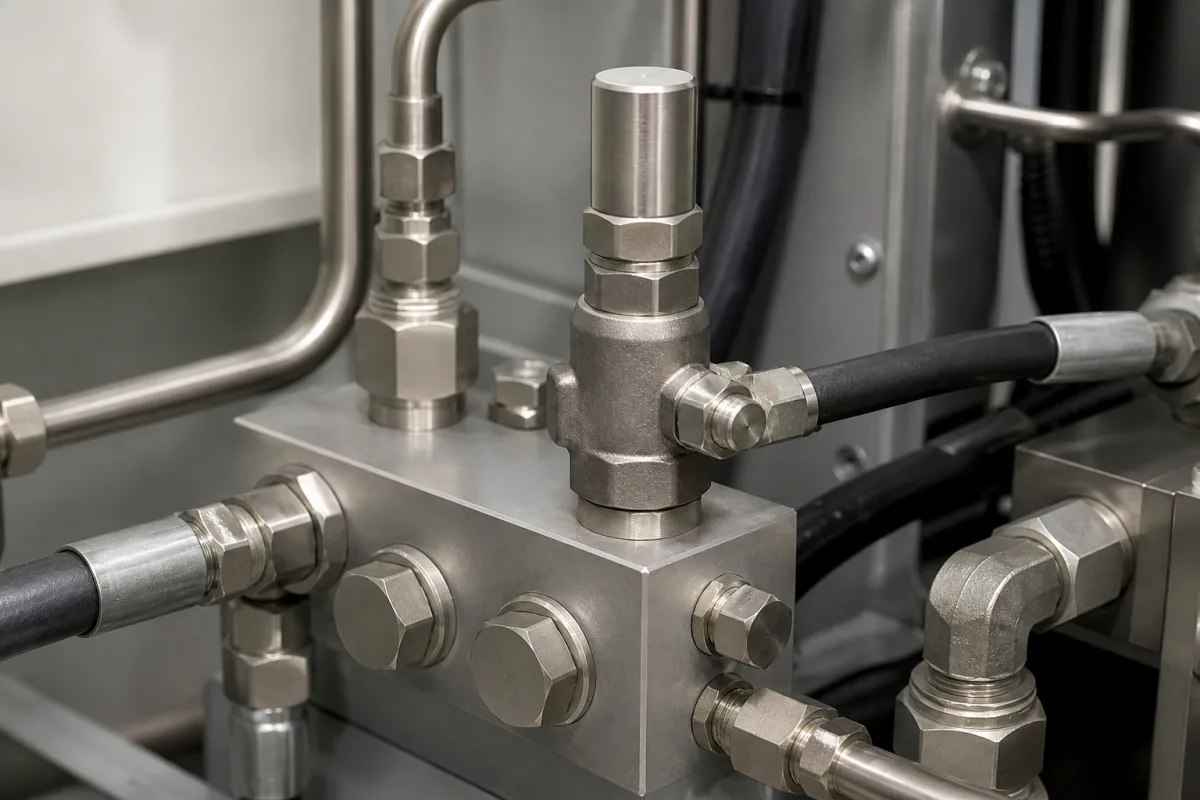
A safety device installed on a distribution manifold/block to prevent overpressure by automatically releasing excess fluid when pressure exceeds a preset limit.
Product Specifications

Technical details and manufacturing context for Relief Valve (Optional)

Definition
An optional relief valve is a critical safety component integrated into a distribution manifold or block system. Its primary function is to protect the entire fluid distribution network and connected equipment from damage due to excessive pressure buildup. When system pressure reaches a predetermined set point, the valve opens to discharge a controlled amount of fluid (liquid or gas) to the atmosphere or a return line, thereby reducing pressure to a safe operating level before resealing.
Working Principle
The valve operates based on a force-balance mechanism. A spring (or other actuating element) applies a closing force to a sealing element (disc, poppet, or diaphragm). When the system pressure acting on the sealing area generates an upward force that exceeds the spring force, the valve lifts off its seat. This creates an opening, allowing fluid to flow out until the pressure drops below the set point, at which point the spring force reseats the valve, stopping the flow.
Common Materials
Stainless Steel (Body/Spring), Elastomer (Seal), Brass
Technical Parameters
  • Set Pressure - The pressure at which the valve begins to open. (bar or psi) Standard Spec
Components / BOM
  • Valve Body
    Houses internal components and provides inlet/outlet connections to the manifold.
    Material: Stainless Steel or Brass
  • Spring
    Provides the adjustable closing force that determines the set pressure.
    Material: Stainless Steel
  • Poppet/Disc
    The moving sealing element that lifts off the seat to allow flow when pressure is exceeded.
    Material: Stainless Steel
  • Seal (O-ring/Gasket)
    Ensures a leak-tight seal between the poppet/disc and the valve seat when closed.
    Material: FKM (Viton) or NBR (Nitrile) Elastomer
  • Adjustment Screw/Cap
    Allows for calibration and adjustment of the spring tension to set the relief pressure.
    Material: Stainless Steel or Brass
Engineering Reasoning
0.5-25.0 bar
28.5 bar (115% of maximum rated pressure)
Design Rationale: Plastic deformation of the spring-disk assembly due to sustained pressure exceeding the material's yield strength (typically 250-350 MPa for spring steel), leading to permanent set and loss of calibration
Risk Mitigation (FMEA)
Trigger Corrosive fluid ingress (pH <4.0 or >10.5) interacting with the 316L stainless steel sealing surface
Mode: Pitting corrosion at the valve seat causing continuous leakage below set pressure
Strategy: Application of PTFE coating (0.1-0.3 mm thickness) on all wetted surfaces or selection of Hastelloy C-276 material
Trigger Cyclic pressure fluctuations exceeding ±15% of set pressure at frequencies above 5 Hz
Mode: High-cycle fatigue fracture of the spring (typically at 10^6-10^7 cycles) leading to catastrophic failure to open
Strategy: Installation of pulsation dampener upstream with 0.5-1.0 L accumulator volume and pressure snubber

Industry Taxonomies & Aliases

Commonly used trade names and technical identifiers for Relief Valve (Optional).

Applied To / Applications

This component is essential for the following industrial systems and equipment:

Industrial Ecosystem & Supply Chain DNA

Complementary Systems
Downstream Applications
Specialized Tooling

Application Fit & Sizing Matrix

Operational Limits
pressure: Up to 6000 psi (414 bar)
other spec: Flow capacity: 10-500 GPM (38-1893 L/min), Slurry concentration: ≤5% solids by weight
temperature: -20°C to 150°C
Media Compatibility
✓ Hydraulic oil ✓ Process water ✓ Compressed air
Unsuitable: Highly corrosive acids (e.g., hydrochloric acid, sulfuric acid)
Sizing Data Required
  • Required relief pressure (set point)
  • Maximum flow rate during relief event
  • Fluid properties (density, viscosity, compressibility)

Reliability & Engineering Risk Analysis

Failure Mode & Root Cause
Sticking or Failure to Open
Cause: Corrosion, fouling, or accumulation of debris on the valve seat or moving parts, preventing proper operation when pressure exceeds setpoint.
Leakage or Failure to Reseat
Cause: Wear or damage to the valve seat or disc from erosion, corrosion, or improper installation, causing the valve to leak after activation or not fully close.
Maintenance Indicators
  • Audible hissing or continuous leakage from the valve discharge, indicating it's not reseating properly.
  • Visible corrosion, physical damage, or signs of tampering on the valve body or adjustment mechanism.
Engineering Tips
  • Implement a regular testing and inspection schedule per ASME standards to verify set pressure and reseating performance, using calibrated equipment.
  • Ensure proper installation with adequate support and alignment, and protect the valve from environmental contaminants and corrosive atmospheres.

Compliance & Manufacturing Standards

Reference Standards
ISO 4126-1: Safety devices for protection against excessive pressure - Safety valves ASME/ANSI B16.34: Valves - Flanged, Threaded, and Welding End DIN EN ISO 4126-1: Sicherheitseinrichtungen gegen unzulässigen Überdruck - Sicherheitsventile
Manufacturing Precision
  • Set Pressure: +/-3% of specified pressure
  • Seat Leakage: Zero detectable leakage at 90% of set pressure
Quality Inspection
  • Hydrostatic Shell Test: 1.5 times maximum allowable working pressure
  • Set Pressure and Pop Test: Functional verification at specified operating conditions

Factories Producing Relief Valve (Optional)

Verified manufacturers with capability to produce this product in China

✓ 92% Supplier Capability Match Found

P Procurement Specialist from United States Feb 28, 2026
★★★★★
"The technical documentation for this Relief Valve (Optional) is very thorough, especially regarding technical reliability."
Technical Specifications Verified
T Technical Director from United Arab Emirates Feb 25, 2026
★★★★★
"Reliable performance in harsh Machinery and Equipment Manufacturing environments. No issues with the Relief Valve (Optional) so far."
Technical Specifications Verified
P Project Engineer from Australia Feb 22, 2026
★★★★★
"Testing the Relief Valve (Optional) now; the technical reliability results are within 1% of the laboratory datasheet."
Technical Specifications Verified
Verification Protocol

“Feedback is collected from verified sourcing managers during RFQ (Request for Quote) and factory evaluation processes on CNFX. These reports represent historical performance data and technical audit summaries from our B2B manufacturing network.”

9 sourcing managers are analyzing this specification now. Last inquiry for Relief Valve (Optional) from USA (1h ago).

Supply Chain Compatible Machinery & Devices

Heavy-Duty CNC Plasma Cutting Machine

Industrial machine for precision metal cutting using plasma arc technology

Explore Specs →
Automated Assembly Line System

Integrated production system for sequential component assembly operations

Explore Specs →
Automated Powder Coating System

Integrated industrial system for applying dry powder coatings to metal substrates.

Explore Specs →
Centrifugal Pump Impeller

Rotating component that transfers energy to fluid in centrifugal pumps.

Explore Specs →

Frequently Asked Questions

What materials are used in this relief valve construction?

This relief valve features a stainless steel body and spring for corrosion resistance, brass adjustment components, and elastomer seals (O-rings/gaskets) for reliable fluid containment and pressure management.

How does this relief valve prevent overpressure in machinery systems?

The valve automatically opens when system pressure exceeds the preset limit, releasing excess fluid through the poppet/disc mechanism. This protects equipment from damage by maintaining safe operating pressures in distribution manifolds and blocks.

What maintenance does this industrial relief valve require?

Regular inspection of seals for wear, checking spring tension, and verifying pressure settings via the adjustment screw/cap. Periodic cleaning of the valve body and poppet ensures consistent performance in machinery applications.

Can I contact factories directly on CNFX?

CNFX is an open directory, not a transaction platform. Each factory profile provides direct contact information and production details to help you initiate direct inquiries with Chinese suppliers.

Get Quote for Relief Valve (Optional)

Request technical pricing, lead times, or customized specifications for Relief Valve (Optional) directly from verified manufacturing units.

Your business information is encrypted and only shared with verified Relief Valve (Optional) suppliers.

Thank you! Your message has been sent. We'll respond within 1–3 business days.

Need to Manufacture Relief Valve (Optional)?

Connect with verified factories specializing in this product category

Add Your Factory Contact Us
Previous Product
Release/Click Mechanism
Next Product
Remote Control