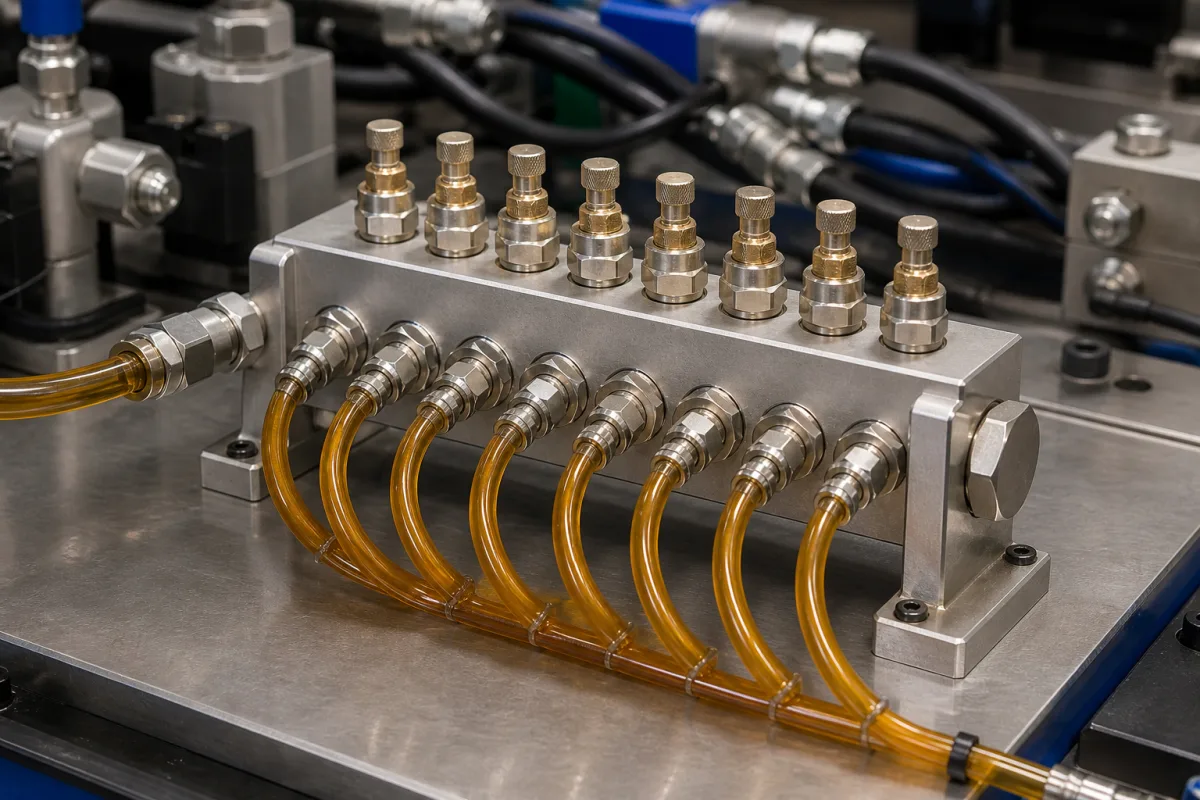
Lubricant distribution manifold with screw-in metering valves: single-line volumetric distributor blocks that give each outlet a fixed dose of oil or fluid grease per cycle
The block that splits one lubricant line into a row of metered outlets · screw-in piston metering valves and their manifolds, the dose each outlet gives per cycle, the pressure needed to fire them and the pressure they need to reset
On machine tools, packaging and printing machines, one small pump feeds dozens of slideways, screws and bearings through a single line. What gives each point its own amount is the distribution block: a manifold with one volumetric metering valve per outlet, each discharging a fixed dose every time the line is pressurised and refilling when the pressure is released. Buying or replacing one means choosing the number of outlets, the dose at each, the lubricant they can handle, and the pressures at which they fire and reset.
Distribution manifolds and blocks for single-line (intermittent) centralised lubrication of machines: manifold bodies with screw-in or integral volumetric piston metering valves (prelubrication and relubrication types), their metering nipples, outlet connections, materials, operating and reset pressures, and reset times. Choosing between single-line, dual-line and progressive systems, pumps, monitoring and system design is covered on the Lubrication system page. Progressive divider blocks, dual-line metering valves and resistance-type flow units are outside this page.
CNFX editorial research · Sources checked October 13, 2026 · 3 sources
Outlets and doses: 1- to 6-port manifolds for screw-in valves, integral 2-, 3- and 5-outlet blocks, and doses from 0.01 to 0.60 cm³ per cycle
SKF describes its MonoFlex single-line distributors as delivering a precisely metered quantity of 0.01 to 1.5 cm³ per cycle to each lubrication point, across 11 product series. Three published designs show how the dose and the outlet count are chosen: [1]
SKF's VL manifolds in one of its dimension tables step 17 mm between screw-in points, from 40 mm long for one port to 125 mm for six. [1] Its metering nipples for oil are brass and those for fluid grease nickel-plated brass, so the two can be told apart on the block; ILC uses black and grey nipples for the same purpose. [1][2]
Editorial calculation: a block like the one in the image, with eight outlets, fitted with 0.10 cm³ valves (an example choice) delivers 0.8 cm³ per lubrication cycle in total, and the pump must displace that plus the line's compression losses each cycle.
The image shows such a block: an aluminium manifold with eight knurled brass metering elements screwed into its top, eight outlet fittings on its front feeding amber nylon tubes, and a main-line fitting at one end.
Design
Outlets
Dose per outlet per cycle
Body and connections
SKF MonoFlex series 351 in VL manifold
Single-port valves screwed (M10×1) into manifolds with 1 to 6 screw-in points; other counts on request
0.05, 0.10, 0.20, 0.40 or 0.60 cm³ for oil (marked on the replaceable metering nipple); 0.10–0.60 cm³ for fluid grease
Aluminium or stainless steel (1.4305) bodies and manifolds; 4 mm lubrication point lines by quick connector or DIN 3862 solderless fitting; 10 N·m tightening torque [1]
ILC Ilcomatic 4
Blocks with 2, 3 or 5 outputs
10, 20, 30, 60, 100 or 160 mm³ (0.01–0.16 cm³), marked on the nipple; nipples interchangeable from 30 mm³ up
PARA IFEX 50FG body with fastening holes; M10×1 main-line port; 4 mm outlet lines; black nipples for oil, grey for soft grease [2]
Dropsa Dromatic 06 (V33 injectors)
Valves for single-line positive-displacement systems
0.03, 0.06, 0.10 or 0.16 cc, fixed
Compression fitting for 4 mm tube or push-in fitting for 4 mm nylon tube [3]
List the lubrication points with the dose each needs, the lubricant (oil viscosity or grease grade), the outlet line size and connection type, and the body material; ask for nipples marked with the dose.
02
Firing and resetting the valves: 6 to 50 bar to discharge, the line relieved to 1–3 bar to refill, and 15 to 90 s before the next cycle
Volumetric valves of this kind discharge while the main line is pressurised and refill only when it is relieved. SKF explains that in a prelubrication distributor the line pressure drives the metering piston to expel its dose, and when the pump stops and pressure is relieved a spring returns the piston and refills the chamber; a relubrication distributor stores the dose under spring load and delivers it only after relief, which SKF names for applications where a sudden pressure at the lubrication point is undesirable, for example slideways on grinding machines. [1]
Reset takes time. ILC gives reset times of 15 s for 20–220 cSt oils and 30 s for 250–2000 cSt oils at all doses, and 90 s for soft greases at 30–160 mm³, measured on a simulated system of 20 metering devices and 15 m of Φ6 × 4 mm line; more devices or longer pipes lengthen them. [2] Dropsa states a minimum pause of 40 s between cycles. [3] ILC adds that a pressure switch should be fitted at the end of the main line where pressure drops above 10 bar are expected, and that the last distributor on the line should be mounted with its outlets facing up. [2]
Editorial calculation: at Dropsa's 40 s minimum pause, a point cannot receive more than 3600 / 40 = 90 doses an hour, so a 0.16 cc valve is limited to 14.4 cc per hour before pump run time is even counted; a point needing more needs a larger dose per cycle, not a faster cycle. [3]
Design
Operating pressure
Reset (relief) pressure
Lubricant range
SKF 351, oil
6–45 bar (DIN 3862 nipple) or 6–80 bar (quick connector)
≤ 1 bar
Mineral and synthetic oil 20–2000 mm²/s; 0–80 °C [1]
Give the pump's maximum pressure and relief behaviour, the main line length and diameter, the number of valves on the line, the lubricant viscosity at the lowest operating temperature, and the cycle interval planned.
03
Block and valve details to send
Paste it into your enquiry below or into an email to a maker, then replace every bracket.
Points: [number; dose per point per cycle]
Block: [outlet count; screw-in valves or integral; body material]
Lubricant: [oil viscosity or grease NLGI grade; temperature]
Pressures: [pump maximum; operating pressure; relief]
Cycle: [interval; reset time needed]
Connections: [main line thread; outlet line size; quick connector or compression]
Explore company information and manufacturing capabilities, then discuss the scope of your project with a relevant supplier.
Share this page
Compiled and source-reviewed by the CNFX editorial team.
Each manufacturer above links to the page on that company's own website where the product is listed, with the date we checked it. How we source and review
· Page last updated 13 October 2026
Buyer questions
How much lubricant does each outlet of a single-line distribution block give?
SKF's MonoFlex 351 valves give 0.05–0.60 cm³ per cycle for oil, ILC's Ilcomatic 4 gives 10–160 mm³ and Dropsa's Dromatic 06 gives 0.03–0.16 cc, each fixed by the metering nipple or valve size. [1][2][3]
Why must the line pressure drop between lubrication cycles?
The metering pistons refill only when the main line is relieved; SKF specifies relief to 1 bar or less for oil on its 351 series, and ILC gives a maximum reset pressure of 1 to 3 bar. [1][2]
How often can a single-line lubrication block cycle?
Dropsa states a minimum pause of 40 s for Dromatic 06; ILC gives reset times of 15 s to 90 s depending on lubricant, measured with 20 valves on 15 m of line. [3][2]
Sources and what still needs a direct check
Sources checked 2026-10-13. Three sources from three publishers: SKF's MonoFlex lubricant distributors catalogue (PUB LS/P2 11213 EN, 1-5001-EN), ILC's Ilcomatic 4 volumetric metering valve brochure, and Dropsa's Dromatic System 06 component page.