Editorial Technical Reference

Robotic Palletizing Arm

This page explains how Robotic Palletizing Arm is classified within Machinery and Equipment Manufacturing. Technical values and manufacturer relationships are research references; confirm the current specification and supplier evidence for each order.

Technical Definition & Core Assembly

A robotic arm designed for automated palletizing, picking and placing products onto pallets with precision.
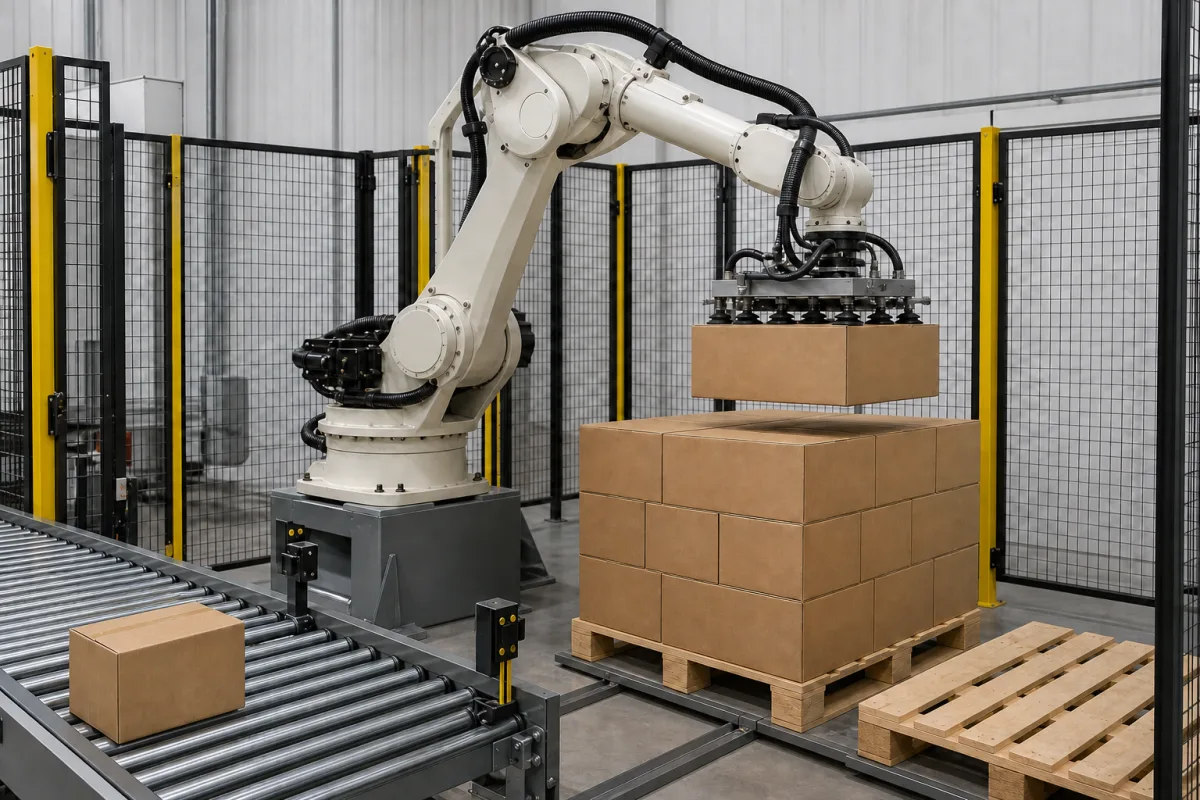
Representative product image. Confirm appearance and specifications with the manufacturer.

Product Specifications

Technical details and manufacturing context for Robotic Palletizing Arm

Definition
The Robotic Palletizing Arm is a component used in automated material handling systems, specifically for palletizing operations. It receives individual items or cases from a conveyor and stacks them onto pallets according to pre-programmed patterns. This automates repetitive and potentially hazardous manual palletizing tasks, ensuring consistent placement, load stability, and high throughput in manufacturing, warehousing, and distribution environments. The arm typically has 4 to 6 axes of movement, driven by servo motors and precision gears or belts. An end-effector, such as a mechanical gripper or vacuum suction head, picks up products. Sensors provide positional feedback to locate incoming products and target pallet positions. The control system calculates optimal paths for transfer and placement, adapting to different product sizes and palletizing patterns. Key parameters include payload capacity (50–200 kg), reach (1500–3000 mm), repeatability (±0.05–±0.1 mm), maximum speed (1.5–2.5 m/s), cycle time (6–12 s), power supply (380 V AC ±10%), rated power (5–15 kW), operating temperature (0–45 °C), protection rating (IP54–IP65), arm material (aluminum/steel), weight (500–1500 kg), and footprint (1.5–3.0 m²). These values are reference ranges and must be verified for specific models. Standards such as ISO 9283, IEC 60038, IEC 60721-3-3, and IEC 60529 are referenced for testing and environmental conditions. The arm is constructed from aluminum alloy, carbon steel, and industrial-grade polymers. It is a critical part of the Automated Conveyance and Palletizing System, handling the final stage of material handling. Always confirm model-specific specifications and standards with the legal manufacturer or supplier.
Working Principle
The arm operates based on programmed instructions from a central control system. It uses servo motors and precision gears or belts for multi-axis movement (typically 4 to 6 axes). An end-effector attached to the wrist picks up the product. Sensors provide positional feedback, allowing the arm to locate the incoming product on the infeed conveyor and the target position on the pallet. The control system calculates the optimal path to transfer the product and place it accurately, often adjusting for different product sizes and palletizing patterns.
Common Materials
Aluminum alloy, Carbon steel, Industrial-grade polymers
Technical Parameters
ParameterTypical rangeNotes & selection driver
Payload Capacity50–200 kgMaximum load at full reach; higher loads reduce speed.ISO 9283
Reach1500–3000 mmHorizontal distance from base to wrist center.
Number of Axes4–64-axis for simple palletizing; 6-axis for complex patterns.
Repeatability±0.05–±0.1 mmPositioning accuracy at wrist center.ISO 9283
Maximum Speed1.5–2.5 m/sLinear speed of end effector; affects cycle time.
Cycle Time6–12 sTime for one pick-and-place cycle at max speed.
Power Supply380 ±10% V ACThree-phase; voltage tolerance per IEC.IEC 60038
Rated Power5–15 kWTotal installed power including controller.
Operating Temperature0–45 °CAmbient temperature range for continuous operation.IEC 60721-3-3
Protection RatingIP54–IP65IP54 for standard; IP65 for dusty/wet environments.IEC 60529
Arm MaterialAluminum/SteelAluminum for weight reduction; steel for rigidity.
Weight500–1500 kgRobot arm only, excluding controller and end effector.
Footprint1.5–3.0 Base area required for installation.

Ranges are indicative industry figures for RFQ preparation, not a supplier commitment. Confirm every value and standard with the legal manufacturer before ordering.

Components / BOM
  • Manipulator Arm
    Provides the structural framework and multi-axis movement for positioning the end-effector.
    Material: Aluminum alloy / Carbon steel
  • End-Effector (Gripper/Suction Head)
    The tool attached to the wrist that physically interacts with and secures the product for handling.
    Material: Aluminum / Polymers / Rubber
  • Servo Motors
    Provide precise torque and rotational control for each joint/axis of the arm.
    Material: Various metals and alloys (housing), copper windings
  • Wrist Assembly
    The final segment of the arm that orientates the end-effector (roll, pitch, yaw).
    Material: Aluminum alloy / Steel
  • Precision Gears or Belts
    Transmit and step down the servo output at each axis.
  • Position Feedback Sensors
    Tell the controller where the arm actually is, so it can find the infeed product and the pallet target.

Applied To / Applications

This component is essential for the following industrial systems and equipment:

Industrial Ecosystem & Supply Chain Structure

Complementary Systems
Downstream Applications
Specialized Tooling

Application Fit & Sizing Matrix

Operational Limits
pressure: Not applicable (mechanical system)
other spec: Payload capacity: 50-500 kg, Reach: 1.5-3.5 m, Cycle time: 5-15 seconds per pick/place
temperature: 0°C to 50°C (operating environment)
Media Compatibility
✓ Cardboard boxes ✓ Plastic totes ✓ Bagged products
Unsuitable: Explosive or hazardous material environments without specialized certification
Sizing Data Required
  • Maximum payload weight (kg)
  • Required reach/distance (m)
  • Required cycle speed (units/hour)

Reliability & Engineering Risk Analysis

Failure Mode & Root Cause
Gearbox backlash and wear
Cause: Inadequate lubrication, misalignment, or excessive cyclic loading leading to premature gear tooth degradation and positional inaccuracy.
Motor encoder or resolver failure
Cause: Contamination from dust/debris, electrical noise interference, or mechanical shock/vibration disrupting feedback signals and causing erratic motion or loss of position control.
Maintenance Indicators
  • Unusual grinding or clicking noises during motion cycles, indicating potential gear or bearing failure.
  • Inconsistent pallet stacking or dropped products, suggesting drift in positional accuracy due to mechanical wear or sensor issues.
Engineering Tips
  • Implement a predictive maintenance program using vibration analysis and thermal imaging to detect early-stage bearing and gear wear before catastrophic failure.
  • Establish strict environmental controls to minimize dust and particulate contamination, and use shielded cables with proper grounding to protect sensitive electronics from electrical interference.

Indicative industry ranges for design and RFQ preparation. Confirm the exact figures and applicable standard with the manufacturer before specifying.

Compliance & Manufacturing Standards

Applicable Standards
ISO 10218-1:2011 - Robots and robotic devices - Safety requirements for industrial robots ANSI/RIA R15.06 - Industrial Robots and Robot Systems - Safety Requirements CE Marking - Machinery Directive 2006/42/EC

Quoted from the published standard.

Manufacturing Precision
  • Positioning repeatability: +/-0.1mm
  • End-effector alignment: +/-0.05°
Quality Inspection
  • Load capacity verification test
  • Safety system functional test

Manufacturers of Robotic Palletizing Arm

Manufacturer profiles associated with Robotic Palletizing Arm.

Sourcing Robotic Palletizing Arm from China?
Tell us your specification and target quantity — we will match it against manufacturer records and come back with the factories that fit.
Request manufacturers We manufacture this

Manufacturer listings support early research and capability understanding. They are not certification, ranking, or transaction guarantees.

Technical documentation
Request current drawings, revision history, and a signed specification sheet.
Manufacturing capability
Verify equipment lists, process limits, capacity, and representative production evidence.
Inspection readiness
Confirm test methods, calibrated equipment, sampling plans, and traceable reports.
Supplier transparency
Check the legal entity, factory address, ownership, certifications, and direct contacts.

CNFX does not score or rank suppliers. Buyers must verify all claims and documents with the legal manufacturer before ordering.

Supply Chain Compatible Machinery & Devices

Automated Powder Coating System

Integrated industrial system for applying dry powder coatings to metal substrates.

Explore Specs →
Centrifugal Pump Impeller

The centrifugal pump impeller is a critical rotating component that converts mechanical energy from the motor into kinetic energy in fluid systems.

Explore Specs →
High-Precision CNC Laser Cutting Machine

Computer-controlled industrial machine using focused laser beams to cut sheet metal with micron-level accuracy.

Explore Specs →
Industrial-Grade Hydraulic Cylinder Piston Rod

This industrial-grade piston rod is a precision-ground cylindrical component designed for use in hydraulic cylinders.

Explore Specs →

Frequently Asked Questions

What is the typical payload capacity of this robotic arm?

The payload capacity is listed as 50–200 kg, depending on the model and reach. Higher loads may reduce speed. Always verify the exact capacity for your specific application with the manufacturer.

How many axes does the arm have?

The arm typically has 4 to 6 axes. A 4-axis configuration is suitable for simple palletizing, while a 6-axis configuration allows for more complex patterns. Confirm the axis count for the specific model.

What is the repeatability of the arm?

Repeatability is ±0.05 to ±0.1 mm at the wrist center, according to ISO 9283. This indicates the precision of placement. Verify the actual repeatability for the model you are considering.

What power supply is required?

The arm requires a three-phase power supply of 380 V AC ±10%, per IEC 60038. The rated power is 5–15 kW including the controller. Check the specific power requirements with the supplier.

Data Basis

Editorial classification, named public sources where available, and source-reviewed manufacturer records.

Preliminary Technical Classification
This page supports structured research, RFQ preparation, and supplier evaluation. It does not replace buyer-led supplier qualification, standards review, or technical approval.
Buyer enquiry

Request manufacturing insight for Robotic Palletizing Arm

Ask for use case, specification boundaries, supplier type, and RFQ preparation information for this product.

Where it goes
Straight to the CNFX editorial desk, and to the manufacturer if this product is linked to a claimed profile. Nothing is broadcast to a supplier list.
Your details stay here
We do not sell or rent enquiry data, and we do not add you to a mailing list. Used only to answer this request.
No commission, no middleman
CNFX is a directory. We take no cut of any order and never negotiate on a supplier's behalf.
What we don't claim
A listing is not an endorsement. Qualify every supplier and verify every figure yourself before ordering.

Your business information is used only to process this request.

Thank you! Your message has been sent. We'll respond within 1–3 business days.
Sorry, we couldn't send your message. Please try again, or email us at contact@cnfx.com.

Need to Manufacture Robotic Palletizing Arm?

Compare manufacturer profiles with relevant product and process capability.

Previous Product
Robotic Manipulator
Next Product
Rock Bolting Rig
Get QuotesChat