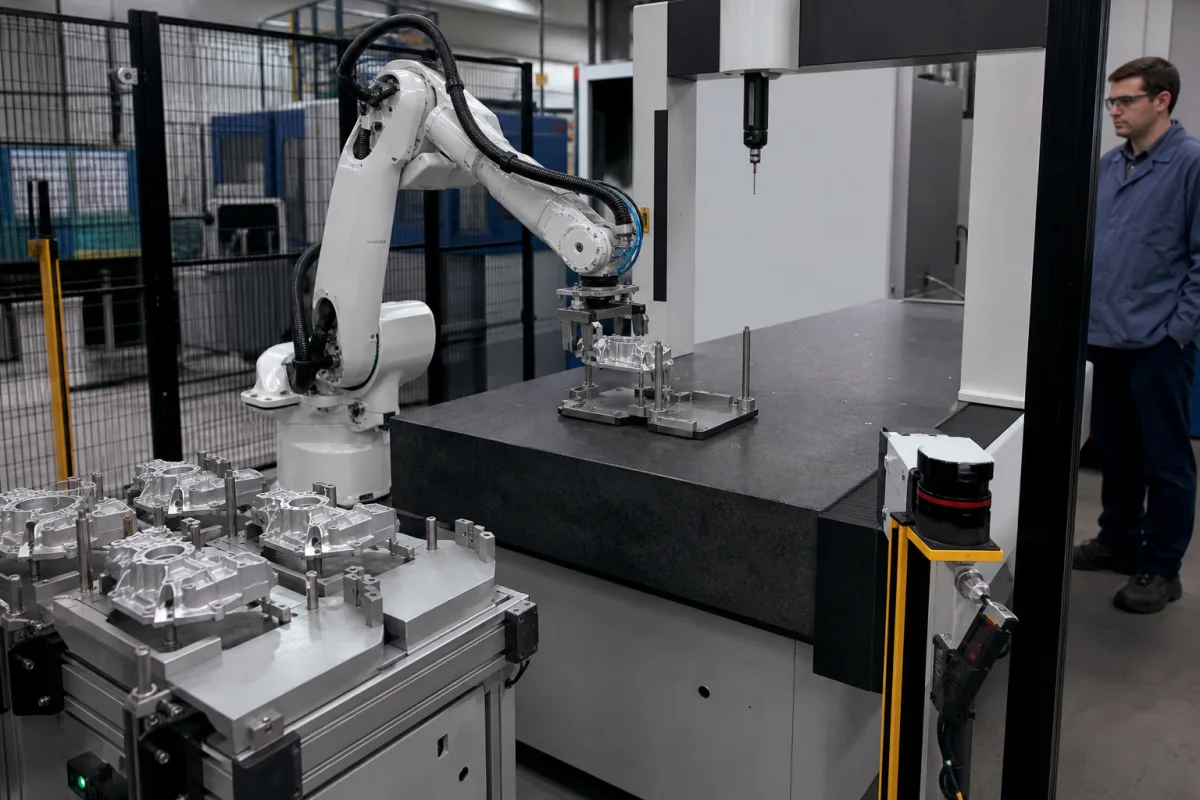
Robotic part handler for a coordinate measuring machine: the cobot cell that queues parts, sets each one on the CMM table and takes it off after measurement
Robot part handling for coordinate measuring machines · cobot loading from drawers and pallet racks, kinematic pallets on the CMM table, part queues, RFID program call-up, and pallet shuttles as the alternative
Between parts, a CMM waits for someone to take the measured part off and put the next one on. A robotic part handler takes over that swap: parts wait in drawers or on a rack, a collaborative robot puts the next one onto a fixture on the measuring table, the CMM runs the program for that part, and the robot takes it away and loads the next, through a break, a shift change or the night.
Robot loading and unloading cells for coordinate measuring machines: part storage (drawers, pallet racks), the cobot that transfers parts, the fixtures and kinematic pallets it places them on, part queues and program selection, and the pallet shuttle loaders offered instead of a robot. Robot arms as a product family are covered on the Industrial robotic arm page, the six-axis arm as a mechanical unit on the Robotic manipulator page, press-tending and stamped-part transfer robots on the Industrial robot arm for press tending page, and welding arms on the Robotic arm for welding page. The CMM itself is covered on the Coordinate measuring machines (CMM) and Measuring system for the shop floor pages; vacuum grippers for machine tending on the Specialized end effector page. Robot cells that load lenses into centering and surfacing machines are covered on the Automated lens loader page.
CNFX editorial research · Sources checked October 13, 2026 · 5 sources
Where the cobot picks from: 3 to 6 drawers of 0.3 m² and 100 kg in Hexagon TEMPO, a 16-part queue in Mitutoyo's automation cell
Hexagon describes TEMPO as an off-the-shelf automated part loading system for new and existing CMMs, configurable with 3 to 6 loading drawers, each with 0.3 m² of storage and holding up to 100 kg of parts. The collaborative robot is supplied by Universal Robots; Hexagon calls it ISO 10218-1-certified, light enough to relocate, with collision detection and customisable stopping times. [1]
Editorial calculation from the Hexagon figures: 3 drawers give 0.9 m² and up to 300 kg of parts waiting; 6 drawers give 1.8 m² and up to 600 kg. The drawer rating is for parts on storage, and Hexagon's page does not name the cobot model or its payload, so the heaviest single part has to be checked against the robot separately. [1]
Mitutoyo's automation cell, as described by its distributor Willrich Precision, splits the job into four modules: M1 the CMM that measures, M2 a cobot that loads and unloads, M3 a pallet rack that keeps parts ready, and M4 a workstation that manages jobs and results. It runs up to 16 parts in an automated queue, selects the measuring program by RFID, and works with Mitutoyo CNC CMM models except STRATO and LEGEX. [5]
Give the heaviest part with its fixture, the number of parts to run unattended, and how the CMM is to know which program each part needs (RFID, barcode or fixed slot).
02
Locating the part on the CMM table: kinematic pallets of 400 × 600 mm for 50 kg and 500 × 750 mm for 150 kg, lowered by a 6 bar lifter
Hexagon's CMM loading systems seat a pallet on fixed kinematic locators: a pneumatic lifter lowers the pallet onto them for repeatable part positioning, a stopper cylinder keeps the pallet out of the kinematic area while the rollers are lowered, and a qualification sphere area lets the probe tip be qualified without removing the loading system from the CMM. [2][3]
The lightweight version takes a 400 × 600 mm pallet and a maximum component weight of 50 kg; the heavy-duty version a 500 × 750 mm pallet and 150 kg. Both run on a 6 bar compressed-air supply. Hexagon lists both as manual loading systems, loaded by the operator. [2][3] Editorial calculation: 50 kg on 0.24 m² is about 208 kg/m², 150 kg on 0.375 m² is 400 kg/m², and a TEMPO drawer's 100 kg on 0.3 m² is about 333 kg/m². [1]
ZEISS's manual pallet feeding system for CONTURA, MICURA and PRISMO uses a three-point support to give reproducible workpiece positions. [4] Hexagon sells these pallet seats as manual systems; whether a robot cell places bare parts into a fixture or places whole fixtured pallets onto such locators is a design choice to settle with the cell supplier.
Ask whether the robot places bare parts into a fixture on the table or places whole pallets onto kinematic locators, and for the pallet size, rated weight and air supply of the locating system.
03
Robot or pallet shuttle: ZEISS ShuttleLoad, MultiLoad feeding up to four CMMs from 16 storage places, and the Duplex two-pallet station
Not every unattended CMM uses a robot. ZEISS offers automatic loaders that move pre-loaded pallets instead of single parts. [4]
ShuttleLoad loads and unloads the CMM automatically with pre-loaded pallets, is operated through a simple user interface and a handheld scanner, and is listed for PRISMO and CONTURA, other machines on request. MultiLoad loads up to four CMMs simultaneously from a workpiece store with 16 storage locations in storage towers, listed for PRISMO, MICURA, CONTURA, DuraMax and O-INSPECT. The Duplex system for DuraMax has two pallet spaces so one pallet is clamped or unclamped while the other is measured, and an Automation Kit automates the pallet change. [4]
The difference for the buyer is what gets moved. A shuttle moves the whole pallet with parts already clamped on it, so each part is fixtured by a person in advance; a cobot cell such as TEMPO or the Mitutoyo cell picks individual parts from drawers or a rack. [4][1][5]
State whether parts arrive loose or already fixtured on pallets, and how many CMMs one loader has to serve.
04
Data for a robotic CMM part handler
Paste it into your enquiry below or into an email to a maker, then replace every bracket.
CMM: [make, model, table size, controller and software]
Parts: [part families; heaviest part with fixture; largest envelope]
Storage: [drawers, rack or pallets; parts per unattended run]
Placement: [bare part into fixture, or pallet onto kinematic locators; air supply]
Identification: [RFID, barcode or fixed slot for program selection]
Safety: [cobot standard; light curtain or fencing; operator access during the run]
Explore company information and manufacturing capabilities, then discuss the scope of your project with a relevant supplier.
Share this page
Compiled and source-reviewed by the CNFX editorial team.
Each manufacturer above links to the page on that company's own website where the product is listed, with the date we checked it. How we source and review
· Page last updated 13 October 2026
Buyer questions
How many parts can a CMM robot loader hold?
Hexagon's TEMPO has 3 to 6 drawers of 0.3 m² holding up to 100 kg of parts each; Mitutoyo's automation cell queues up to 16 parts. [1][5]
How heavy a part can a CMM loading pallet take?
Hexagon's kinematic loading systems are rated 50 kg on a 400 × 600 mm pallet and 150 kg on a 500 × 750 mm pallet, both with a 6 bar air supply. [2][3]
How does the CMM know which part the robot has loaded?
Mitutoyo's automation cell selects the measuring program by RFID. [5]
Is there an alternative to a robot for unattended CMM loading?
Yes. ZEISS ShuttleLoad changes pre-loaded pallets automatically, and MultiLoad feeds up to four CMMs from 16 storage locations. [4]
Sources and what still needs a direct check
Sources checked 2026-10-13. Hexagon's TEMPO product page (archived copy) and two Hexagon CMM loading-system catalogue entries, ZEISS's CMM loading products page, and Willrich Precision's page for the Mitutoyo Automation Cell.