Structured Manufacturing Data (2026)

Servo Motors

Based on aggregated insights from structured factory profiles within the CNFX directory, the standard Servo Motors used in the Machinery and Equipment Manufacturing sector typically supports operational capacities ranging from standard industrial configurations to heavy-duty production requirements.

Technical Definition & Core Assembly

A canonical Servo Motors is characterized by the integration of Stator and Rotor. In industrial production environments, manufacturers listed on CNFX commonly emphasize Electrical steel laminations construction to support stable, high-cycle operation across diverse manufacturing scenarios.

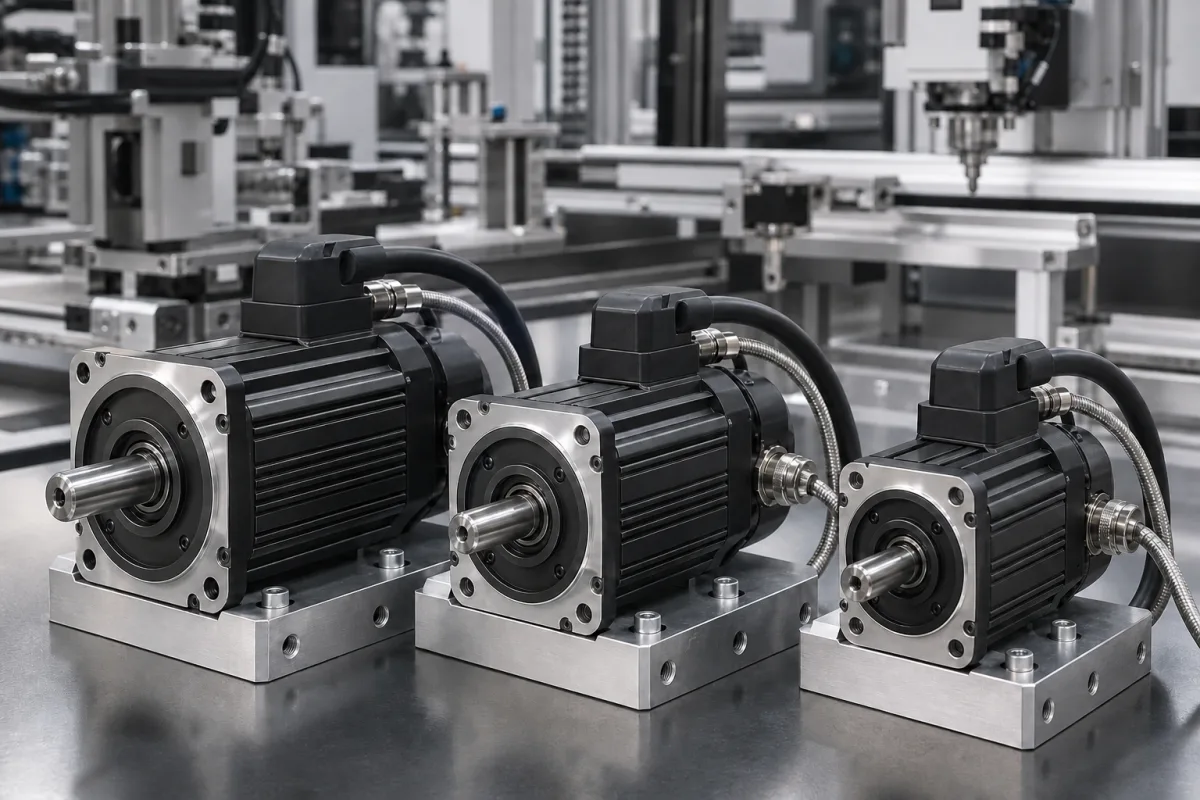
Precision electric motors used for accurate position, velocity, and torque control in automated systems.
Product Specifications

Technical details and manufacturing context for Servo Motors

Definition
Servo motors are specialized electric motors that serve as the primary actuation components in multi-axis positioning systems, providing precise rotational control to drive mechanical axes through feedback mechanisms that continuously adjust performance based on position, speed, and torque requirements.
Working Principle
Servo motors operate using closed-loop control systems where a controller sends command signals to the motor driver, which powers the motor to achieve desired motion. Position/speed sensors (typically encoders or resolvers) provide real-time feedback to the controller, which compares actual performance with target values and makes continuous adjustments to minimize error, ensuring high precision movement.
Common Materials
Electrical steel laminations, Copper windings, Permanent magnets (neodymium or samarium-cobalt), Aluminum or steel housing
Technical Parameters
  • Rated torque output capacity (Nm) Standard Spec
Components / BOM
  • Stator Part
    Stationary part containing copper windings that create rotating magnetic field when energized
    Material: Electrical steel laminations with copper windings
  • Rotor Part
    Rotating part with permanent magnets that interacts with stator's magnetic field to produce torque
    Material: Permanent magnets (neodymium or samarium-cobalt) on steel core
  • Encoder
    Position/speed feedback device that provides real-time data to controller for closed-loop operation
    Material: Optical or magnetic sensors with glass/metal code disk
  • Bearings
    Support rotor shaft rotation with minimal friction and maintain precise alignment
    Material: Steel balls with ceramic or steel races

Industry Taxonomies & Aliases

Commonly used trade names and technical identifiers for Servo Motors.

Applied To / Applications

This component is essential for the following industrial systems and equipment:

Industrial Ecosystem & Supply Chain Structure

Complementary Systems
Downstream Applications
Specialized Tooling

Application Fit & Sizing Matrix

Operational Limits
pressure: Standard atmospheric (not pressure-rated)
other spec: IP65/IP67 protection rating, 0-100% relative humidity (non-condensing)
temperature: -10°C to 40°C (operating), -20°C to 80°C (storage)
Media Compatibility
✓ Clean industrial environments ✓ Automated machinery enclosures ✓ Controlled laboratory settings
Unsuitable: Submerged or high-pressure washdown environments without proper IP69K rating
Sizing Data Required
  • Required torque (Nm)
  • Maximum speed (RPM)
  • Load inertia (kg·m²)

Reliability & Engineering Risk Analysis

Failure Mode & Root Cause
Bearing failure
Cause: Contamination ingress, inadequate lubrication, or excessive axial/radial loads leading to wear, pitting, or seizure.
Encoder malfunction
Cause: Electrical noise interference, physical damage to the encoder disc or sensor, or degradation of signal integrity due to aging or environmental exposure.
Maintenance Indicators
  • Excessive audible vibration or grinding noise during operation
  • Overheating of the motor housing or erratic/unstable motion control
Engineering Tips
  • Implement a proactive lubrication schedule using manufacturer-recommended greases and ensure seals are intact to prevent contamination.
  • Install proper shielding and grounding for encoder cables, and regularly verify encoder alignment and signal quality through diagnostic tools.

Compliance & Manufacturing Standards

Reference Standards
ISO 13849-1:2015 (Safety of machinery) IEC 60034-1:2022 (Rotating electrical machines) EN 61800-5-1:2007 (Adjustable speed electrical power drive systems)
Manufacturing Precision
  • Shaft Runout: ≤0.02mm
  • Mounting Face Flatness: ≤0.05mm
Quality Inspection
  • Vibration Analysis (to ISO 10816)
  • Insulation Resistance Test (per IEC 60034-1)

Factories Producing Servo Motors

Manufacturer profiles with relevant production capability in China

Manufacturer listings support early research and capability understanding. They are not certification, ranking, or transaction guarantees.

Technical documentation
4/5
Manufacturing capability
4/5
Inspection readiness
5/5
Supplier transparency
3/5

These scores are example evaluation dimensions, not real customer ratings, country-specific buyer feedback, or live inquiry activity.

Supply Chain Compatible Machinery & Devices

Heavy-Duty CNC Plasma Cutting Machine

Industrial machine for precision metal cutting using plasma arc technology

Explore Specs →
Automated Assembly Line System

Integrated production system for sequential component assembly operations

Explore Specs →
Automated Powder Coating System

Integrated industrial system for applying dry powder coatings to metal substrates.

Explore Specs →
Centrifugal Pump Impeller

Rotating component that transfers energy to fluid in centrifugal pumps.

Explore Specs →

Frequently Asked Questions

What are the key components in a servo motor BOM?

Essential components include bearings for smooth rotation, an encoder for precise position feedback, the rotor with permanent magnets, and the stator with copper windings and electrical steel laminations.

How do servo motors achieve precise control in machinery?

Servo motors use closed-loop control systems with encoder feedback to continuously adjust position, velocity, and torque, ensuring accurate performance in automated manufacturing applications.

What materials are used in servo motor construction?

Servo motors typically feature electrical steel laminations for efficient magnetic circuits, copper windings for electromagnetic fields, high-strength permanent magnets (neodymium or samarium-cobalt), and durable aluminum or steel housing.

Can I contact factories directly on CNFX?

CNFX is an open directory, not a transaction platform. Each factory profile provides direct contact information and production details to help you initiate direct inquiries with Chinese suppliers.

Data Basis

CNFX manufacturer profiles, technical classification, publicly available product information, and ongoing plausibility checks.

Preliminary Technical Classification
This page supports structured research, RFQ preparation, and supplier evaluation. It does not replace buyer-led supplier qualification, standards review, or technical approval.

Request Manufacturing Insight for Servo Motors

Ask for use case, specification boundaries, supplier type, and RFQ preparation information for Servo Motors.

Your business information is used only to process this request.

Thank you! Your message has been sent. We'll respond within 1–3 business days.

Need to Manufacture Servo Motors?

Compare manufacturer profiles with relevant product and process capability.

Create Manufacturer Profile Contact Us
Previous Product
Servo Motor/Actuator
Next Product
Servo Motors & Drives