Industry-Verified Manufacturing Data (2026)

Roll Shell/Cylinder

Based on aggregated insights from multiple verified factory profiles within the CNFX directory, the standard Roll Shell/Cylinder used in the Machinery and Equipment Manufacturing sector typically supports operational capacities ranging from standard industrial configurations to heavy-duty production requirements.

Technical Definition & Core Assembly

A canonical Roll Shell/Cylinder is characterized by the integration of Shell Body and Surface Coating. In industrial production environments, manufacturers listed on CNFX commonly emphasize Chrome-plated steel construction to support stable, high-cycle operation across diverse manufacturing scenarios.

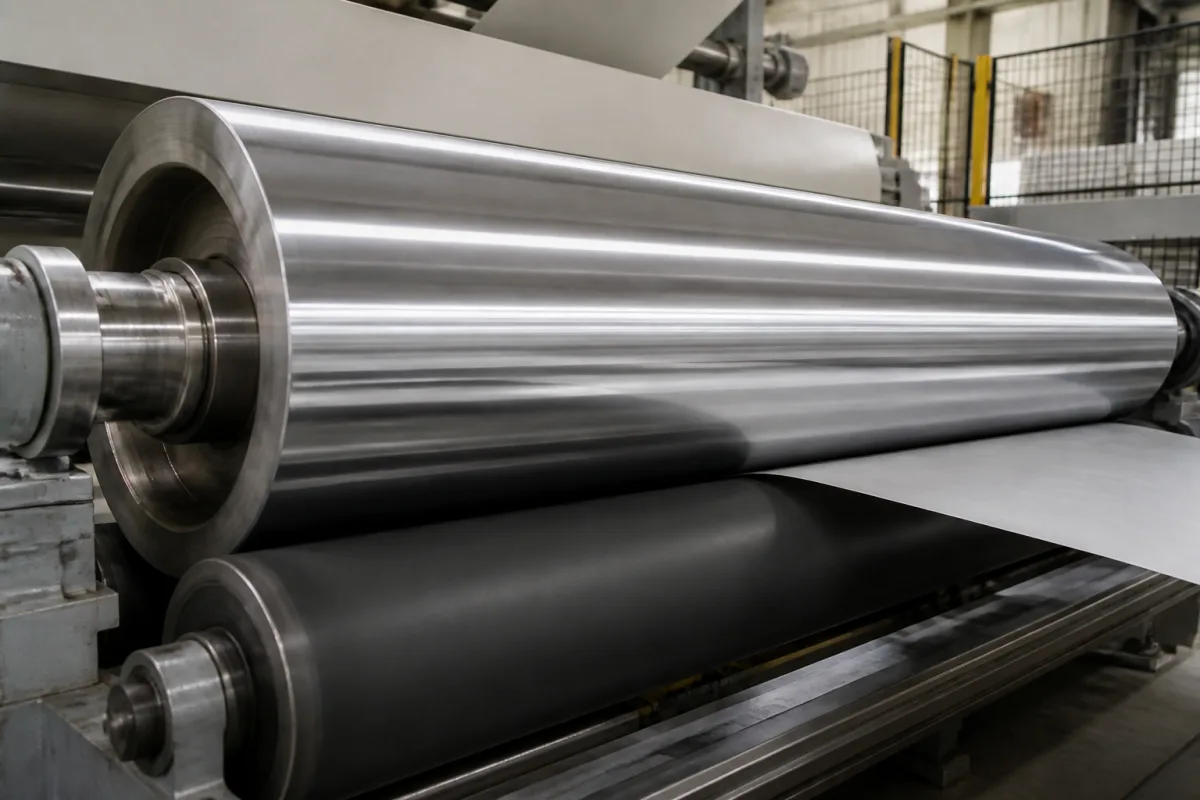
The cylindrical outer casing of a nip roll that provides structural integrity and surface contact for material processing.
Product Specifications

Technical details and manufacturing context for Roll Shell/Cylinder

Definition
The roll shell/cylinder is the primary structural component of a nip roll assembly, forming the cylindrical outer surface that directly contacts and processes materials. It serves as the load-bearing element that maintains roll geometry under pressure while providing the working surface for operations like calendering, laminating, or thickness control in various manufacturing processes.
Working Principle
The roll shell rotates around its central axis, creating a nip point when paired with another roll. Material passes through this nip where pressure, heat, or other forces are applied. The shell's surface characteristics, diameter, and structural rigidity determine the quality and consistency of the processed material.
Common Materials
Chrome-plated steel, Stainless steel, Ceramic-coated alloys, Polyurethane
Technical Parameters
  • Outer diameter of the cylindrical shell, critical for determining nip gap and processing characteristics (mm) Standard Spec
Components / BOM
  • Shell Body
    Primary cylindrical structure providing the working surface
    Material: Steel alloy
  • Surface Coating
    Protective or functional layer applied to the shell surface
    Material: Chrome plating or ceramic coating
  • End Journals
    Machined ends for bearing mounting and drive connection
    Material: Steel
Engineering Reasoning
0.5-3.0 MPa contact pressure, 20-120°C surface temperature, 0.1-5.0 m/s tangential velocity
Yield strength exceedance at 250 MPa (SAE 1045 steel), surface temperature >180°C causing phase transformation, Hertzian contact stress >1.5 GPa
Design Rationale: Plastic deformation from Hertzian contact stress exceeding material yield strength, thermal fatigue from cyclic heating above 180°C causing martensite formation, surface spalling from subsurface shear stress exceeding 0.58×yield strength
Risk Mitigation (FMEA)
Trigger Misalignment exceeding 0.05 mm/m between roll axes
Mode: Edge loading causing localized Hertzian stress concentration >2.0 GPa
Strategy: Laser alignment system with 0.01 mm/m precision and automatic correction feedback loop
Trigger Coolant flow reduction below 2.0 L/min per 100 mm roll width
Mode: Surface temperature gradient >50°C/mm causing thermal stress cracking
Strategy: Redundant cooling circuits with flow sensors triggering at 1.8 L/min threshold

Industry Taxonomies & Aliases

Commonly used trade names and technical identifiers for Roll Shell/Cylinder.

Applied To / Applications

This component is essential for the following industrial systems and equipment:

Industrial Ecosystem & Supply Chain DNA

Complementary Systems
Downstream Applications
Specialized Tooling

Application Fit & Sizing Matrix

Operational Limits
pressure: Up to 10 MPa (100 bar)
other spec: Max slurry concentration: 40% solids by weight
temperature: -20°C to 150°C
Media Compatibility
✓ Paper pulp slurries ✓ Textile dye solutions ✓ Polymer coating compounds
Unsuitable: Highly abrasive mineral slurries with sharp particulates
Sizing Data Required
  • Material web width (mm)
  • Required nip pressure (N/mm)
  • Roll rotational speed (RPM)

Reliability & Engineering Risk Analysis

Failure Mode & Root Cause
Surface fatigue cracking
Cause: Cyclic thermal and mechanical stresses from repeated heating/cooling cycles and rotational loading, often exacerbated by improper material selection or manufacturing defects
Wear and dimensional degradation
Cause: Abrasive contact with processed materials, thermal expansion/contraction mismatches, and improper alignment causing uneven loading and accelerated surface deterioration
Maintenance Indicators
  • Visible surface cracks or spalling on the cylinder shell, especially near welds or high-stress areas
  • Abnormal vibration patterns or audible grinding/knocking sounds during operation indicating imbalance or internal damage
Engineering Tips
  • Implement regular thermal imaging inspections to detect hot spots and uneven temperature distribution that precede fatigue failures
  • Establish precision alignment protocols and use laser alignment tools during installation/rebuilds to ensure optimal load distribution and minimize wear

Compliance & Manufacturing Standards

Reference Standards
ISO 286-2:2010 (Cylindrical fits) ASTM A36/A36M-19 (Structural steel) DIN 8606 (Cylindrical shells for pressure vessels)
Manufacturing Precision
  • Bore diameter: +/-0.02 mm
  • Surface flatness: 0.1 mm per meter
Quality Inspection
  • Dye Penetrant Test (surface defects)
  • Ultrasonic Testing (internal integrity)

Factories Producing Roll Shell/Cylinder

Verified manufacturers with capability to produce this product in China

✓ 92% Supplier Capability Match Found

P Project Engineer from United States Feb 22, 2026
★★★★★
"The technical documentation for this Roll Shell/Cylinder is very thorough, especially regarding technical reliability."
Technical Specifications Verified
S Sourcing Manager from United Arab Emirates Feb 19, 2026
★★★★★
"Reliable performance in harsh Machinery and Equipment Manufacturing environments. No issues with the Roll Shell/Cylinder so far."
Technical Specifications Verified
P Procurement Specialist from Australia Feb 16, 2026
★★★★★
"Testing the Roll Shell/Cylinder now; the technical reliability results are within 1% of the laboratory datasheet."
Technical Specifications Verified
Verification Protocol

“Feedback is collected from verified sourcing managers during RFQ (Request for Quote) and factory evaluation processes on CNFX. These reports represent historical performance data and technical audit summaries from our B2B manufacturing network.”

15 sourcing managers are analyzing this specification now. Last inquiry for Roll Shell/Cylinder from Turkey (47m ago).

Supply Chain Compatible Machinery & Devices

Heavy-Duty CNC Plasma Cutting Machine

Industrial machine for precision metal cutting using plasma arc technology

Explore Specs →
Automated Assembly Line System

Integrated production system for sequential component assembly operations

Explore Specs →
Automated Powder Coating System

Integrated industrial system for applying dry powder coatings to metal substrates.

Explore Specs →
Centrifugal Pump Impeller

Rotating component that transfers energy to fluid in centrifugal pumps.

Explore Specs →

Frequently Asked Questions

What are the main components in a roll shell BOM?

The bill of materials for a roll shell typically includes end journals for mounting, the shell body as the main cylindrical structure, and surface coating for durability and performance.

Which material is best for corrosive environments?

Stainless steel roll shells offer excellent corrosion resistance, making them ideal for wet processing applications or environments with chemical exposure.

How does surface coating affect roll performance?

Surface coatings like chrome plating, ceramic coatings, or polyurethane provide specific benefits including wear resistance, friction control, thermal properties, and material release characteristics for different processing applications.

Can I contact factories directly on CNFX?

CNFX is an open directory, not a transaction platform. Each factory profile provides direct contact information and production details to help you initiate direct inquiries with Chinese suppliers.

Get Quote for Roll Shell/Cylinder

Request technical pricing, lead times, or customized specifications for Roll Shell/Cylinder directly from verified manufacturing units.

Your business information is encrypted and only shared with verified Roll Shell/Cylinder suppliers.

Thank you! Your message has been sent. We'll respond within 1–3 business days.

Need to Manufacture Roll Shell/Cylinder?

Connect with verified factories specializing in this product category

Add Your Factory Contact Us
Previous Product
Roll Heating System
Next Product
Rollback Executor