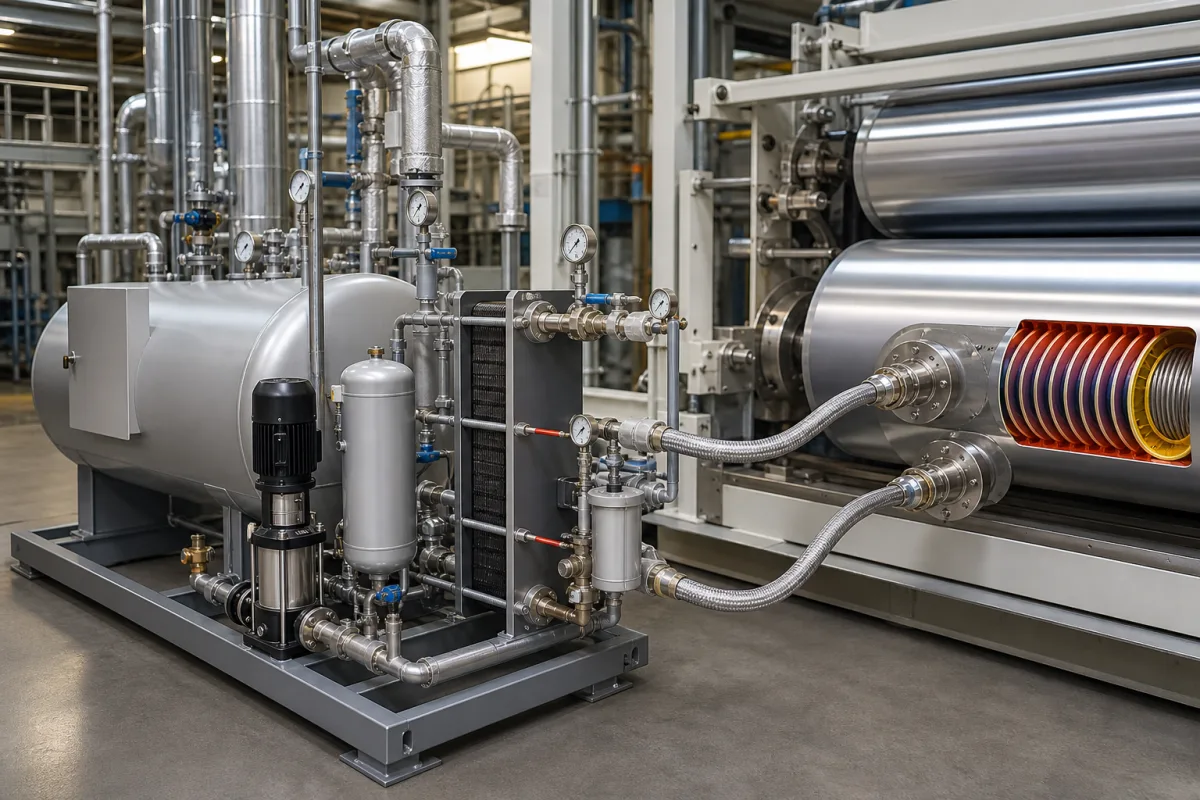
Fluid-heated roll system for calender, converting and film-line rolls: drilled or double-shell roll passages, rotary joint and surface temperature profile
Heating a process roll from the inside with circulating thermal oil or pressurised water: the passages in the roll, the rotary joint that feeds them, and the surface temperature profile that results — where 10 °F across a 16-inch steel roll changes its diameter by about 0.001 inch
Calenders, laminators, embossers and film lines need rolls whose surface stays at a set temperature across the whole web, while the roll turns and carries a nip load. One way to do it is to pump a heated fluid — thermal oil, or water under pressure — from a heating unit beside the machine, through a rotary joint on the roll journal, and along passages just under the roll surface. The heating unit is only half of the system: how the passages are laid out inside the roll, and how much the fluid cools on its way along them, decide whether the surface is even.
Systems that heat process rolls internally with a circulating fluid: the roll's internal passages (peripherally drilled, double-shell with displacement body, helical or counter-flow), rotary joints for thermal oil and hot water, and the resulting surface temperature profile, with electrically heated heat-pipe rolls compared. Induction heating of workpieces and fluids is covered on the Induction heater page; fired or electric hot-oil heater packages on the Thermal fluid (hot oil) heating system page; the oil circuit of leather ironing and embossing presses on the Heat transfer assembly for heated leather press rolls page; stand-alone temperature control units on the Mould temperature controller and Jacket temperature control system pages; steam-heated paper machine drying cylinders, calender stacks, intermediate calender rolls and deflection-compensated rolls on their own pages.
CNFX editorial research · Sources checked October 12, 2026 · 4 sources
Peripherally drilled or double shell: where the hot fluid runs inside the roll
Breitenbach's roll ranges show the two construction families side by side: paper-industry thermo rolls drilled peripherally just below the surface, and double-shell heat transfer and chill rolls with the fluid running between an outer shell and an inner body. [1][2]
American Roller's roll product manager notes that in chilled iron rolls the drilled holes sit 1.5 to 4 inches below the surface, and that differing iron structures transfer heat at different rates, so the surface profile depends on the casting; double-shell rolls can be uniform if they are designed properly for internal fluid velocity and volume. [3] He also lists when steel heated rolls are preferred: length-to-diameter over 10:1, high load with limited diameter, lower moment of inertia, corrosion resistance, rapid thermal shock or engraving. [3]
Editorial note: the passage design is part of the roll, not the heating unit, so a roll bought for one fluid flow rate may not reach its surface uniformity on a smaller pump; give the roll maker the fluid, flow and supply temperature the plant can deliver.
Specify the heating fluid, supply temperature and flow, the surface temperature and permitted variation across the web width, roll diameter and face, nip load and speed.
02
Surface temperature profile: ends 30–40 °F hotter than the web area, and what 10 °F does to a 16-inch roll
American Roller describes the profile problem: on heated rolls the ends, acting as heat sinks outside the web, can run 30 to 40 °F hotter than the area under the web, and the fluid can lose temperature as it crosses the web, leaving a taper; it estimates that chilled iron rolls show about 20% less variation. [3]
The reason it matters in a nip is thermal growth: the same article says a 16-inch steel roll with only a 10 °F difference can change in diameter by about 0.001 inch. [3] Editorial calculation: 10 °F is about 5.6 K and 0.001 inch is 25.4 µm on a 406 mm roll; 30–40 °F is about 17–22 K. A 25 µm change in diameter is about twelve times the 0.002 mm runout and shape tolerance Breitenbach grinds its thermo rolls to, [1] so the ground geometry is only kept in service if the temperature profile is.
American Roller points to electrically heated rolls with heat pipes as the alternative for a more uniform profile. [3] Editorial note: ask any roll supplier for a measured surface temperature profile across the face at your operating temperature, flow and speed, with the roll ends included, not only the fluid inlet and outlet temperatures.
Ask for: surface temperature map across the face at operating conditions; fluid inlet and outlet temperatures and flow; expected crown change from heating.
03
The rotary joint: getting oil or water into a turning roll at 300 rpm and up to 650 °F
Every fluid-heated roll needs a rotary joint on its journal to pass fluid in and out while turning. Kadant Johnson's ELSX joint, announced in 2019 for steam or thermal oil, gives two sets of maximum design ratings: [4]
For thermal oil the joint uses an application-specific seal ring meant to prevent leaks during break-in, and its internal support guides were enlarged for high-energy, high-vibration duty. [4] Editorial calculation: 650 °F is about 343 °C and 150 psig about 10.3 bar gauge; 300 rpm on a 915 mm roll, the largest Breitenbach thermo roll diameter, [1] is a surface speed of about 860 m/min, so faster or smaller-journal duties need a joint rated for the speed as well as the temperature.
Editorial note: check the rotary joint, flexible hoses and the heating unit against the same maximum temperature and pressure; the lowest-rated component sets the limit of the system.
Explore company information and manufacturing capabilities, then discuss the scope of your project with a relevant supplier.
Share this page
Compiled and source-reviewed by the CNFX editorial team.
Each manufacturer above links to the page on that company's own website where the product is listed, with the date we checked it. How we source and review
· Page last updated 13 October 2026
Buyer questions
How are heated rolls built inside?
Either peripherally drilled just under the surface (Breitenbach thermo rolls, water or oil to 330 °C) or double shell with a displacement body, helical or counter-flow passages. [1][2]
Why are heated roll ends hotter?
American Roller says the ends act as heat sinks outside the web and can run 30–40 °F hotter than the web area; fluid cooling across the web can also leave a taper. [3]
How much does temperature change roll diameter?
About 0.001 inch for a 10 °F difference on a 16-inch steel roll, according to American Roller. [3]
What limits the rotary joint?
Kadant Johnson rates its ELSX joint for thermal oil at 300 rpm, 150 psig and 650 °F maximum design values. [4]
Sources and what still needs a direct check
Sources checked 2026-10-12. Roll constructions, dimensions, materials, tolerances and the 330 °C rating come from Breitenbach's thermo roll and heat transfer roll pages; temperature profile, thermal growth and design choices from American Roller's article on chilled iron versus hardened steel rolls; rotary joint ratings from Pulp and Paper Canada's report on Kadant Johnson's ELSX joint.