Industry-Verified Manufacturing Data (2026)

Nip Rolls

Based on aggregated insights from multiple verified factory profiles within the CNFX directory, the standard Nip Rolls used in the Machinery and Equipment Manufacturing sector typically supports operational capacities ranging from standard industrial configurations to heavy-duty production requirements.

Technical Definition & Core Assembly

A canonical Nip Rolls is characterized by the integration of Roll Shell/Cylinder and Bearings. In industrial production environments, manufacturers listed on CNFX commonly emphasize Chrome-plated steel construction to support stable, high-cycle operation across diverse manufacturing scenarios.

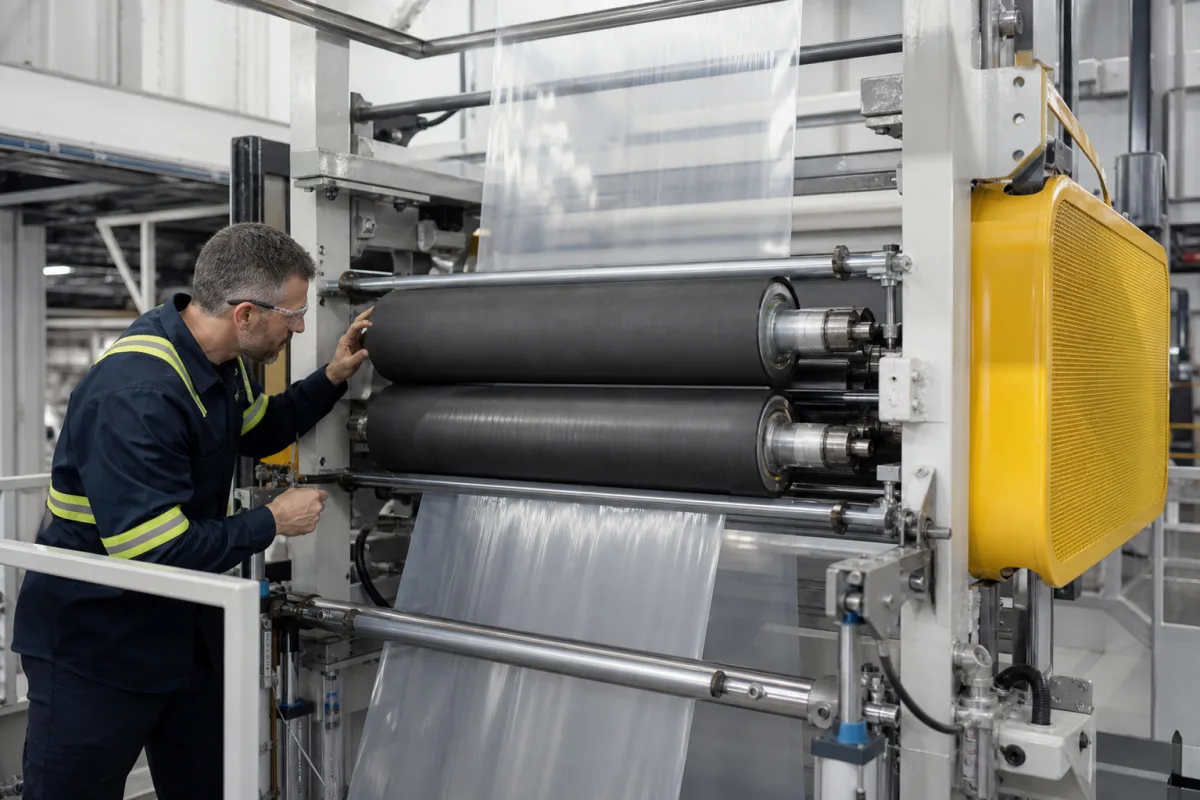
A pair of counter-rotating rollers that compress and flatten the plastic film bubble as it exits the film blowing machine.
Product Specifications

Technical details and manufacturing context for Nip Rolls

Definition
Nip rolls are critical components in plastic film blowing machines that serve to collapse the inflated tubular bubble of molten plastic into a flat, layered film. Positioned at the top of the tower, they apply controlled pressure to seal the bubble, define the final film thickness, and initiate the winding process. Their operation is essential for converting the continuous tubular extrusion into a manageable flat sheet for subsequent processing like slitting or winding.
Working Principle
The nip rolls consist of two parallel, counter-rotating cylinders. The inflated plastic bubble is guided between them. As the rolls rotate, they pinch the bubble shut, applying even pressure across its width. This action collapses the bubble, forces out trapped air, and creates a sealed, double-layer flat film. The speed of the nip rolls, relative to the bubble inflation rate, controls the draw ratio and final film orientation and thickness.
Common Materials
Chrome-plated steel, Rubber-covered steel
Technical Parameters
  • Roll diameter and face width, which determine the contact area and pressure distribution on the film. (mm) Customizable
Components / BOM
  • Roll Shell/Cylinder
    The main cylindrical body that makes contact with the film. Often chrome-plated for durability and smooth finish or rubber-covered for better grip.
    Material: Steel
  • Bearings
    Support the roll shafts, allowing smooth, low-friction rotation and maintaining precise alignment between the two rolls.
    Material: Steel (bearing grade)
  • Pressure Adjustment Mechanism
    A system (often pneumatic or hydraulic) to control and evenly apply the nip pressure across the roll width.
    Material: Steel, Aluminum
  • Drive System (Gear/Motor)
    Provides the rotational force to the rolls, synchronizing their speed with the film line speed.
    Material: Steel, Copper (windings)
Engineering Reasoning
0.5-2.0 MPa nip pressure, 0.1-0.3 mm gap tolerance, 20-120°C surface temperature
Exceeding 2.5 MPa nip pressure causes permanent roller deformation, gap deviation >0.5 mm creates film thickness variation >15%, surface temperature >150°C initiates polymer adhesion
Design Rationale: Hertzian contact stress exceeding roller material yield strength (typically 350-450 MPa for hardened steel), thermal expansion mismatch between roller core and covering material (CTE difference >5×10⁻⁶/°C), polymer melt adhesion at temperatures exceeding Vicat softening point
Risk Mitigation (FMEA)
Trigger Insufficient cooling water flow (<2 L/min per roller)
Mode: Thermal expansion-induced roller misalignment causing film wrinkles
Strategy: Integrate redundant cooling circuits with flow sensors and automatic pressure compensation
Trigger Abrasive polymer additives (e.g., TiO₂ >5% concentration)
Mode: Progressive roller surface wear exceeding 0.05 mm/year
Strategy: Apply HVOF-sprayed tungsten carbide coating (1200 HV hardness) with 0.3 mm thickness

Industry Taxonomies & Aliases

Commonly used trade names and technical identifiers for Nip Rolls.

Industrial Ecosystem & Supply Chain DNA

Complementary Systems
Downstream Applications
Specialized Tooling

Application Fit & Sizing Matrix

Operational Limits
pressure: Up to 50 bar nip pressure
other spec: Line speed: 10-300 m/min, Roll diameter: 150-600 mm
temperature: Ambient to 150°C (typical film processing range)
Media Compatibility
✓ Polyethylene (LDPE/HDPE) ✓ Polypropylene (PP) ✓ Polyvinyl Chloride (PVC)
Unsuitable: Abrasive-filled compounds or slurries
Sizing Data Required
  • Film width (mm)
  • Required nip pressure (bar)
  • Production line speed (m/min)

Reliability & Engineering Risk Analysis

Failure Mode & Root Cause
Surface degradation and uneven wear
Cause: Inconsistent nip pressure, misalignment, or abrasive contaminants in the web material leading to localized wear patterns and loss of surface integrity.
Bearing failure and shaft damage
Cause: Improper lubrication, excessive loading, thermal expansion mismatches, or ingress of process fluids causing bearing seizure, fretting, or shaft scoring.
Maintenance Indicators
  • Audible grinding, knocking, or irregular humming from the roll assembly during operation
  • Visible surface defects such as grooves, flat spots, or discoloration on the roll face
Engineering Tips
  • Implement precision laser alignment and dynamic nip pressure monitoring to ensure uniform load distribution and prevent edge wear
  • Establish a condition-based lubrication regimen using high-temperature, water-resistant greases and install protective seals to guard against contamination

Compliance & Manufacturing Standards

Reference Standards
ISO 9001:2015 - Quality management systems ASTM E1251 - Standard Test Method for Analysis of Aluminum and Aluminum Alloys by Spark Atomic Emission Spectrometry CE Marking - Machinery Directive 2006/42/EC
Manufacturing Precision
  • Bore diameter: +/-0.02 mm
  • Surface flatness: 0.1 mm per meter
Quality Inspection
  • Dye Penetrant Test for surface defects
  • Hardness testing (Rockwell or Brinell)

Factories Producing Nip Rolls

Verified manufacturers with capability to produce this product in China

✓ 98% Supplier Capability Match Found

S Sourcing Manager from Singapore Mar 01, 2026
★★★★★
"As a professional in the Machinery and Equipment Manufacturing sector, I confirm this Nip Rolls meets all ISO standards."
Technical Specifications Verified
P Procurement Specialist from Germany Feb 26, 2026
★★★★☆
"Standard OEM quality for Machinery and Equipment Manufacturing applications. The Nip Rolls arrived with full certification. (Delivery took slightly longer than expected, but technical support was excellent.)"
Technical Specifications Verified
T Technical Director from Brazil Feb 23, 2026
★★★★★
"Great transparency on the Nip Rolls components. Essential for our Machinery and Equipment Manufacturing supply chain."
Technical Specifications Verified
Verification Protocol

“Feedback is collected from verified sourcing managers during RFQ (Request for Quote) and factory evaluation processes on CNFX. These reports represent historical performance data and technical audit summaries from our B2B manufacturing network.”

9 sourcing managers are analyzing this specification now. Last inquiry for Nip Rolls from Poland (28m ago).

Supply Chain Compatible Machinery & Devices

Hydraulic Press

Industrial machine using hydraulic pressure to compress, form, or assemble materials

Explore Specs →
Heavy-Duty CNC Plasma Cutting Machine

Industrial machine for precision metal cutting using plasma arc technology

Explore Specs →
Automated Assembly Line System

Integrated production system for sequential component assembly operations

Explore Specs →
Automated Powder Coating System

Integrated industrial system for applying dry powder coatings to metal substrates.

Explore Specs →

Frequently Asked Questions

What materials are nip rolls typically made from?

Nip rolls are commonly constructed from chrome-plated steel for smooth operation or rubber-covered steel for enhanced grip and reduced film damage, ensuring durability in industrial machinery applications.

How do nip rolls function in film blowing machinery?

Nip rolls operate as a pair of counter-rotating rollers that compress and flatten the plastic film bubble as it exits the film blowing machine, controlling thickness and preparing the film for winding or further processing.

What components are included in a nip roll BOM?

A typical bill of materials for nip rolls includes bearings for smooth rotation, a drive system (gear/motor) for controlled movement, a pressure adjustment mechanism for precise compression, and the roll shell/cylinder that contacts the film.

Can I contact factories directly on CNFX?

CNFX is an open directory, not a transaction platform. Each factory profile provides direct contact information and production details to help you initiate direct inquiries with Chinese suppliers.

Get Quote for Nip Rolls

Request technical pricing, lead times, or customized specifications for Nip Rolls directly from verified manufacturing units.

Your business information is encrypted and only shared with verified Nip Rolls suppliers.

Thank you! Your message has been sent. We'll respond within 1–3 business days.

Need to Manufacture Nip Rolls?

Connect with verified factories specializing in this product category

Add Your Factory Contact Us
Previous Product
Needle Valve
Next Product
Nozzle Array