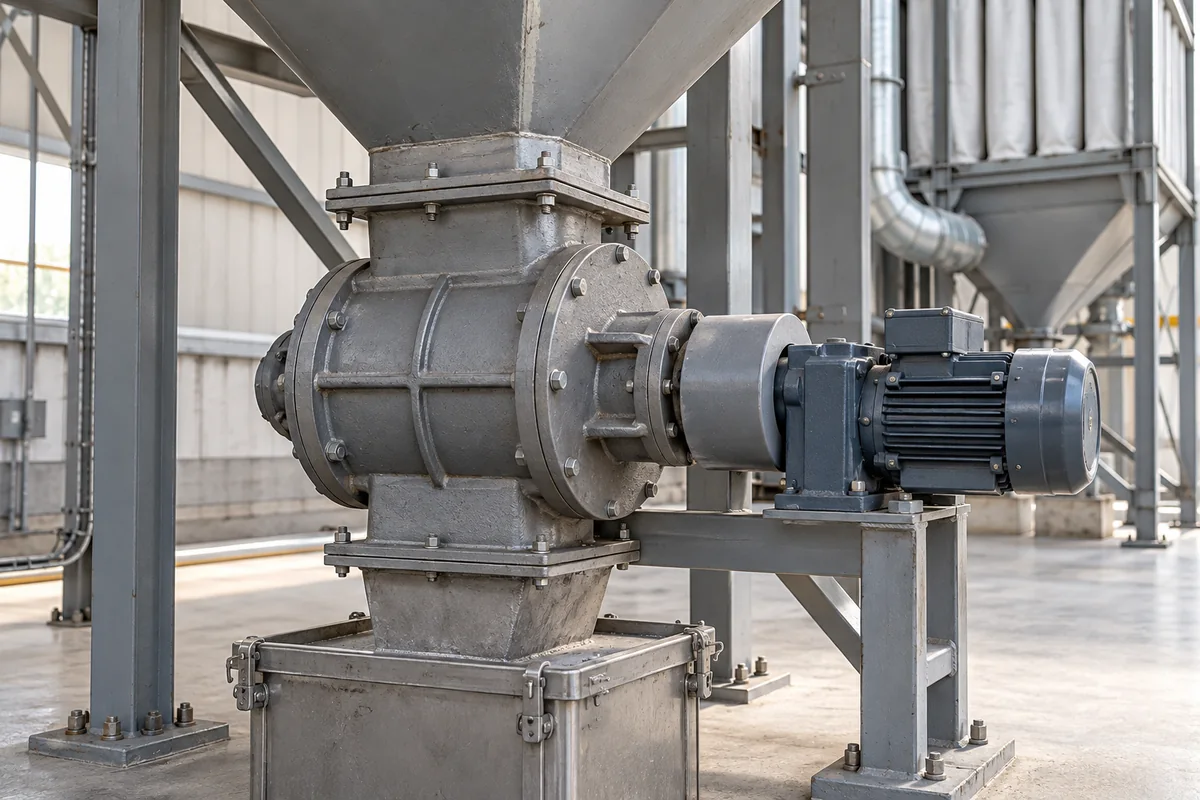
Dust-collector discharge rotary valve: the airlock that seals and empties a baghouse or cyclone hopper
The rotary airlock that empties a baghouse or cyclone hopper into a dust bin · air seal against collector suction, sizing for upset dust loads, run-on after fan stop and flame isolation
A dust collector hopper collects what the filters or cyclone shed and has to be emptied continuously while the collector runs under suction. The rotary valve (rotary airlock) at its outlet does that: a vaned rotor turning in a close-fitting housing passes dust down into a bin, conveyor or bag while blocking the air that would otherwise be drawn up through the outlet. On this duty the seal matters as much as the capacity, because air leaking in carries dust back up to the filters, and the valve has to cope with the surge of dust that arrives during cleaning, after upsets and after the fan stops.
Rotary valves (rotary airlocks) fitted at the discharge of baghouse, cartridge-collector and cyclone hoppers in dust collection and disposal systems, with their drives and monitoring. Valves at hopper, bin and silo outlets for feeding powders and granules, including rotary dosing and pneumatic-conveying feed duties, are covered on the Powder hopper valve page. Eccentric rotary control valves for liquids and gases, RTO switching valves and complete dust collectors are outside this page.
CNFX editorial research · Sources checked October 12, 2026 · 4 sources
Holding the seal against a baghouse at 15–20 in w.c.: what leakage air does to the hopper and the filters
In patent US5676281, BHM Co. states that its 60-inch material seal has proved sufficient for baghouse applications operating at 15–20 inches of water column positive or negative pressure, and that on a suction system any air introduced to the hopper through the discharge opening causes re-entrainment of dust to the fabric filter. [1] Editorial calculation: 1 in w.c. ≈ 249 Pa, so 15–20 in w.c. is about 3.7–5.0 kPa across the valve.
Donaldson, describing dust collector hoppers, says the main function of the rotary airlock is to provide an air seal at the hopper discharge, and that on collectors running under negative pressure, worn rotor blades let air leak into the discharge opening. That air can bring in moisture that makes dry dust sticky or caked, or simply stop collected dust flowing freely into the valve; the resulting build-up raises the risks of re-entrainment, higher pressure drop and shorter filter life, so Donaldson calls for regular inspection of the valve body and rotor blades for wear with a replacement schedule. [2]
Prater's Darrell Malczewski describes the same duty at the end of a pneumatic circuit: the airlock under a cyclone or baghouse keeps its separation efficiency by preventing air leakage while discharging, and that it can form part of NFPA compliance as a flame isolation barrier against a deflagration in the cyclone or baghouse. [3] He warns that large clearances or a rotor over-compensated for thermal expansion make the valve leak, and that leakage air also disrupts the flow of material into the pockets. [3]
Editorial note: when the valve is to serve as flame isolation, ask for the evidence that the specific valve, rotor clearance and speed have been qualified for that role; a valve sold only as an airlock has not.
02
Sizing for the surge, not the average: upset loads, dust that falls after the fan stops, and an 80% fill factor
Donaldson notes that sizing for the continuous nominal dust discharge rate is straightforward, but that valves end up undersized when the designer forgets the larger amounts that reach the hopper during process upsets or downtime cleaning, and the dust that falls into the hopper immediately after the exhaust fan shuts down. [2] It calls a time delay essential, so that the valve keeps running until the hopper is empty before it stops, whether the collector is indoors or outdoors. [2]
Valve capacity is quoted as volume per revolution. Prater says displacement is quoted with a fill factor applied, cites 80% as a stated value that process conditions can raise or lower, and notes that a rotor never fills completely; poor-flowing dust and high speeds lower the fill further, and a wider inlet throat gives the pockets more time to fill. [3] For a slow valve, it notes that 5 rpm gives 40 pulses a minute, one every 1.5 seconds, and suggests more than 10 rpm, preferably 15, where uniform flow matters. [3]
Glorair, a dust collector maker, lists its rotary valves from 2 L per revolution with a 0.55 kW motor and 150 mm flange to 66 L per revolution with 7.5 kW and an 800 mm flange, all at 24 rpm, in cast iron or cast stainless steel with direct or chain-and-sprocket drive. [4]
Glorair model
Volume per revolution
Motor
Square flange
Editorial calculation: m³/h at 24 rpm and 80% fill
Watching the valve and the hopper: zero-speed switches, level indicators and discharge screens
Donaldson lists two low-cost additions for this duty: a zero-speed switch that confirms the rotor is turning, and hopper level indicators that give early warning of build-up. [2] It also notes that some valve makers now ship guard screens on the discharge side to stop personnel reaching into the rotor, and that with some dusts these screens can impede flow out of the valve. [2]
For sticky, moist, fine, agglomerating or hygroscopic dusts, Donaldson says steeper hoppers, non-stick hopper coatings, larger discharge openings and larger rotary valves may be needed, and insulation where condensation can form in the hopper. [2] The BHM Co. patent describes a different answer to the sealing problem altogether: a fluidised, baffled airlock with no rotor that keeps a column of at least about 30 inches of dust in each of two chambers, about 60 inches in total, on the premise that each inch of fluidised depth resists about 1–2 inches of water column. [1]
04
Data for a dust-collector rotary valve enquiry
Paste it into your enquiry below or into an email to a maker, then replace every bracket.
Collector: [baghouse, cartridge or cyclone; operating pressure in Pa or in w.c.; hopper outlet size]
Dust: [type; bulk density; flowability; moisture; abrasiveness; temperature]
Load: [nominal discharge rate; peak during cleaning and after fan stop]
Valve: [volume per revolution; speed; rotor clearance; material; drive]
Safety: [flame isolation required; ATEX or NFPA evidence; discharge guard]
Controls: [run-on timer after fan stop; zero-speed switch; hopper level indicator]
Discharge: [bin, screw or drag conveyor, bag]
2 companies list this product among what they make. Company figures are quoted from each
company's own website; every card states where the relationship came from.
Suzhou Glorair Purifying Equipment Co. Ltd.
Manufacturing site to be confirmed for the order
Lists rotary valves among its dust collector parts, from 2 L to 66 L per revolution at 24 rpm with 0.55–7.5 kW motors, in cast iron or cast stainless steel, with direct or chain-and-sprocket drive.
Lists rotary airlock valves and rotary feeders in stainless steel or cast iron, and states they are used under cyclones and other dust collecting devices as well as for pneumatic conveying.
Explore company information and manufacturing capabilities, then discuss the scope of your project with a relevant supplier.
Share this page
Compiled and source-reviewed by the CNFX editorial team.
Each manufacturer above links to the page on that company's own website where the product is listed, with the date we checked it. How we source and review
· Page last updated 13 October 2026
Buyer questions
Why does a dust collector need a rotary airlock?
To seal the hopper outlet while emptying it. A BHM Co. patent says air entering the hopper of a suction baghouse re-entrains dust to the filters, and Donaldson links leakage to build-up, higher pressure drop and shorter filter life. [1][2]
How should the valve be sized?
For peak, not only nominal, dust loads: Donaldson points to process upsets, cleaning and dust falling after fan shutdown. Prater cites 80% pocket fill as a stated basis for ratings. [2][3]
Should the valve stop when the fan stops?
Donaldson calls a time delay essential so the valve runs on until the hopper is empty. [2]
What sizes are offered for dust collectors?
Glorair lists rotary valves from 2 to 66 L per revolution at 24 rpm, with motors from 0.55 to 7.5 kW and flanges from 150 to 800 mm. [4]
Sources and what still needs a direct check
Sources checked 2026-10-12. Baghouse pressure and the re-entrainment mechanism come from BHM Co.'s US5676281; hopper, leakage, sizing, run-on and monitoring guidance from Donaldson's technical article; fill factor, speed and flame-isolation role from a Prater Industries article in Processing; valve sizes from Glorair's product page. Values apply to the sources named.