Industry-Verified Manufacturing Data (2026)

Dust Disposal System

Based on aggregated insights from multiple verified factory profiles within the CNFX directory, the standard Dust Disposal System used in the Machinery and Equipment Manufacturing sector typically supports operational capacities ranging from standard industrial configurations to heavy-duty production requirements.

Technical Definition & Core Assembly

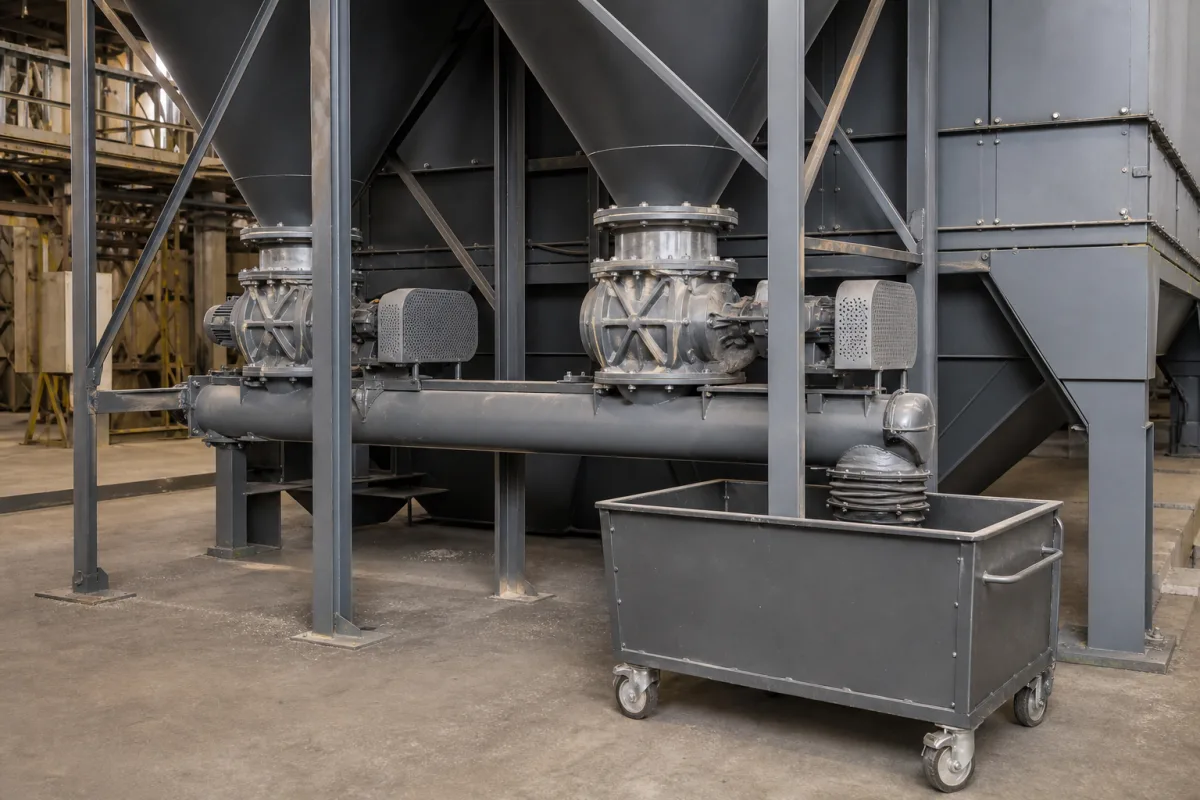
A canonical Dust Disposal System is characterized by the integration of Dust Hopper and Rotary Valve. In industrial production environments, manufacturers listed on CNFX commonly emphasize Carbon Steel construction to support stable, high-cycle operation across diverse manufacturing scenarios.

A subsystem within dust collection systems that handles the final processing, storage, or removal of collected particulate matter.
Product Specifications

Technical details and manufacturing context for Dust Disposal System

Definition
The Dust Disposal System is a critical component of industrial dust collection systems responsible for the final handling of captured particulate matter. It manages the transfer, storage, compaction, or removal of dust from collection points (such as hoppers or filters) to designated disposal containers, recycling systems, or waste management facilities. This system ensures safe, efficient, and compliant handling of industrial dust while maintaining continuous operation of the dust collection process.
Working Principle
The system operates by receiving accumulated dust from collection points through gravity discharge, pneumatic conveying, or mechanical transfer mechanisms. It may include components for dust compaction, container filling, dust level monitoring, and automated container exchange. Some systems incorporate safety features like explosion venting, fire suppression, and dust containment to prevent environmental contamination and workplace hazards.
Common Materials
Carbon Steel, Stainless Steel, Galvanized Steel
Technical Parameters
  • Connection diameter for dust inlet/outlet ports (mm) Customizable
Components / BOM
  • Dust Hopper
    Temporary storage and collection point for dust before disposal
    Material: Carbon Steel
  • Rotary Valve
    Controls dust discharge rate while maintaining system pressure
    Material: Cast Iron/Stainless Steel
  • Dust Container
    Final storage vessel for collected dust
    Material: Galvanized Steel/Plastic
  • Compaction Mechanism
    Reduces dust volume in containers for efficient storage
    Material: Steel
  • Level Sensor
    Monitors dust level in containers and triggers alerts
    Material: Stainless Steel/Plastic
Engineering Reasoning
0.1-0.5 bar differential pressure across disposal mechanism
0.8 bar differential pressure causing structural deformation or 85°C material temperature exceeding polymer seals' glass transition
Design Rationale: Differential pressure exceeding yield strength of containment materials (e.g., 250 MPa for 304 stainless steel) or thermal expansion mismatch between metal components and elastomer seals (CTE difference of 15×10⁻⁶/°C)
Risk Mitigation (FMEA)
Trigger Moisture ingress exceeding 5% relative humidity in collected dust
Mode: Material bridging and compaction forming solid mass with 1.8 g/cm³ density
Strategy: Integrated moisture sensor with 3% RH threshold triggering bypass valve and desiccant injection system
Trigger Abrasive particle concentration exceeding 30% silica content by mass
Mode: Wear rate acceleration to 0.5 mm/1000 operating hours on disposal mechanism surfaces
Strategy: Hardened steel components with 60 HRC minimum hardness and sacrificial wear plates with 12 mm replacement threshold

Industry Taxonomies & Aliases

Commonly used trade names and technical identifiers for Dust Disposal System.

Applied To / Applications

This component is essential for the following industrial systems and equipment:

Industrial Ecosystem & Supply Chain DNA

Complementary Systems
Downstream Applications
Specialized Tooling

Application Fit & Sizing Matrix

Operational Limits
pressure: 0 to 1.5 bar (gauge)
flow rate: Up to 50,000 m³/h
temperature: -20°C to 120°C
slurry concentration: Up to 60% solids by weight
Media Compatibility
✓ Wood dust ✓ Metal grinding fines ✓ Plastic particulates
Unsuitable: Explosive dust environments (ATEX Zone 20/21)
Sizing Data Required
  • Total dust collection rate (kg/h)
  • Particle size distribution (μm)
  • Required storage/disposal cycle time (hours)

Reliability & Engineering Risk Analysis

Failure Mode & Root Cause
Dust accumulation and bridging
Cause: Inadequate airflow velocity, high humidity causing material clumping, or improper hopper design leading to material stagnation and blockages
Filter media blinding and pressure drop increase
Cause: Excessive fine particulate loading, moisture ingress causing filter cake formation, or insufficient pulse-jet cleaning system effectiveness
Maintenance Indicators
  • Sudden increase in system differential pressure (≥20% above normal operating range)
  • Audible change in fan/motor operation (unusual vibrations, grinding noises, or irregular cycling)
Engineering Tips
  • Implement predictive maintenance through continuous monitoring of differential pressure across filters and vibration analysis on rotating components to schedule cleaning/replacement before failure
  • Optimize material handling by maintaining consistent airflow velocity (typically 3500-4500 FPM in ducts), installing hopper vibrators or air pads to prevent bridging, and ensuring proper material moisture control

Compliance & Manufacturing Standards

Reference Standards
ISO 14644-1:2015 (Cleanrooms and associated controlled environments) ANSI/ASHRAE Standard 52.2-2017 (Method of Testing General Ventilation Air-Cleaning Devices) DIN EN 1093-3:2008 (Safety of machinery - Evaluation of the emission of airborne hazardous substances)
Manufacturing Precision
  • Ductwork diameter: +/-0.5mm
  • Filter housing flatness: 0.2mm
Quality Inspection
  • Leakage Test (pressure decay method)
  • Particle Count Test (ISO 14644-1 compliance)

Factories Producing Dust Disposal System

Verified manufacturers with capability to produce this product in China

✓ 97% Supplier Capability Match Found

P Procurement Specialist from Canada Feb 08, 2026
★★★★★
"As a professional in the Machinery and Equipment Manufacturing sector, I confirm this Dust Disposal System meets all ISO standards."
Technical Specifications Verified
T Technical Director from United States Feb 05, 2026
★★★★★
"Standard OEM quality for Machinery and Equipment Manufacturing applications. The Dust Disposal System arrived with full certification."
Technical Specifications Verified
P Project Engineer from United Arab Emirates Feb 02, 2026
★★★★★
"Great transparency on the Dust Disposal System components. Essential for our Machinery and Equipment Manufacturing supply chain."
Technical Specifications Verified
Verification Protocol

“Feedback is collected from verified sourcing managers during RFQ (Request for Quote) and factory evaluation processes on CNFX. These reports represent historical performance data and technical audit summaries from our B2B manufacturing network.”

14 sourcing managers are analyzing this specification now. Last inquiry for Dust Disposal System from USA (43m ago).

Supply Chain Compatible Machinery & Devices

Hydraulic Press

Industrial machine using hydraulic pressure to compress, form, or assemble materials

Explore Specs →
Heavy-Duty CNC Plasma Cutting Machine

Industrial machine for precision metal cutting using plasma arc technology

Explore Specs →
Automated Assembly Line System

Integrated production system for sequential component assembly operations

Explore Specs →
Automated Powder Coating System

Integrated industrial system for applying dry powder coatings to metal substrates.

Explore Specs →

Frequently Asked Questions

What materials are available for dust disposal systems in machinery manufacturing?

Our dust disposal systems are constructed from durable materials including carbon steel, stainless steel, and galvanized steel to withstand industrial environments and various particulate types.

What components are included in a typical dust disposal system BOM?

A complete dust disposal system typically includes a compaction mechanism, dust container, dust hopper, level sensor, and rotary valve for efficient particulate handling and removal.

How does a dust disposal system integrate with existing dust collection systems?

Our dust disposal systems are designed as subsystems that seamlessly connect to your existing dust collection infrastructure, handling the final stage of particulate processing, storage, or removal.

Can I contact factories directly on CNFX?

CNFX is an open directory, not a transaction platform. Each factory profile provides direct contact information and production details to help you initiate direct inquiries with Chinese suppliers.

Get Quote for Dust Disposal System

Request technical pricing, lead times, or customized specifications for Dust Disposal System directly from verified manufacturing units.

Your business information is encrypted and only shared with verified Dust Disposal System suppliers.

Thank you! Your message has been sent. We'll respond within 1–3 business days.

Need to Manufacture Dust Disposal System?

Connect with verified factories specializing in this product category

Add Your Factory Contact Us
Previous Product
Dust Discharge Mechanism
Next Product
Dust Enclosure