Machine safety guarding · Fixed and interlocked perimeter guards, opening size against distance to the hazard, robot cell spaces, guard design rules
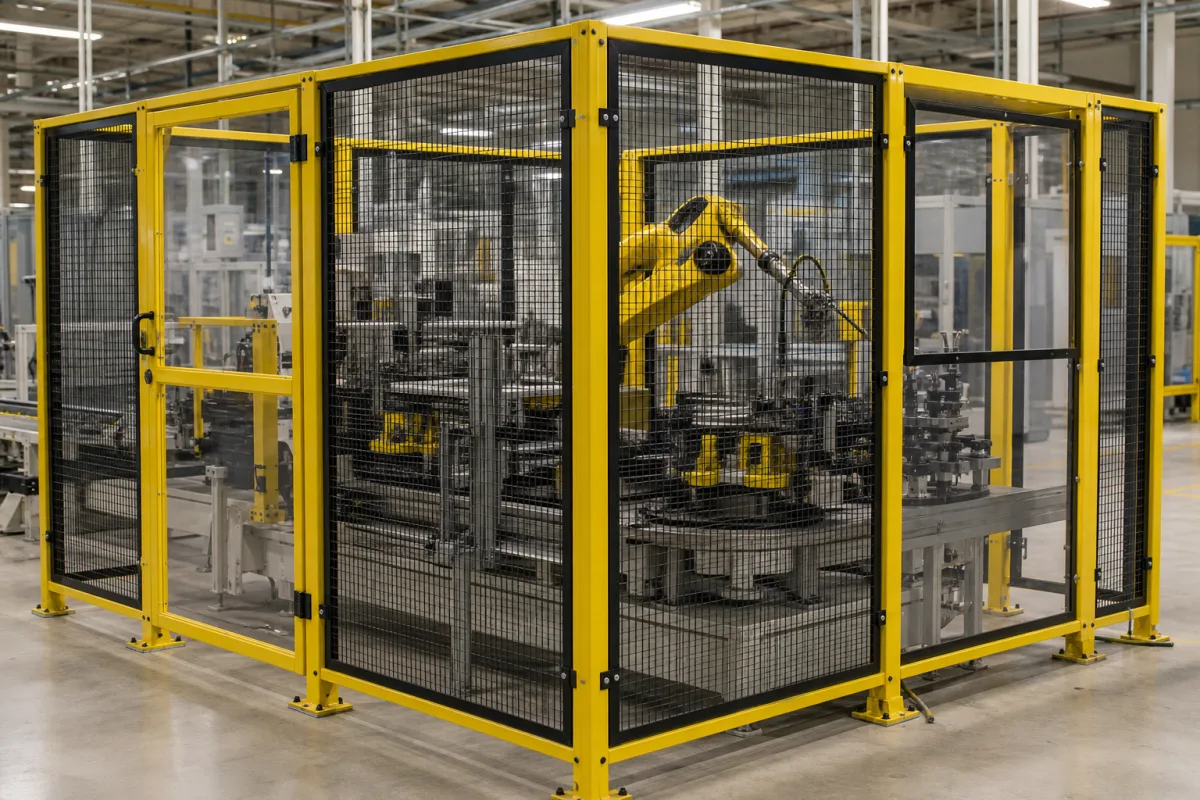
Safety guarding keeps people out of machine danger zones; for robot cells and automated lines it is mesh-panel perimeter fencing with posts and interlocked access doors, like the yellow-framed enclosure pictured around a robot cell. Ask three things first: which hazards the guard must keep people from reaching, what opening size and distance from the hazard the mesh and gaps give, and which doors must be interlocked to stop the machine before anyone can reach a hazard.
Fixed and interlocked perimeter guards, mesh fencing panels, posts and access doors for machines, robot cells and automated lines. Light curtains and safety laser scanners, safety relays and controllers, and guarding built into a machine by its maker as a single product are outside this page.
CNFX editorial research · Sources checked October 11, 2026 · 4 sources
Size guard openings by their distance from the hazard
29 CFR 1910.212 requires machine guarding to protect operators and others from point-of-operation hazards, ingoing nip points, rotating parts, flying chips and sparks, using barrier guards, two-hand tripping devices or electronic safety devices; guards are to be fixed to the machine where possible and must not create an accident hazard themselves. Fan blades less than 7 ft above the floor must be guarded with openings no larger than 1/2 in. [1]
For mechanical power presses, 29 CFR 1910.217 requires point-of-operation guards that prevent hands or fingers reaching the hazard through, over, under or around the guard, conform to the maximum openings of Table O-10, create no pinch point, use fasteners not readily removable by the operator and give maximum visibility. Table O-10 allows a maximum opening of 1/4 in at 1/2 to 1 1/2 in from the hazard, 1/2 in at 2 1/2 to 3 1/2 in, 7/8 in at 6 1/2 to 7 1/2 in, 1 1/4 in at 7 1/2 to 12 1/2 in, 1 7/8 in at 15 1/2 to 17 1/2 in and 2 1/8 in at 17 1/2 to 31 1/2 in. [2]
Editorial calculation: a mesh with 1 1/4 in (about 32 mm) openings must stand at least 7 1/2 in (about 190 mm) from the danger line under that table, and a 2 1/8 in (about 54 mm) opening at least 17 1/2 in (about 445 mm). Table O-10 is written for mechanical power presses; for other machines check the reach-distance rules that apply in your market, and size panels so the fence position meets them.
Give the supplier the machine or cell layout with hazard zones, required fence height and distance from hazards, mesh opening and panel sizes, number and type of access doors, interlock and locking devices, floor fixing, load and impact requirements, colour, and the standards the guarding must meet in your market.
02
Plan robot cell spaces, perimeter guards and interlocks
OSHA's Technical Manual chapter on industrial robot systems distinguishes the robot's restricted, operating and safeguarded spaces and lists safeguarding devices including presence-sensing devices, fixed barrier or perimeter guards that prevent access and contact with moving parts, and interlocked barrier guards; awareness devices such as chains, signs and lights are only used together with other safeguards. Its case examples include inadequate perimeter guarding that let a worker enter the safeguarded space without causing a protective stop. [3]
The manual says that in automatic mode all safeguarding devices should be active and the operator should never have access to hazards; servicing during automatic operation is not allowed unless safeguarding prevents operation or causes a stop without restart. During teaching in manual mode, robot speed should be reduced to 10 in/s (250 mm/s) or less. It recommends site acceptance testing before start-up and periodic checks of stopping performance, safety distances and safety function settings, with a documented risk assessment at each stage. [3]
Editorial note: size the perimeter to the robot's restricted space plus the stopping distance of the robot and any tooling, and place interlocked doors so that the robot stops before a person entering can reach it.
03
Compare what suppliers offer
The supplier linked to this page lists machine safety guarding; its card links to the page reviewed.
Ask any supplier for panel and mesh dimensions and openings, post and fixing details, door types and interlock provisions, impact or load test data, finish and the standards it designs to.
04
Set fence height, mesh pitch and powered-door limits to ISO figures
Guard-fencing maker Axelent summarises ISO 13857 in its Safety Book: fencing must be at least 1400 mm high, and the required height is read from the hazard's height and its distance from the fence; its example, a hazard 1600 mm high and 400 mm away, needs 2200 mm. It says the same values appear in ANSI B11.19 Annex E and CSA ISO 13857. [4]
Mesh needs a safety distance from panel to hazard of at least 120 mm for slots up to 20 mm high or square openings up to 30 x 30 mm, and 200 mm for slots over 20 mm high and 30 to 65 mm wide; closer than that, Axelent advises solid panels. A hazard near the ground must be at least 1100 mm away, or the gap under the fence must be closed with a kick plate. Without additional safety devices, a powered closing guard may not exceed 75 N and 4 J; trip bars are limited to 150 N and 10 J. [4]
Editorial note: these ISO-based figures differ from OSHA Table O-10, which covers mechanical power presses [2]; name the standard the fence must meet in the enquiry.
05
Trace the guarding parts
This is a functional reference built from the sources cited; it is not one maker's specification.
Fill the specification fields with values for your cell
A guarding quotation needs values for your machines and layout. The table explains each field, gives published values where a reviewed source states them, and says what to obtain from the supplier.
Field
What it means and published values
Ask the supplier for
Mesh Opening (mm)
Press table: 1/4 in at closest to 2 1/8 in at 17 1/2 in+. [2]
Explore company information and manufacturing capabilities, then discuss the scope of your project with a relevant supplier.
Share this page
Compiled and source-reviewed by the CNFX editorial team.
Published product pages show what a company offers, not tested performance. Confirm the legal seller, factory and scope for your order. How we source and review
· Page last updated 13 October 2026
Buyer questions
How large can the openings in a machine guard be?
For mechanical power presses, OSHA Table O-10 allows 1/4 in close to the hazard, rising to 2 1/8 in at 17 1/2 to 31 1/2 in away. [2]
What should guard a robot cell?
OSHA's robotics manual lists fixed or interlocked perimeter guards and presence-sensing devices, with awareness devices only as supplements. [3]
How fast may a robot move during teaching?
OSHA's Technical Manual recommends 10 in/s (250 mm/s) or less on any part of the application. [3]
How high must perimeter guard fencing be?
Axelent's Safety Book, citing ISO 13857, gives 1400 mm as the minimum and reads the required height from the hazard's height and its distance from the fence; its example needs 2200 mm for a hazard 1600 mm high and 400 mm away. [4]
Sources and what still needs a direct check
Sources checked 2026-10-11. 29 CFR 1910.212 and 1910.217 are US workplace safety regulations; OSHA's Technical Manual gives non-binding guidance on industrial robot systems.