Industry-Verified Manufacturing Data (2026)

System Control Cabinet

Based on aggregated insights from multiple verified factory profiles within the CNFX directory, the standard System Control Cabinet used in the Motor Vehicle Manufacturing sector typically supports operational capacities ranging from standard industrial configurations to heavy-duty production requirements.

Technical Definition & Core Assembly

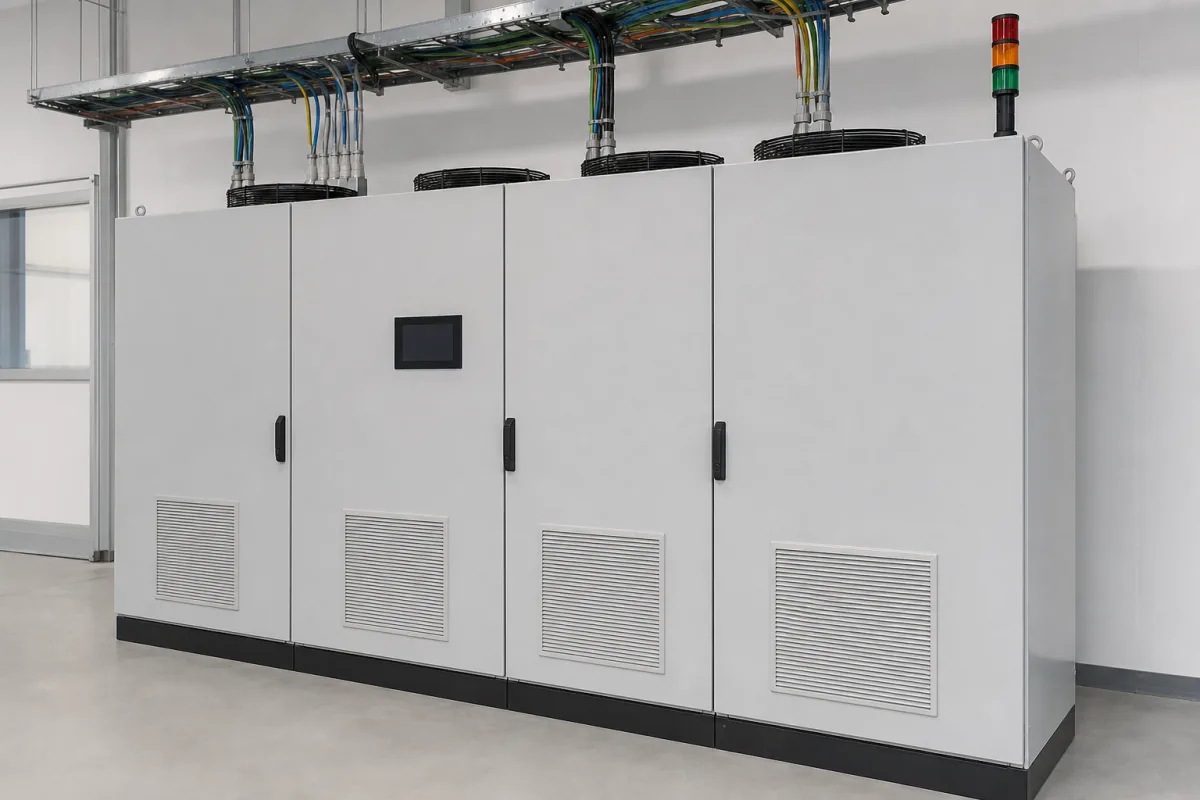
A canonical System Control Cabinet is characterized by the integration of PLC Module and HMI Panel. In industrial production environments, manufacturers listed on CNFX commonly emphasize Galvanized steel construction to support stable, high-cycle operation across diverse manufacturing scenarios.

Centralized enclosure housing control systems for automotive chassis assembly operations
Product Specifications

Technical details and manufacturing context for System Control Cabinet

Definition
A specialized cabinet that serves as the central control unit within the Automotive Modular Chassis Assembly System, containing electrical components, PLCs, HMIs, and safety systems that coordinate and monitor the assembly process of vehicle chassis modules.
Working Principle
The cabinet receives input signals from sensors and operators, processes them through programmable logic controllers (PLCs) and industrial computers, and outputs control signals to actuators, motors, and other assembly equipment to execute precise chassis assembly operations according to programmed sequences.
Common Materials
Galvanized steel, Polycarbonate windows, Copper wiring
Technical Parameters
  • Standard cabinet dimensions (H×W×D): 2000×800×600 (mm) Customizable
Components / BOM
  • PLC Module
    Central processing unit for controlling assembly sequences
    Material: Electronic components
  • HMI Panel
    Operator interface for monitoring and controlling assembly processes
    Material: Touchscreen glass, aluminum frame
  • Power Distribution Unit
    Distributes electrical power to various control components
    Material: Copper busbars, insulating materials
  • Safety Relay Module
    Ensures emergency stop and safety circuit functionality
    Material: Electronic components, plastic housing
Engineering Reasoning
24-48 VDC, 0-55°C ambient temperature, 5-95% relative humidity non-condensing
Ambient temperature exceeding 60°C for >30 minutes, voltage input exceeding 60 VDC, ingress protection rating below IP54
Design Rationale: Semiconductor junction temperature exceeding 150°C causing thermal runaway in PLC processors, dielectric breakdown at >60 VDC in 24V-rated components, condensation-induced corrosion on PCB traces below 5°C dew point differential
Risk Mitigation (FMEA)
Trigger Harmonic distortion exceeding 8% THD in 480VAC supply
Mode: Transformer core saturation in 480VAC-to-24VDC power supply
Strategy: Install 5% impedance line reactors with K-factor 13 rating on input side
Trigger VFD-induced EMI at 2-10 MHz from adjacent 50HP motors
Mode: Bit errors in PROFINET IO communication at 100 Mbps
Strategy: Shielded twisted pair cables with 360° EMC glands, ferrite cores on all I/O lines

Industry Taxonomies & Aliases

Commonly used trade names and technical identifiers for System Control Cabinet.

Industrial Ecosystem & Supply Chain DNA

Complementary Systems
Downstream Applications
Specialized Tooling

Application Fit & Sizing Matrix

Operational Limits
pressure: Atmospheric (sealed NEMA/IP rated enclosure)
other spec: Humidity: 10-90% non-condensing, Vibration: ≤5g, Dust ingress: IP54 minimum
temperature: 5°C to 40°C (operating), -10°C to 60°C (storage)
Media Compatibility
✓ Clean industrial air environments ✓ Automated assembly line control signals ✓ Low-voltage power distribution (24VDC/120VAC)
Unsuitable: High-pressure hydraulic fluid spray areas
Sizing Data Required
  • Total PLC/I/O module count and dimensions
  • Required cable entry/exit points and gland sizes
  • Heat dissipation load from internal components (W)

Reliability & Engineering Risk Analysis

Failure Mode & Root Cause
Overheating of components
Cause: Inadequate ventilation, dust accumulation blocking airflow, or excessive ambient temperature causing thermal stress on electrical components like PLCs, drives, and contactors.
Corrosion and electrical short circuits
Cause: Moisture ingress due to poor sealing, condensation from temperature fluctuations, or exposure to corrosive atmospheres leading to oxidation of terminals, PCB tracks, and relay contacts.
Maintenance Indicators
  • Audible buzzing, arcing, or unusual humming from relays, contactors, or transformers indicating loose connections or failing components.
  • Visible signs like discoloration, melting, or smoke from wiring insulation, burnt smell, or LED indicators on devices showing fault codes (e.g., overload, ground fault).
Engineering Tips
  • Implement regular thermographic inspections using infrared cameras to detect hot spots early, and ensure cabinet cooling systems (fans, filters, air conditioners) are clean and functional to maintain optimal operating temperatures.
  • Maintain proper sealing integrity with gaskets and cable glands, use desiccant breathers to control humidity, and apply anti-corrosion coatings on internal metal surfaces in harsh environments.

Compliance & Manufacturing Standards

Reference Standards
IEC 61439-1: Low-voltage switchgear and controlgear assemblies UL 508A: Standard for Industrial Control Panels ISO 13849-1: Safety of machinery - Safety-related parts of control systems
Manufacturing Precision
  • Panel flatness: ≤ 1.0 mm per meter
  • Mounting hole alignment: ± 0.5 mm
Quality Inspection
  • Dielectric withstand test (hipot test)
  • IP rating verification test (dust/water ingress protection)

Factories Producing System Control Cabinet

Verified manufacturers with capability to produce this product in China

✓ 96% Supplier Capability Match Found

T Technical Director from Australia Jan 31, 2026
★★★★★
"Reliable performance in harsh Motor Vehicle Manufacturing environments. No issues with the System Control Cabinet so far."
Technical Specifications Verified
P Project Engineer from Singapore Jan 28, 2026
★★★★☆
"Testing the System Control Cabinet now; the technical reliability results are within 1% of the laboratory datasheet. (Delivery took slightly longer than expected, but technical support was excellent.)"
Technical Specifications Verified
S Sourcing Manager from Germany Jan 25, 2026
★★★★★
"Impressive build quality. Especially the technical reliability is very stable during long-term operation."
Technical Specifications Verified
Verification Protocol

“Feedback is collected from verified sourcing managers during RFQ (Request for Quote) and factory evaluation processes on CNFX. These reports represent historical performance data and technical audit summaries from our B2B manufacturing network.”

9 sourcing managers are analyzing this specification now. Last inquiry for System Control Cabinet from USA (1h ago).

Supply Chain Compatible Machinery & Devices

Automotive Battery Management System

Electronic control system for monitoring and managing vehicle battery packs.

Explore Specs →
Automotive Wireless Power Transfer System

Wireless charging system for electric vehicles using electromagnetic induction.

Explore Specs →
Automotive Solid-State Battery Pack

High-energy-density solid-state battery system for electric vehicles

Explore Specs →
Automotive Active Grille Shutter System

Aerodynamic system with motorized shutters for vehicle thermal and efficiency management.

Explore Specs →

Frequently Asked Questions

What materials are used in the System Control Cabinet for motor vehicle manufacturing?

The cabinet is constructed from galvanized steel for durability, features polycarbonate windows for visibility, and uses copper wiring for reliable electrical connections in automotive assembly environments.

What components are included in the BOM for this control cabinet?

The bill of materials includes an HMI Panel for operator interface, PLC Module for process control, Power Distribution Unit for electrical management, and Safety Relay Module for operational safety compliance.

How does this control cabinet benefit automotive chassis assembly operations?

It centralizes control systems in a single enclosure, improving efficiency, reducing wiring complexity, and providing organized access to PLC, HMI, and safety components for streamlined automotive manufacturing processes.

Can I contact factories directly on CNFX?

CNFX is an open directory, not a transaction platform. Each factory profile provides direct contact information and production details to help you initiate direct inquiries with Chinese suppliers.

Get Quote for System Control Cabinet

Request technical pricing, lead times, or customized specifications for System Control Cabinet directly from verified manufacturing units.

Your business information is encrypted and only shared with verified System Control Cabinet suppliers.

Thank you! Your message has been sent. We'll respond within 1–3 business days.

Need to Manufacture System Control Cabinet?

Connect with verified factories specializing in this product category

Add Your Factory Contact Us
Previous Product
Suction System
Next Product
Tachometer