Structured Manufacturing Data (2026)

Sensors (Proximity/Vision)

Based on aggregated insights from structured factory profiles within the CNFX directory, the standard Sensors (Proximity/Vision) used in the Machinery and Equipment Manufacturing sector typically supports operational capacities ranging from standard industrial configurations to heavy-duty production requirements.

Technical Definition & Core Assembly

A canonical Sensors (Proximity/Vision) is characterized by the integration of Sensor housing and Detection element. In industrial production environments, manufacturers listed on CNFX commonly emphasize Stainless steel housing construction to support stable, high-cycle operation across diverse manufacturing scenarios.

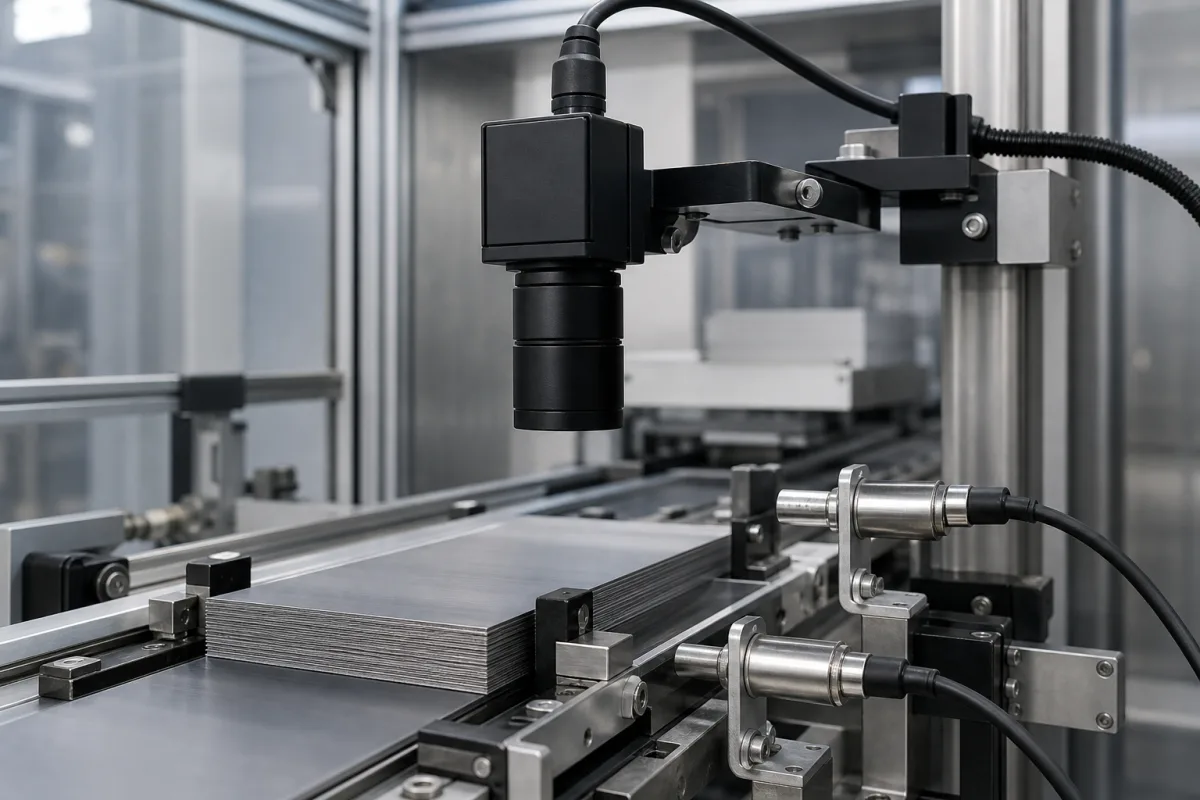
Electronic devices that detect the presence, position, or characteristics of objects within a stacking mechanism's operational zone.
Product Specifications

Technical details and manufacturing context for Sensors (Proximity/Vision)

Definition
Sensors (Proximity/Vision) are critical components within a stacking mechanism that provide real-time feedback on object positioning, alignment, and presence. Proximity sensors detect objects without physical contact using electromagnetic fields, infrared, or ultrasonic waves, while vision sensors use cameras and image processing to identify object features, orientation, and quality. Together, they ensure precise stacking operations by monitoring pallet positions, product alignment, layer completion, and detecting potential jams or misalignments.
Working Principle
Proximity sensors operate by emitting electromagnetic fields or beams (infrared/ultrasonic) and detecting changes when objects enter their detection range. Vision sensors capture images through cameras, process them using algorithms to extract features like edges, patterns, or colors, and compare them to reference data to determine object position, orientation, and integrity. Both types send signals to the stacking mechanism's control system to adjust operations accordingly.
Common Materials
Stainless steel housing, Polycarbonate lens, Electronic circuitry (silicon, copper), Epoxy resin encapsulation
Technical Parameters
  • Detection range for proximity sensors (e.g., 2-100mm) and field of view for vision sensors (e.g., 50-500mm working distance) (mm) Standard Spec
Components / BOM
  • Sensor housing
    Protects internal electronics from environmental factors and mechanical damage
    Material: Stainless steel or engineering plastic
  • Detection element Part
    Emits and receives signals (electromagnetic, infrared, ultrasonic) or captures visual data
    Material: Semiconductor materials, optical glass
  • Signal processing unit
    Processes raw sensor data and converts it into usable control signals
    Material: Printed circuit board with integrated circuits
  • Connection interface Part
    Provides electrical connection to the stacking mechanism's control system
    Material: Brass connectors, copper wiring, plastic housing

Industry Taxonomies & Aliases

Commonly used trade names and technical identifiers for Sensors (Proximity/Vision).

Applied To / Applications

This component is essential for the following industrial systems and equipment:

Industrial Ecosystem & Supply Chain Structure

Complementary Systems
Downstream Applications
Specialized Tooling

Application Fit & Sizing Matrix

Operational Limits
pressure: 0.8 to 1.1 bar (atmospheric), IP67/IP69K rated for environmental protection
other spec: Detection range: 2mm to 60mm (proximity), 0.5m to 5m (vision); Response time: <2ms (proximity), <100ms (vision); Supply voltage: 10-30V DC
temperature: -20°C to +70°C (operational), -40°C to +85°C (storage)
Media Compatibility
✓ Metallic objects (steel, aluminum) ✓ Plastic/polymer components ✓ Packaged goods (cardboard, containers)
Unsuitable: High-vibration environments with continuous mechanical shock >50g
Sizing Data Required
  • Required detection distance/range
  • Object size and material characteristics
  • Required response time and output signal type

Reliability & Engineering Risk Analysis

Failure Mode & Root Cause
Sensor Drift/Calibration Loss
Cause: Environmental factors (temperature fluctuations, vibration, electromagnetic interference) causing gradual deviation from calibrated settings, leading to inaccurate proximity detection or vision misalignment.
Optical Contamination/Lens Degradation
Cause: Accumulation of dust, oil, moisture, or chemical residues on optical surfaces (for vision sensors) or sensing faces (for proximity sensors), obstructing signal transmission and reducing detection reliability.
Maintenance Indicators
  • Intermittent or erratic detection signals (e.g., false triggers, missed objects) during operation
  • Visible physical damage or contamination on sensor surfaces (e.g., cracked lenses, dirty optics, corroded housings)
Engineering Tips
  • Implement regular calibration and environmental compensation routines, using shielded cabling and stable mounting to minimize interference and mechanical stress.
  • Establish preventive cleaning schedules with appropriate solvents, install protective enclosures or air purges in harsh environments, and use sensors with suitable IP ratings for the operating conditions.

Compliance & Manufacturing Standards

Reference Standards
ISO 13849-1: Safety of machinery - Safety-related parts of control systems IEC 60947-5-2: Low-voltage switchgear and controlgear - Proximity switches EN 61326-1: Electrical equipment for measurement, control and laboratory use - EMC requirements
Manufacturing Precision
  • Housing dimensional tolerance: +/-0.1mm
  • Sensing distance accuracy: +/-5% of nominal range
Quality Inspection
  • Environmental sealing test (IP rating verification)
  • Functional accuracy test with calibrated reference targets

Factories Producing Sensors (Proximity/Vision)

Manufacturer profiles with relevant production capability in China

Manufacturer listings support early research and capability understanding. They are not certification, ranking, or transaction guarantees.

Technical documentation
4/5
Manufacturing capability
4/5
Inspection readiness
5/5
Supplier transparency
3/5

These scores are example evaluation dimensions, not real customer ratings, country-specific buyer feedback, or live inquiry activity.

Supply Chain Compatible Machinery & Devices

Heavy-Duty CNC Plasma Cutting Machine

Industrial machine for precision metal cutting using plasma arc technology

Explore Specs →
Automated Assembly Line System

Integrated production system for sequential component assembly operations

Explore Specs →
Automated Powder Coating System

Integrated industrial system for applying dry powder coatings to metal substrates.

Explore Specs →
Centrifugal Pump Impeller

Rotating component that transfers energy to fluid in centrifugal pumps.

Explore Specs →

Frequently Asked Questions

What environmental conditions can these proximity/vision sensors withstand in machinery manufacturing?

Our sensors feature stainless steel housing and epoxy resin encapsulation for durability against dust, moisture, and vibration in industrial environments, with polycarbonate lenses providing impact resistance.

How do these sensors integrate with existing stacking mechanism control systems?

The sensors include standardized connection interfaces and signal processing units that output compatible signals (digital/analog) for seamless integration with PLCs and industrial automation controllers.

What maintenance is required for these stacking mechanism sensors?

Minimal maintenance is needed due to the sealed stainless steel housing and encapsulated electronics. Periodic lens cleaning and connection checks are recommended for optimal performance.

Can I contact factories directly on CNFX?

CNFX is an open directory, not a transaction platform. Each factory profile provides direct contact information and production details to help you initiate direct inquiries with Chinese suppliers.

Data Basis

CNFX manufacturer profiles, technical classification, publicly available product information, and ongoing plausibility checks.

Preliminary Technical Classification
This page supports structured research, RFQ preparation, and supplier evaluation. It does not replace buyer-led supplier qualification, standards review, or technical approval.

Request Manufacturing Insight for Sensors (Proximity/Vision)

Ask for use case, specification boundaries, supplier type, and RFQ preparation information for Sensors (Proximity/Vision).

Your business information is used only to process this request.

Thank you! Your message has been sent. We'll respond within 1–3 business days.

Need to Manufacture Sensors (Proximity/Vision)?

Compare manufacturer profiles with relevant product and process capability.

Create Manufacturer Profile Contact Us
Previous Product
Sensors (optional)
Next Product
Separation Bowl