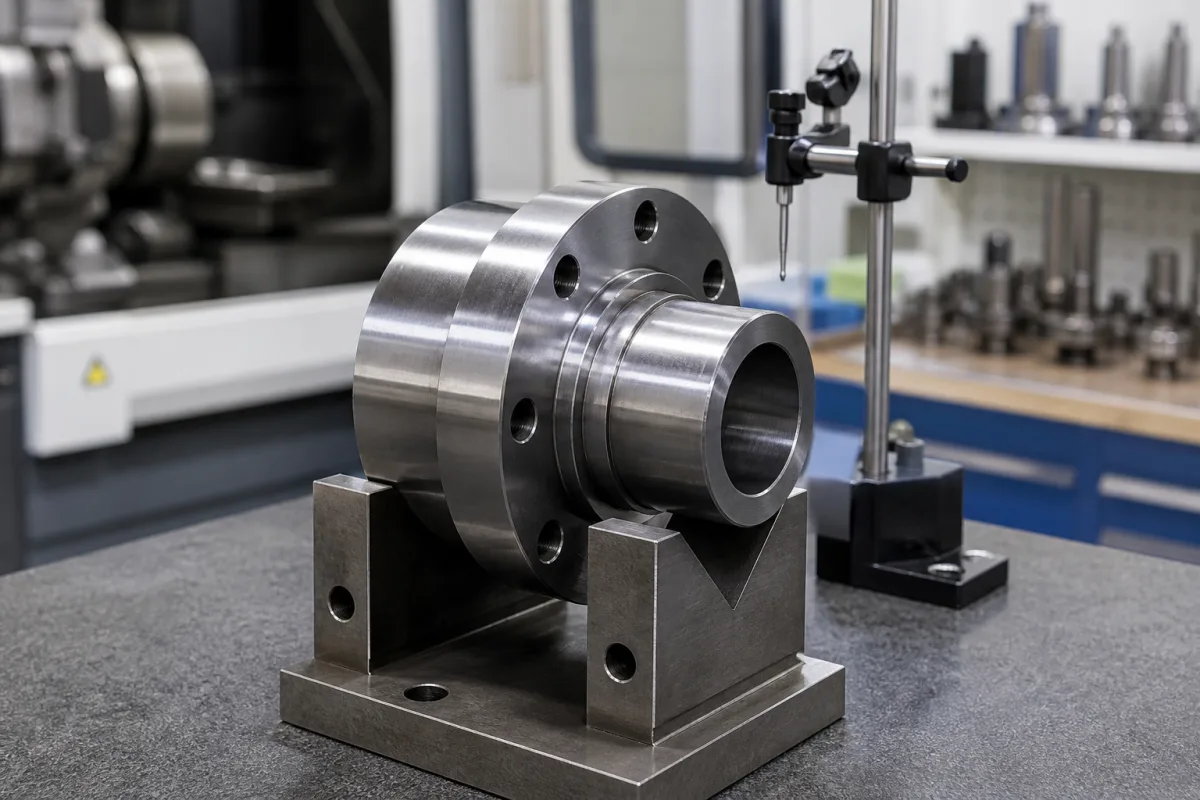
Shaft coupling adapter (flanged shaft-hub adapter clamped to the shaft by a keyless locking assembly instead of a key)
Keyless shaft-hub adapters · flanged hubs clamped to the shaft by locking assemblies, transmissible torque and thrust, shaft and hub contact pressure, material yield checks, hub outer diameter, fits and surface finish
A shaft coupling adapter here is the hub that carries a coupling flange, pulley or sprocket on a shaft without a key: a flanged or plain hub bored to clear the shaft, with a keyless locking assembly between them whose tapered rings, pulled together by screws, press on shaft and hub bore. Ask three things first: what peak torque, thrust and bending the joint must carry with a safety factor, whether shaft and hub materials can take the contact pressure, and whether the hub's outer diameter is large enough for the pressure from inside.
Flanged and plain shaft-hub adapters fixed by keyless locking assemblies (taper locking rings) for couplings, pulleys, sprockets, levers and conveyor drums. Couplings themselves are covered on the Shaft coupling page; sprocket hubs on the Sprocket hubs and roller chain sprockets page; air-shaft and safety-chuck adapters for winding are covered on the Core chucking system page; precision gearhead and bellows drive lines on their own page.
CNFX editorial research · Sources checked October 12, 2026 · 4 sources
Peak torque with a safety factor, and the contact pressure it puts on shaft and hub
Tsubaki's Power-Lock selection guide starts from maximum torque and thrust: T max = 5252 × HP × sf ÷ n (ft·lb), with a safety factor greater than 1 "for every maximum or peak torque" in servo and stepper drives, then compares T max (or the combined load M R when torque and thrust act together) with the rated transmissible torque M t. Because "large contact pressure applies to both the shaft and hub during installation", it requires the yield points of shaft and hub materials to exceed the contact pressures by a series coefficient, given as σ0.2S ≥ 1.2 × P and σ0.2B ≥ 1.2 × P´ for one series. [1][2]
A distributor listing for Tsubaki's PL050X080 (AS series, 50 mm shaft, 80 mm hub bore) gives transmissible torque 1,770 N·m, thrust 70.6 kN, shaft contact pressure 180 MPa, hub contact pressure 113 MPa, M8 × 22 screws and -30 to 200 °C. [3]
Editorial calculation: a 20 hp drive at 100 rpm with a safety factor of 2 gives 5252 × 20 × 2 ÷ 100 ≈ 2,101 ft·lb, about 2,850 N·m, more than the 1,770 N·m of the 50 mm unit, so a larger size or two units would be needed. If a 1.2 factor applied to that unit, the shaft would need a yield point of at least 1.2 × 180 = 216 MPa and the hub at least 1.2 × 113 ≈ 136 MPa; the AS series uses its own coefficient K2 from Tsubaki's table, so check it. Drive power and speed are assumed examples. [1][2][3]
Give the supplier the shaft diameter and material, hub material and outer diameter (or flange drawing), peak torque, thrust and bending moment, safety factor, speed, temperature, whether the shaft is hollow, space available along the shaft, and whether the joint must be released and re-clamped in service.
02
Hub outer diameter, fits, surface finish and stacking more than one unit
Tsubaki gives hub diameter tables for each series and, where the hub material is not listed, a formula for the minimum hub outer diameter D N from the hub bore D, hub contact pressure P´, hub yield point σ0.2B and a hub configuration coefficient K3; in another series it checks the combined stress in the hub from contact pressure and torque against the hub yield point. [1][2]
Ringfeder's RfN 7012, as described by its distributor Bibus, is a slim four-piece locking assembly whose clamping cones prevent axial displacement and which is self-releasing. It recommends Ra 3.2 μm on shaft and hub bore, fits of shaft k9-h9 and hub N9-H9 (maximum k11-h11 and N11-H11), and grade 12.9 screws whose tightening torque may be reduced to 50% with torque, thrust and contact pressures falling proportionally. The values of two or more units in series may be added if they are within 4·L of each other, and its values apply to the lightly oiled delivery condition. [4]
Explore company information and manufacturing capabilities, then discuss the scope of your project with a relevant supplier.
Share this page
Compiled and source-reviewed by the CNFX editorial team.
Each manufacturer above links to the page on that company's own website where the product is listed, with the date we checked it. How we source and review
· Page last updated 13 October 2026
Buyer questions
How is a shaft coupling adapter different from a coupling?
It is the hub that fixes a coupling, pulley or sprocket to the shaft without a key; the couplings themselves are on the Shaft coupling page. [4][1]
How much torque can a 50 mm keyless locking device carry?
One Tsubaki Power-Lock for a 50 mm shaft and 80 mm hub bore is listed at 1,770 N·m and 70.6 kN thrust. [3]
What surface finish and fits are needed?
Ringfeder recommends Ra 3.2 μm and shaft k9-h9 with hub N9-H9 for its RfN 7012. [4]
Why check the hub outer diameter?
Tsubaki sizes the minimum hub diameter to tolerate the contact pressure from inside the hub. [1]