Industry-Verified Manufacturing Data (2026)

Sorting Mechanism (e.g., Robotic Arm, Diverter Gate)

Based on aggregated insights from multiple verified factory profiles within the CNFX directory, the standard Sorting Mechanism (e.g., Robotic Arm, Diverter Gate) used in the Machinery and Equipment Manufacturing sector typically supports operational capacities ranging from standard industrial configurations to heavy-duty production requirements.

Technical Definition & Core Assembly

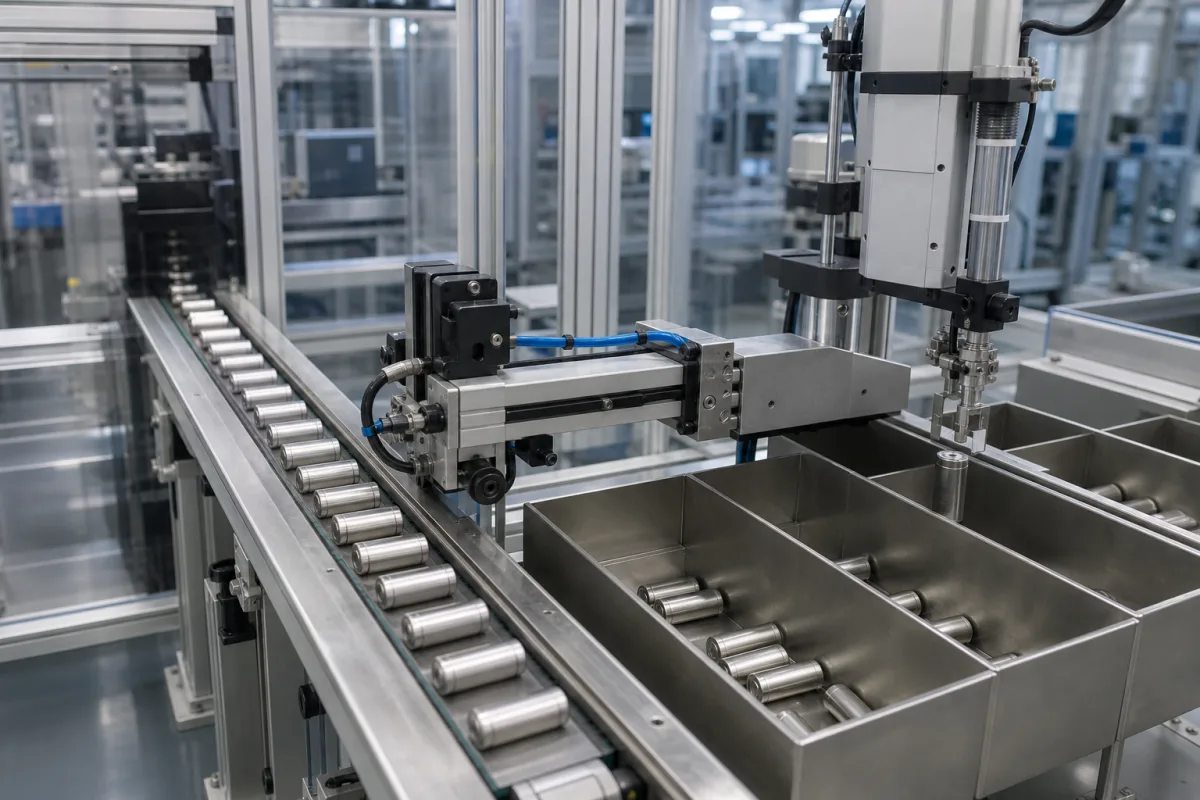
A canonical Sorting Mechanism (e.g., Robotic Arm, Diverter Gate) is characterized by the integration of Actuator and End-Effector or Gate Blade. In industrial production environments, manufacturers listed on CNFX commonly emphasize Stainless Steel (AISI 304/316) construction to support stable, high-cycle operation across diverse manufacturing scenarios.

A mechanical or electromechanical component within an Automated Cell Sorting Station that physically separates, directs, or routes individual cells or cell batches into designated pathways or containers based on predefined criteria.
Product Specifications

Technical details and manufacturing context for Sorting Mechanism (e.g., Robotic Arm, Diverter Gate)

Definition
The Sorting Mechanism is a critical functional part of an Automated Cell Sorting Station, responsible for the final physical separation action. It receives signals from the station's control system (which has analyzed cells via sensors like cameras or flow cytometers) and executes the sorting command. Common implementations include robotic arms that pick and place cells into specific wells or trays, or diverter gates that rapidly switch to channel cells into different output streams. Its role is to translate digital sorting decisions into precise, reliable physical movement, ensuring high-purity sorted cell populations for downstream applications in research, diagnostics, or biomanufacturing.
Working Principle
The mechanism operates by receiving an electrical signal from the station's central controller, which contains the sorting decision for each cell (e.g., 'sort left' or 'sort right'). An actuator (like a servo motor, solenoid, or pneumatic cylinder) is energized, causing a physical movement. For a robotic arm, this involves coordinated motion along axes to grasp and transfer a cell container. For a diverter gate, it involves a rapid toggling motion to alter the cell's path in a flow stream. The movement is designed for speed, accuracy, and minimal disturbance to the delicate cells.
Common Materials
Stainless Steel (AISI 304/316), Aluminum Alloy, Engineering Plastics (e.g., PEEK, PTFE)
Technical Parameters
  • Sorting Cycle Time: The time required for the mechanism to complete one sort action (e.g., gate toggle or arm pick-place cycle), critical for determining overall station throughput. (ms) Standard Spec
Components / BOM
  • Actuator
    Converts control signals (electrical, pneumatic) into precise mechanical motion to drive the sorting action.
    Material: Various (e.g., steel coils for solenoid, aluminum housing for servo motor)
  • End-Effector or Gate Blade
    The part that makes direct contact or interacts with the cell container/stream (e.g., gripper, paddle, gate surface).
    Material: Stainless steel or sterilizable plastic
  • Motion Guide / Bearing
    Provides smooth, low-friction linear or rotational guidance for the moving parts of the mechanism.
    Material: Stainless steel, ceramic balls
Engineering Reasoning
0.5-2.0 N·m torque, 0.1-1.0 mm positioning accuracy, 10-100 kPa pneumatic pressure
2.5 N·m torque exceeds gear train yield strength, 0.01 mm positioning error exceeds encoder resolution, 150 kPa pressure exceeds seal burst rating
Design Rationale: Gear tooth bending fatigue at 2.5 N·m stress concentration factor of 1.8, encoder quadrature signal phase error exceeding 90°, elastomer seal extrusion at 150 kPa differential pressure
Risk Mitigation (FMEA)
Trigger Pneumatic valve spool stiction exceeding 0.5 N breakaway force
Mode: Diverter gate response time delay exceeding 200 ms specification
Strategy: Diamond-like carbon coating on spool with 0.05 μm surface roughness, 0.1 μm clearance fit
Trigger Servo motor resolver alignment error of 0.5° mechanical
Mode: Robotic arm positioning error accumulation of 0.15 mm per 100 cycles
Strategy: Absolute encoder with 21-bit resolution (2,097,152 counts/rev), thermal compensation at 50 ppm/°C

Industry Taxonomies & Aliases

Commonly used trade names and technical identifiers for Sorting Mechanism (e.g., Robotic Arm, Diverter Gate).

Applied To / Applications

This component is essential for the following industrial systems and equipment:

Industrial Ecosystem & Supply Chain DNA

Complementary Systems
Downstream Applications
Specialized Tooling

Application Fit & Sizing Matrix

Operational Limits
pressure: 0 to 2 bar (max system pressure)
flow rate: Up to 100 mL/min (per sorting channel)
temperature: 5°C to 40°C (operating range)
slurry concentration: Up to 10^6 cells/mL (max viable concentration)
Media Compatibility
✓ Phosphate-buffered saline (PBS) ✓ Cell culture media (e.g., DMEM) ✓ Sterile aqueous buffers
Unsuitable: Organic solvents or corrosive chemicals
Sizing Data Required
  • Maximum throughput (cells/hour)
  • Number of distinct sorting pathways required
  • Cell size range (μm) and viability constraints

Reliability & Engineering Risk Analysis

Failure Mode & Root Cause
Mechanical wear in joints and actuators
Cause: Cyclic loading and friction leading to component degradation, especially in high-cycle applications
Sensor calibration drift or failure
Cause: Environmental factors (dust, vibration, temperature fluctuations) affecting optical or position sensors
Maintenance Indicators
  • Unusual grinding or squeaking noises during operation
  • Inconsistent sorting accuracy or misalignment of items
Engineering Tips
  • Implement predictive maintenance using vibration analysis and thermal imaging to detect early wear patterns
  • Establish regular calibration schedules for sensors and actuators, with environmental controls to minimize drift

Compliance & Manufacturing Standards

Reference Standards
ISO 10218-1:2011 (Robots and robotic devices - Safety requirements for industrial robots) ANSI/RIA R15.06-2012 (Industrial Robots and Robot Systems - Safety Requirements) CE Marking (EU Machinery Directive 2006/42/EC for safety and electromagnetic compatibility)
Manufacturing Precision
  • Positioning Accuracy: +/-0.1mm for robotic arm end-effector
  • Gate Alignment: +/-0.5mm for diverter gate positioning
Quality Inspection
  • Cycle Time and Repeatability Test (verifies consistent sorting speed and accuracy)
  • Load Testing and Endurance Run (validates mechanism durability under maximum rated capacity)

Factories Producing Sorting Mechanism (e.g., Robotic Arm, Diverter Gate)

Verified manufacturers with capability to produce this product in China

✓ 94% Supplier Capability Match Found

P Procurement Specialist from United Arab Emirates Feb 04, 2026
★★★★★
"Great transparency on the Sorting Mechanism (e.g., Robotic Arm, Diverter Gate) components. Essential for our Machinery and Equipment Manufacturing supply chain."
Technical Specifications Verified
T Technical Director from Australia Feb 01, 2026
★★★★★
"The Sorting Mechanism (e.g., Robotic Arm, Diverter Gate) we sourced perfectly fits our Machinery and Equipment Manufacturing production line requirements."
Technical Specifications Verified
P Project Engineer from Singapore Jan 29, 2026
★★★★★
"Found 55+ suppliers for Sorting Mechanism (e.g., Robotic Arm, Diverter Gate) on CNFX, but this spec remains the most cost-effective."
Technical Specifications Verified
Verification Protocol

“Feedback is collected from verified sourcing managers during RFQ (Request for Quote) and factory evaluation processes on CNFX. These reports represent historical performance data and technical audit summaries from our B2B manufacturing network.”

6 sourcing managers are analyzing this specification now. Last inquiry for Sorting Mechanism (e.g., Robotic Arm, Diverter Gate) from Brazil (28m ago).

Supply Chain Compatible Machinery & Devices

Heavy-Duty CNC Plasma Cutting Machine

Industrial machine for precision metal cutting using plasma arc technology

Explore Specs →
Automated Assembly Line System

Integrated production system for sequential component assembly operations

Explore Specs →
Automated Powder Coating System

Integrated industrial system for applying dry powder coatings to metal substrates.

Explore Specs →
Centrifugal Pump Impeller

Rotating component that transfers energy to fluid in centrifugal pumps.

Explore Specs →

Frequently Asked Questions

What materials are recommended for sterile cell sorting applications?

For sterile environments, we recommend AISI 316 stainless steel or PEEK engineering plastics, which offer excellent corrosion resistance and biocompatibility for cell handling.

How does the sorting mechanism integrate with existing automated stations?

Our sorting mechanisms feature standardized mounting interfaces and communication protocols that allow seamless integration with most automated cell sorting stations, minimizing retrofitting requirements.

What maintenance is required for long-term reliability?

Regular lubrication of motion guides/bearings and inspection of end-effector wear are recommended. Stainless steel versions typically require minimal maintenance in controlled environments.

Can I contact factories directly on CNFX?

CNFX is an open directory, not a transaction platform. Each factory profile provides direct contact information and production details to help you initiate direct inquiries with Chinese suppliers.

Get Quote for Sorting Mechanism (e.g., Robotic Arm, Diverter Gate)

Request technical pricing, lead times, or customized specifications for Sorting Mechanism (e.g., Robotic Arm, Diverter Gate) directly from verified manufacturing units.

Your business information is encrypted and only shared with verified Sorting Mechanism (e.g., Robotic Arm, Diverter Gate) suppliers.

Thank you! Your message has been sent. We'll respond within 1–3 business days.

Need to Manufacture Sorting Mechanism (e.g., Robotic Arm, Diverter Gate)?

Connect with verified factories specializing in this product category

Add Your Factory Contact Us
Previous Product
Sorting Mechanism
Next Product
Sorting/Alignment Mechanism