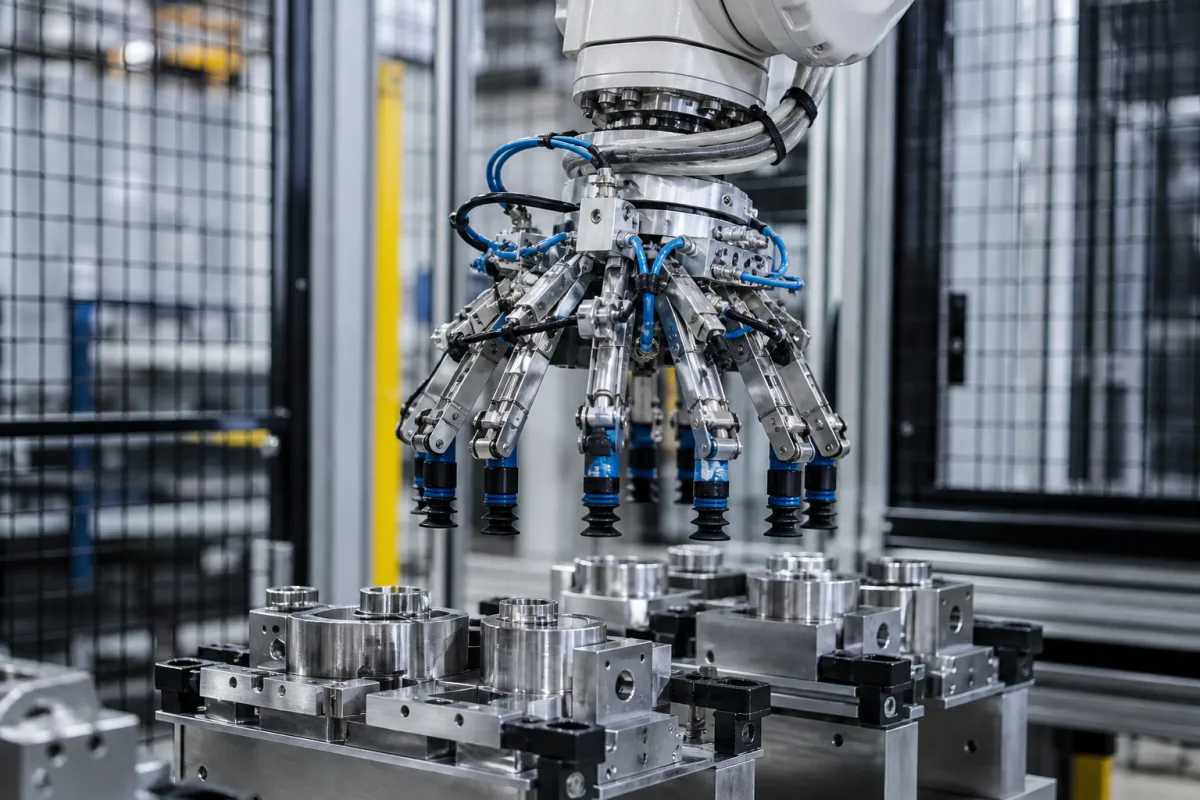
Specialized end effector: a multi-cup vacuum gripper unit with on-tool vacuum source, for robot machine tending and part transfer
A self-contained vacuum gripping tool on the robot wrist · where the vacuum is made, how many cups the tool holder takes, what a published payload figure assumes, and why coolant and chips matter at a machine tool
A finger gripper holds a part by clamping it; a vacuum end effector holds it by the pressure difference under a set of cups, and the tool that carries those cups is a product in its own right. Gripper units built for robots now carry the vacuum source on the tool itself — an electric pump or a compressed-air ejector — together with valves, sensing and a plate that sets the cup pattern. Choosing one comes down to four questions: where the vacuum comes from, how many cups the tool can carry and in what pattern, what safety margin sits behind the payload figure, and whether the parts arrive wet, oily or covered in chips.
Complete vacuum gripper units mounted on a robot flange — tool body with integrated vacuum source (electric pump or ejector), valves, vacuum sensing, cup adaptor plate and cups — used for machine tending, part transfer and packing. Finger grippers are covered on the Robot end effectors: finger grippers page; single suction cups on the Vacuum suction cup page; stand-alone ejectors on the Vacuum generator (Venturi ejector) for vacuum gripping page; block distributors on the Vacuum manifold for multi-cup vacuum grippers page; ingot stacking machines with their own grippers on the Automated ingot stacking and palletizing system page; tool changers on the Tool changers (robotic) page.
CNFX editorial research · Sources checked October 12, 2026 · 3 sources
What the payload figure assumes: OnRobot's 1.5 g cup table against SMC's safety factor of 4 and 8
OnRobot's VGC10 datasheet gives a table of how many 15, 30 or 40 mm cups are needed for a payload at 20, 40, 60 and 75 kPa vacuum on non-porous parts, built from a formula that equates lifting force with payload at 1.5 g of acceleration: number of cups × cup area [mm²] = 14,700 × payload [kg] ÷ vacuum [kPa]. [1] SMC's vacuum pad selection uses W = P × S × 0.1 × 1/t, with a safety factor t of 4 or more for horizontal lifting and 8 or more for vertical lifting. [3]
Editorial calculation: OnRobot — 14,700 × 6 ÷ 75 = 1,176 mm², or 2.6 cups of 450 mm², rounded up to 3. SMC — W = 6 × 9.81 = 58.9 N; S = 58.9 × 4 ÷ (0.1 × 75) = 31.4 cm² = 3,140 mm², or 7.0 cups of 450 mm²; doubling t to 8 doubles this to about 14. The two makers' published payloads therefore cannot be compared without knowing which basis each uses. [1][3]
SMC adds that cups resist shear force and moments poorly, so the workpiece's centre of gravity should sit under the cups and lateral acceleration be kept low, and that vertical lifting should be avoided where possible. It also warns against simply raising the vacuum: doubling vacuum doubles theoretical force while doubling pad diameter quadruples it, and an unnecessarily high vacuum wears pads and lengthens response time. [3] OnRobot's datasheet labels 60% vacuum as for heavy workpieces and 80% as maximum and not recommended. [1]
Case: 6 kg part, 40 mm cups (450 mm² gripping area), 75 kPa
Cups needed
OnRobot table and formula (1.5 g)
3 cups — the default 6 kg rating uses three 40 mm cups [1]
Ask every gripper supplier on what acceleration or safety factor its payload rating is based, at what vacuum level, with which cups, and whether the part is lifted horizontally or vertically.
02
Vacuum made on the tool: an electric BLDC pump against a COAX ejector on compressed air
The two units below represent the two ways a gripper can generate its own vacuum at the wrist. OnRobot's VGC10 carries an integrated electric BLDC pump and needs no external air supply; Piab's piCOBOT L is a vacuum ejector based on Piab's COAX technology with integrated controls, fed with compressed air. [1][2]
Piab lists energy functions that only an ejector needs: an automatic condition monitoring function detects whether the object is leaking or not and switches energy saving on or off, and automatic level determination is stated to cut energy use by up to 90–95% by optimising the energy saving function; an intelligent blow-off and a self-adhesion control remove residual vacuum at release. [2] OnRobot's pump instead runs at full speed until the target vacuum is reached and then slows to hold it. [1]
Editorial note: where a cell has no compressed air, the electric unit avoids an air line along the arm. Leakage decides the rest: OnRobot states its flow as 0–12 L/min, and Piab gives flow against vacuum level in its table, so compare both on the real part rather than on catalogue payloads. [1][2]
Cup count and pattern: 1–7 cups, two channels and a rotatable adaptor plate
On a gripper unit the cup pattern is set by the plate between the tool body and the cups. OnRobot's VGC10 body has 4 G1/8 holes; its adaptor plate has 7, can be rotated 90° either to keep channels A and B separate or to join them for more air flow, and is fixed with 4 screws at 4 N·m. [1]
OnRobot notes that its standard silicone cups suit hard, flat surfaces but not uneven ones, and may leave microscopic silicone traces that disturb later painting; for parts to be painted it lists NBR cups only, and thin dual-lip cups for hard but curved or uneven surfaces. [1] Piab's foam gripper option for piCOBOT uses check valves so that the vacuum level is held even when the whole gripping surface is not covered. [2]
Editorial note: a radial, multi-arm tool like the one pictured is a custom version of the same idea — a body with the vacuum source and a fixture that places each cup over a flat land on the part. Send the part drawing with the flat areas marked, so the supplier can place cups on them rather than over holes or edges.
At the machine tool: coolant, chips and the air path through the gripper
A vacuum gripper pulls in whatever is around the cup. SMC lists this as a condition needing special care: liquid or foreign matter around the workpiece may be sucked into the equipment. [3] OnRobot's VGC10 datasheet is explicit for its own unit: do not use vacuum grippers in wet or damp conditions, particularly in CNC applications with moisture or cutting fluids, which can damage the gripper; the unit has an integrated, field-replaceable 50 µm dust filter. [1]
Piab rates the piCOBOT L body IP65 with an operating humidity of 35–85% RH. [2] Editorial note: an ingress rating describes the housing, not what can be drawn through the cups; for machined parts leaving a wet machining centre, ask the supplier whether the vacuum path tolerates coolant, or plan a blow-off or drain station before the gripper picks.
SMC also notes that permeable or rough workpieces let the vacuum fall, so an adsorption test is needed, and gives about −60 kPa as a guide for an ejector's vacuum. [3] OnRobot adds that a higher vacuum setting does not increase lifting capacity on corrugated cardboard and recommends about 20% there. [1]
State whether parts arrive wet, oily or with chips, the part surface (machined, cast, painted), and the cleaning possible before pick-up.
05
What to send for a vacuum end effector quote
Paste it into your enquiry below or into an email to a maker, then replace every bracket.
Part: [drawing with flat gripping areas; mass; material and surface; wet or dry]
Motion: [horizontal or vertical pick; robot acceleration; cycle time]
Robot: [make and model; flange to ISO 9409-1; payload left for the tool]
Vacuum source: [electric pump or ejector; compressed air available and pressure]
Cups: [number, size and material; paint-compatibility]
Signals: [vacuum sensing; part-present output; blow-off]
Safety basis: [safety factor or acceleration assumed in the payload rating]
Explore company information and manufacturing capabilities, then discuss the scope of your project with a relevant supplier.
Share this page
Compiled and source-reviewed by the CNFX editorial team.
Each manufacturer above links to the page on that company's own website where the product is listed, with the date we checked it. How we source and review
· Page last updated 13 October 2026
Buyer questions
How much can a vacuum gripper unit lift?
It depends on cups, vacuum and the safety basis. OnRobot rates its VGC10 at 6 kg with default cups and up to 15 kg with custom attachments, sizing cups at 1.5 g; Piab lists 564.4 oz (about 16 kg) for piCOBOT L. [1][2]
What safety factor should be used for vacuum cups?
SMC's selection method uses a safety factor of 4 or more for horizontal lifting and 8 or more for vertical lifting in W = P × S × 0.1 × 1/t. [3]
Do I need compressed air for a vacuum gripper?
Not for an electric unit: OnRobot's VGC10 has an integrated electric BLDC pump. Ejector units such as Piab's piCOBOT L need compressed air, up to 101.5 psi. [1][2]
Can a vacuum gripper pick wet parts from a CNC machine?
OnRobot says not to use its vacuum grippers in wet or damp conditions, particularly CNC applications with cutting fluids; SMC warns that liquid around the workpiece may be sucked into the equipment. [1][3]
Sources and what still needs a direct check
Sources checked 2026-10-12. Electric gripper data, cup table and its 1.5 g formula, wet-use warning and layout details come from OnRobot's VGC10 datasheet (v1.7); ejector-based gripper data from Piab's piCOBOT L datasheet (January 2023, distributor-hosted copy); the lifting-force formula, safety factors and handling precautions from SMC's vacuum equipment model selection pages.