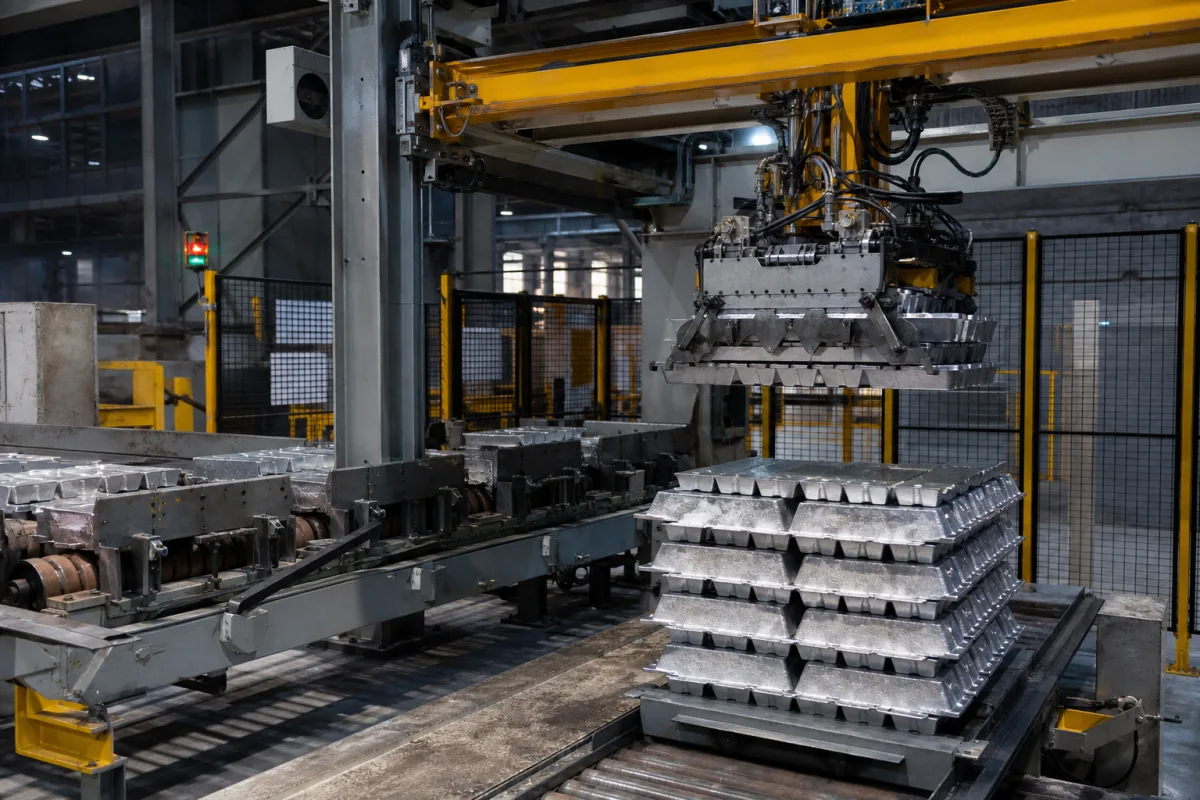
Ingot stackers for continuous casting lines · Grouping ingots into stack units, alternating layer patterns, turning ingots 90°, legged bottom layers for fork-lift access, strapping, and guarding the stacking cell
An automated ingot stacker takes ingots as they leave the moulds of a continuous casting machine, groups them into layers, builds the layers into a stack in a set pattern, and passes the stack on for strapping and fork-lift handling. Ask three things first: what ingots arrive and at what rate, what stack pattern, weight and bottom layer the downstream handling needs, and how people are kept out of the moving parts.
Automatic stacking machines that receive cast ingots from a casting machine conveyor, group them into layers and build bundled stacks, including gantry or robot grippers, turning devices, stack conveyors and strapping interfaces. Casting machines themselves, sow and slab handling, and general palletizing of packaged goods are outside this page except where compared.
CNFX editorial research · Sources checked October 12, 2026 · 4 sources
US patent 4,040,525 (Method and apparatus for stacking ingots according to predetermined arrangements) concerns stacking ingots cast continuously from a nonferrous metal such as zinc. It explains that the cast ingots are grouped into stack units forming a horizontal layer, a set number of layers is stacked and tied together with metal wire or band into a stack of predetermined weight, and that merely piling identical layers makes the stack hard to tie and lets ingots slide dangerously during transport. Its answer is to stack two kinds of four-ingot layers in alternate tiers: pattern A with two parallel rows of two ingots in line, and pattern B with two ingots side by side and the other two turned at right angles on opposite sides. [1]
The patent adds that a stack made only of plain ingots is difficult for a fork lift to convey, so the lowermost layer is made of legged ingots with their legs downward and the plain ingots are stacked on top. In its example the casting chain carries 22 moulds for plain ingots in each row followed by two moulds for legged ingots, giving twelve stack units per stack. It states that the tying must keep pace with the casting rate, because slower tying would reduce casting efficiency. [1]
In the apparatus described, ingots released from the moulds are pushed onto a main conveyor, stoppers close the gaps between them, two rotary arms swing two ingots through 90° to form pattern B, a rotary casing turns the legged bottom layer over through 180°, and a stacking casing with a retractable plate drops each layer onto the stack on a transfer conveyor. [1]
Editorial calculation: in the patent's example each row has 22 plain plus 2 legged moulds, so a stack takes (22 + 2) × 2 = 48 ingots, which matches twelve layers of four ingots. Multiply your ingot mass by the ingots per stack to get the stack weight the fork lift and strapping must handle. [1]
A later Chinese patent application, CN111268419A (filed 19 March 2020), describes an aluminium ingot stacker for criss-cross stacking controlled centrally by a PLC. Ingots run on a roller conveyor against a stop plate, so roller friction packs a full row tightly, and an infrared counter lowers a second stop once the set number of ingots per layer is reached. A clamping head on a servo-driven translation carriage lifts the whole row in one action, a slewing ring driven by a servo motor turns it for the crossed layer, and the stacking platform stands on four hydraulic cylinders with an infrared range finder, lowering by one ingot height after each layer so the clamp does not have to descend. [3]
Give the supplier the metal and ingot type (plain and legged), ingot dimensions and mass, temperature at the stacker, casting rate in ingots per minute, the layer pattern and number of layers, stack weight, bottom-layer arrangement for fork-lift entry, strapping method and material, the casting machine conveyor interface, available floor space, and controls and safety requirements.
02
Guard the stacking cell
OSHA's general machine rule, 29 CFR 1910.212, requires one or more methods of machine guarding to protect the operator and other employees in the machine area from hazards such as those created by the point of operation, ingoing nip points and rotating parts, and gives barrier guards, two-hand tripping devices and electronic safety devices as examples. Guards must be affixed to the machine where possible and secured elsewhere if not, and must not create an accident hazard themselves. [2]
Editorial note: a stacker has moving grippers, pushers, turning devices and conveyors that can trap a person, so ask the supplier how the cell is fenced or otherwise guarded, how people enter to clear a jammed ingot, and which US or local standards its guarding design follows.
03
Rate the stacker for the casting line's ingot output
A 1975 paper in the proceedings of the Australasian Institute of Mining and Metallurgy (AusIMM), by F C Adams and R D Dawson, describes how The Broken Hill Associated Smelters at Port Pirie moved refined lead ingot casting from manually operated rotary casting wheels, in use for the previous 45 years, to automated casting. Its abstract states that the plant has two almost identical casting lines, each producing 25 kg ingots at 25 tonnes per hour on straight-line casting machines with automated stacking, weighing and strapping. The investigation began in 1966, trial operation started in late 1973 and the plant was fully operative in late 1974. [4]
Editorial calculation: 25 tonnes per hour of 25 kg ingots is 25,000 ÷ 25 = 1,000 ingots per hour per line, one ingot about every 3.6 seconds (3,600 ÷ 1,000), and the stacking, weighing and strapping on each line have to keep up with that output. [4]
Editorial note: give the supplier your casting rate in tonnes per hour and your ingot mass, and ask for the ingot rate per hour its stacker is rated for and how stacks are weighed and strapped.
Port Pirie plant item
Published value
Use in your order
Casting lines
Two, almost identical
Number of stackers
Ingot mass
25 kg
Gripper and layer load
Output per line
25 tonnes per hour
Rated stacker capacity
Ingot rate per line
1,000 per hour (Editorial calculation)
Stacker cycle time
04
From receiving member to transfer conveyor, unit by unit
The rows follow the ingot path in US patent 4,040,525; the ingot counter and the lifting platform come from the later Chinese criss-cross palletizer design CN111268419A.
Explore company information and manufacturing capabilities, then discuss the scope of your project with a relevant supplier.
Share this page
Compiled and source-reviewed by the CNFX editorial team.
Each manufacturer above links to the page on that company's own website where the product is listed, with the date we checked it. How we source and review
· Page last updated 13 October 2026
Buyer questions
Why are ingot layers stacked in alternating patterns?
US patent 4,040,525 alternates two four-ingot patterns so the stack can be tied and ingots do not slide during tying or transport. [1]
How does a fork lift get under an ingot stack?
The patent makes the bottom layer from legged ingots with legs downward, so the forks can be inserted beneath the stack. [1]
Does an ingot stacker need guarding?
OSHA 29 CFR 1910.212 requires machine guarding against point of operation, nip point and rotating part hazards. [2]
How does a stacker keep the same number of ingots in each layer?
In patent application CN111268419A, an infrared counter on the infeed conveyor drops a stop plate once the set number of ingots is reached, and the full row is clamped in one action. [3]
How many ingots per hour does a stacker have to handle?
It must match the casting line. An AusIMM paper on the Port Pirie lead plant gives 25 kg ingots at 25 tonnes per hour per line, which is 1,000 ingots per hour (Editorial calculation). [4]
Sources and what still needs a direct check
Sources checked 2026-10-12. The US patent (1977) describes one stacker design in its own terms; 29 CFR 1910.212 is a US federal workplace safety regulation.