Industry-Verified Manufacturing Data (2026)

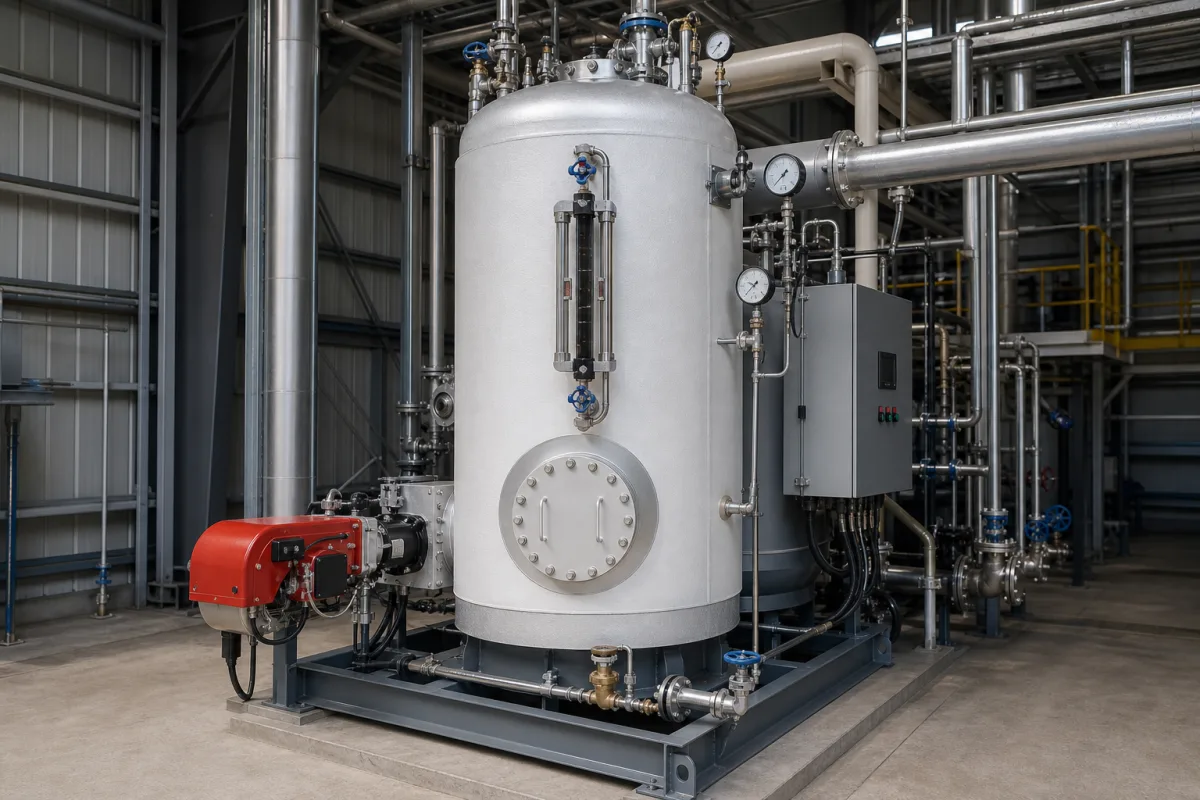
Steam Generator Vessel

Based on aggregated insights from multiple verified factory profiles within the CNFX directory, the standard Steam Generator Vessel used in the Machinery and Equipment Manufacturing sector typically supports operational capacities ranging from standard industrial configurations to heavy-duty production requirements.

Technical Definition & Core Assembly

A canonical Steam Generator Vessel is characterized by the integration of Shell and Heads/End Closures. In industrial production environments, manufacturers listed on CNFX commonly emphasize Carbon Steel construction to support stable, high-cycle operation across diverse manufacturing scenarios.

The pressure vessel that contains water/steam and facilitates heat transfer from combustion gases or heating elements to generate steam.
Product Specifications

Technical details and manufacturing context for Steam Generator Vessel

Definition
A critical pressure vessel component within an Industrial Steam Generation System for Process Heating that serves as the primary containment and heat exchange unit where water is converted to steam through thermal energy transfer from combustion gases, electric heating elements, or other heat sources, designed to withstand high temperatures and pressures while ensuring efficient steam production for industrial heating applications.
Working Principle
Water is introduced into the vessel where it absorbs thermal energy from heat sources (combustion gases, electric elements, or thermal fluids) through heat exchange surfaces, causing it to boil and generate steam at controlled pressure and temperature, with the steam then distributed for process heating applications while maintaining safe operating conditions through pressure regulation and safety systems.
Common Materials
Carbon Steel, Stainless Steel, Alloy Steel
Technical Parameters
  • Vessel diameter and length dimensions (mm) Standard Spec
Components / BOM
  • Shell
    Primary pressure-containing cylindrical body of the vessel
    Material: Carbon Steel or Stainless Steel
  • Heads/End Closures
    Sealed ends of the vessel that contain pressure
    Material: Carbon Steel or Stainless Steel
  • Nozzles/Connections
    Inlet and outlet connections for water, steam, and instrumentation
    Material: Carbon Steel or Stainless Steel
  • Manway
    Access opening for inspection and maintenance
    Material: Carbon Steel or Stainless Steel
  • Support Saddles/Lugs
    Structural supports for mounting and securing the vessel
    Material: Carbon Steel
Engineering Reasoning
0.1-18.0 MPa (1-180 bar) at 100-350°C
Yield strength threshold: 250 MPa at 300°C for SA-516 Grade 70 carbon steel
Design Rationale: Creep rupture due to sustained operation above 0.8σ_y (200 MPa) at temperatures exceeding 300°C, causing microvoid coalescence along grain boundaries
Risk Mitigation (FMEA)
Trigger Water chemistry imbalance with chloride concentration >25 ppm
Mode: Stress corrosion cracking initiating at tube-to-tubesheet welds
Strategy: Install continuous online conductivity monitoring with automatic blowdown at 15 ppm threshold
Trigger Thermal shock from feedwater temperature differential >55°C
Mode: Circumferential cracking at shell-to-dished head transition radius
Strategy: Implement preheating system maintaining feedwater within 30°C of saturation temperature

Industry Taxonomies & Aliases

Commonly used trade names and technical identifiers for Steam Generator Vessel.

Industrial Ecosystem & Supply Chain DNA

Complementary Systems
Downstream Applications
Specialized Tooling

Application Fit & Sizing Matrix

Operational Limits
pressure: Up to 2.5 MPa (25 bar) standard, higher available with specialized designs
flow rate: 5-100 m³/h water capacity, steam output dependent on heat input
temperature: 150°C to 350°C (saturated steam conditions)
slurry concentration: Not applicable - designed for clean water/steam only
Media Compatibility
✓ Demineralized water for high-pressure boilers ✓ Industrial process water with proper treatment ✓ Food-grade steam with sanitary design
Unsuitable: Corrosive chemical solutions or abrasive slurries
Sizing Data Required
  • Required steam output (kg/h)
  • Operating pressure (bar)
  • Heat source capacity (kW or BTU/hr)

Reliability & Engineering Risk Analysis

Failure Mode & Root Cause
Stress Corrosion Cracking (SCC)
Cause: Combination of tensile stress from thermal cycling/pressure, corrosive environment from water chemistry impurities (chlorides, sulfides), and susceptible material (austenitic stainless steel welds or heat-affected zones).
Thermal Fatigue Cracking
Cause: Repeated thermal stresses from startup/shutdown cycles or rapid temperature changes, leading to crack initiation and propagation at stress concentrators (nozzles, penetrations, support attachments).
Maintenance Indicators
  • Visible weeping or leakage at weld seams or nozzle connections, indicating through-wall cracking or gasket failure.
  • Abnormal audible knocking or rumbling during operation, suggesting water hammer, flow instability, or loose internal components.
Engineering Tips
  • Implement strict water chemistry control (maintain low oxygen, chlorides, and conductivity) and regular chemical analysis to minimize corrosion and scaling.
  • Use controlled heating/cooling rates during startups and shutdowns to reduce thermal stresses, and conduct periodic non-destructive testing (e.g., ultrasonic, eddy current) on high-stress areas.

Compliance & Manufacturing Standards

Reference Standards
ISO 16528-1:2018 Boilers and pressure vessels ASME Boiler and Pressure Vessel Code Section I EN 12952 Water-tube boilers and auxiliary installations
Manufacturing Precision
  • Wall thickness: +/- 2% of nominal thickness
  • Nozzle alignment: +/- 1.5mm from true position
Quality Inspection
  • Radiographic Testing (RT) for weld integrity
  • Hydrostatic pressure test at 1.5x design pressure

Factories Producing Steam Generator Vessel

Verified manufacturers with capability to produce this product in China

✓ 98% Supplier Capability Match Found

T Technical Director from Singapore Jan 26, 2026
★★★★★
"The technical documentation for this Steam Generator Vessel is very thorough, especially regarding technical reliability."
Technical Specifications Verified
P Project Engineer from Germany Jan 23, 2026
★★★★☆
"Reliable performance in harsh Machinery and Equipment Manufacturing environments. No issues with the Steam Generator Vessel so far. (Delivery took slightly longer than expected, but technical support was excellent.)"
Technical Specifications Verified
S Sourcing Manager from Brazil Jan 20, 2026
★★★★★
"Testing the Steam Generator Vessel now; the technical reliability results are within 1% of the laboratory datasheet."
Technical Specifications Verified
Verification Protocol

“Feedback is collected from verified sourcing managers during RFQ (Request for Quote) and factory evaluation processes on CNFX. These reports represent historical performance data and technical audit summaries from our B2B manufacturing network.”

12 sourcing managers are analyzing this specification now. Last inquiry for Steam Generator Vessel from India (26m ago).

Supply Chain Compatible Machinery & Devices

Heavy-Duty CNC Plasma Cutting Machine

Industrial machine for precision metal cutting using plasma arc technology

Explore Specs →
Automated Assembly Line System

Integrated production system for sequential component assembly operations

Explore Specs →
Automated Powder Coating System

Integrated industrial system for applying dry powder coatings to metal substrates.

Explore Specs →
Centrifugal Pump Impeller

Rotating component that transfers energy to fluid in centrifugal pumps.

Explore Specs →

Frequently Asked Questions

What materials are best for steam generator vessels in corrosive environments?

For corrosive environments, stainless steel (such as 304 or 316 grades) or alloy steels with corrosion-resistant properties are recommended over standard carbon steel to prevent degradation and ensure longer service life.

How do support saddles or lugs affect steam generator vessel installation?

Support saddles or lugs provide structural stability, distribute weight evenly, and simplify installation by allowing secure mounting to foundations or frameworks, reducing stress on the vessel shell and connections.

What are the key specifications to consider when ordering a custom steam generator vessel?

Key specs include design pressure and temperature, capacity (water/steam volume), material grade (e.g., ASME standards), dimensions, nozzle/connection types and sizes, and compliance with industry codes like ASME Section VIII.

Can I contact factories directly on CNFX?

CNFX is an open directory, not a transaction platform. Each factory profile provides direct contact information and production details to help you initiate direct inquiries with Chinese suppliers.

Get Quote for Steam Generator Vessel

Request technical pricing, lead times, or customized specifications for Steam Generator Vessel directly from verified manufacturing units.

Your business information is encrypted and only shared with verified Steam Generator Vessel suppliers.

Thank you! Your message has been sent. We'll respond within 1–3 business days.

Need to Manufacture Steam Generator Vessel?

Connect with verified factories specializing in this product category

Add Your Factory Contact Us
Previous Product
Steam Generator or Water Atomizer
Next Product
Steam Header